
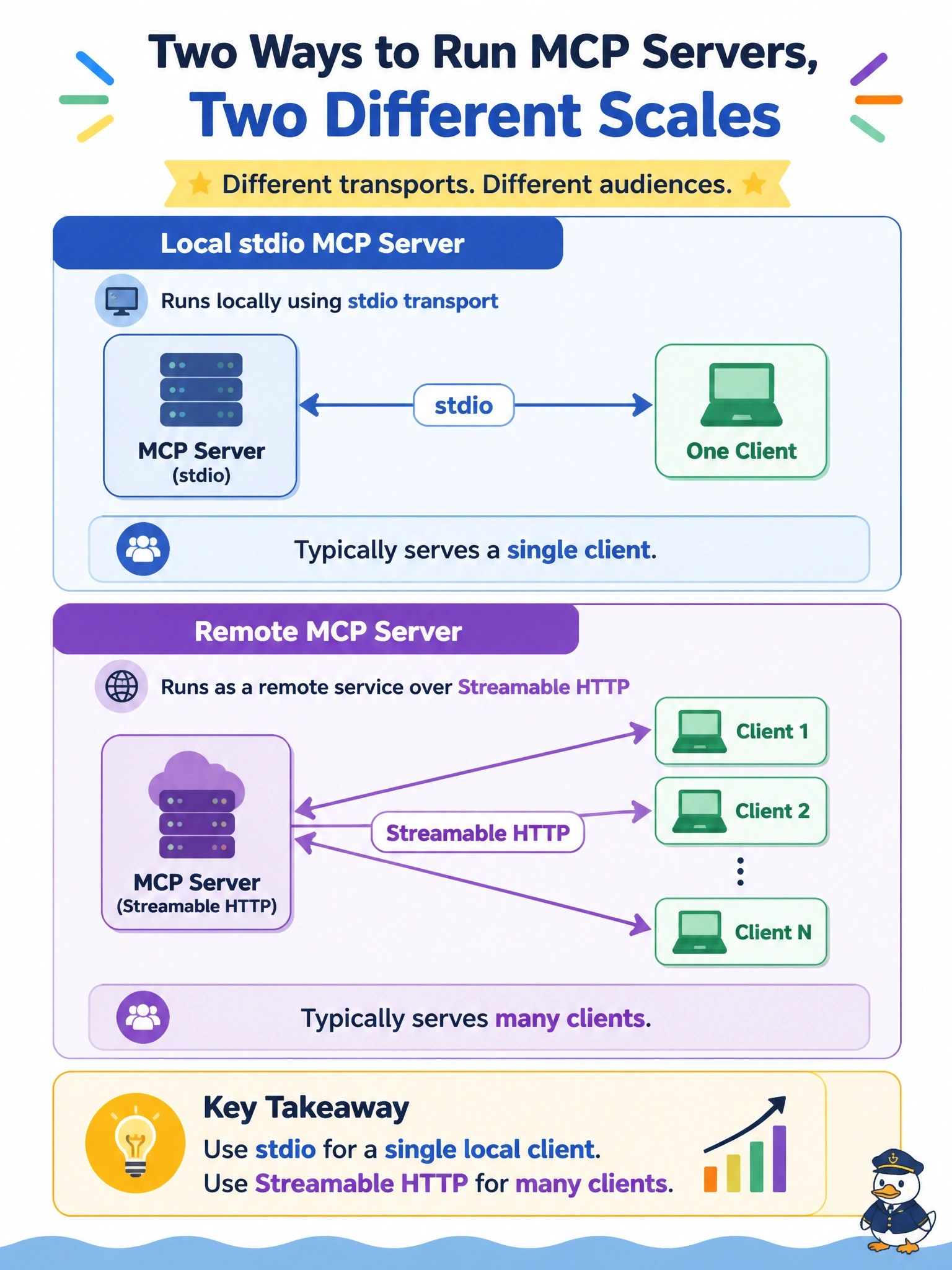
A team runs one MCP server locally over the stdio transport and another as a remote service over Streamable HTTP. How many clients does each kind of server typically serve?
Select an answer to reveal the explanation.
Short Explanation
Think of a stdio server as your private line: the client launched it, so it's usually talking only to that client. A remote HTTP server is a switchboard serving lots of clients. The 'one to one both ways' answer is the trap.
Full Explanation
The architecture overview states that local MCP servers using the stdio transport typically serve a single MCP client, whereas remote MCP servers using the Streamable HTTP transport typically serve many MCP clients. The difference follows from each transport's design. In stdio, the client launches the server as a subprocess and exchanges newline-delimited messages over that process's standard streams, so the process is naturally tied to the client that started it. In Streamable HTTP, the server operates as an independent process that can handle multiple client connections at a single MCP endpoint. Claiming the relationship is one to one in both directions confuses the client's rule with the server's: each client talks to exactly one server, but a server can be reached by many clients. Reversing the counts is wrong because stdin belongs to one parent process and cannot be shared by unrelated hosts, while HTTP servers are built for concurrency. Saying a stdio server accepts connections from every host on the machine invents a listening socket that stdio does not have. Exam caveat: the stdio framing can be reused over sockets for custom transports, but that is a different deployment from the canonical subprocess model. Operational check: confirm each stdio server process has one parent client, and check the remote server's access logs for requests from multiple clients.