
A server author asks a host vendor to forward the entire chat transcript with every tool call so that the server can produce better answers. Which MCP design principle governs the host's response?
Select an answer to reveal the explanation.
Short Explanation
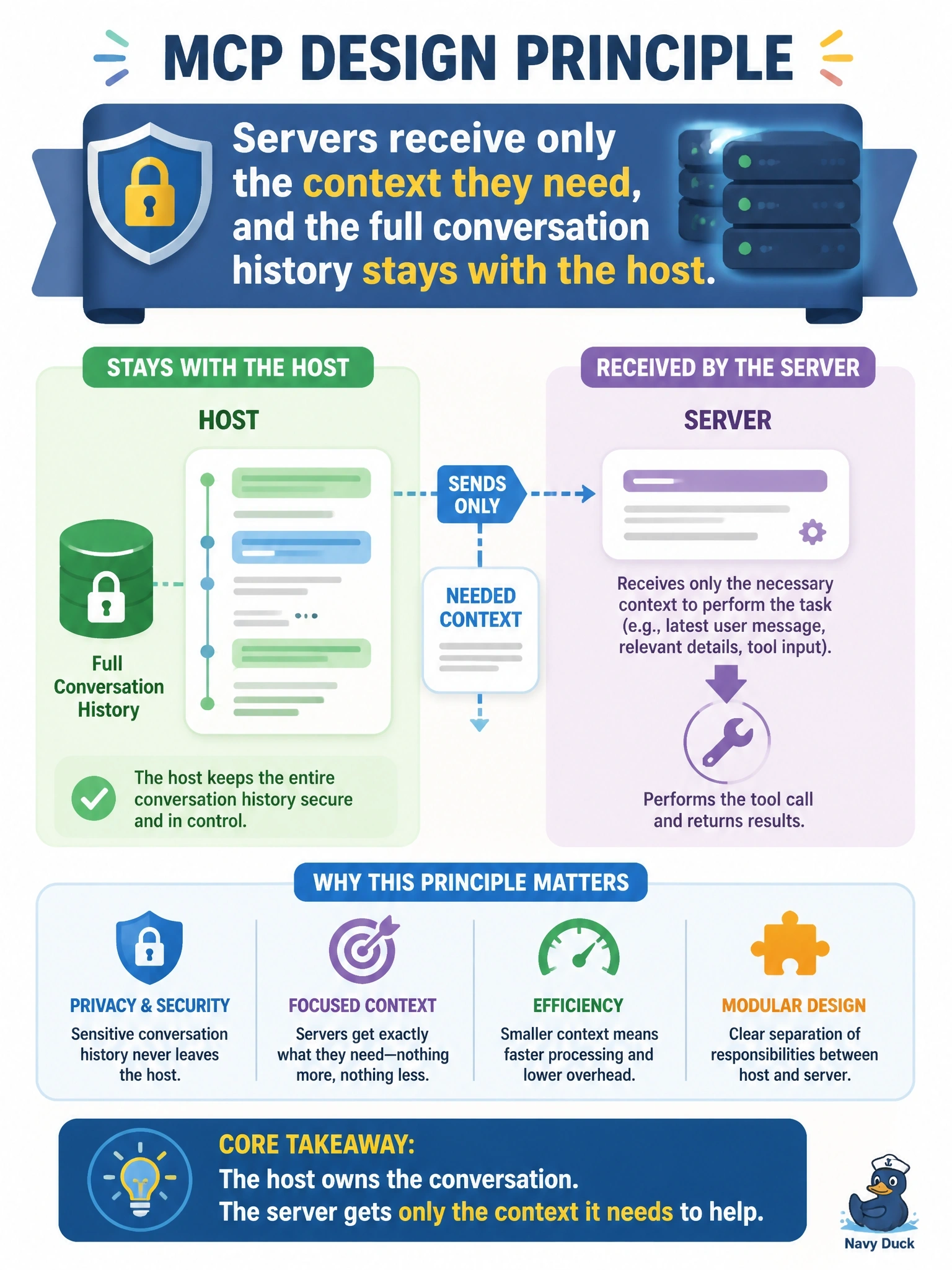
Servers are like contractors you let into one room, not the whole house. They get what the job needs, and the conversation stays with the host. Approving a tool doesn't hand over the transcript.
Full Explanation
One of MCP's design principles is that servers should not be able to read the whole conversation, nor see into other servers. Servers receive only necessary contextual information, the full conversation history stays with the host, each server maintains isolation, and cross-server interactions are controlled by the host. The host vendor should therefore pass only the arguments and context a tool needs rather than the entire transcript. Approving a server's tools grants permission for those tools to be invoked; it does not change the isolation principle or turn the server into a reader of all conversation content. A resources/read request travels from client to server, not from server to host, and hosts do not expose their conversation as an MCP resource that servers can query. Declaring the prompts capability means the server offers prompt templates; it has no effect on what context the server receives. Exam caveat: the deprecated sampling feature's includeContext values thisServer and allServers allowed some context inclusion, and the client could always restrict them, which is one reason they are deprecated. Operational check: inspect the tools/call requests the host sends and confirm the arguments contain only the parameters defined in the tool's inputSchema, not prior conversation turns.