
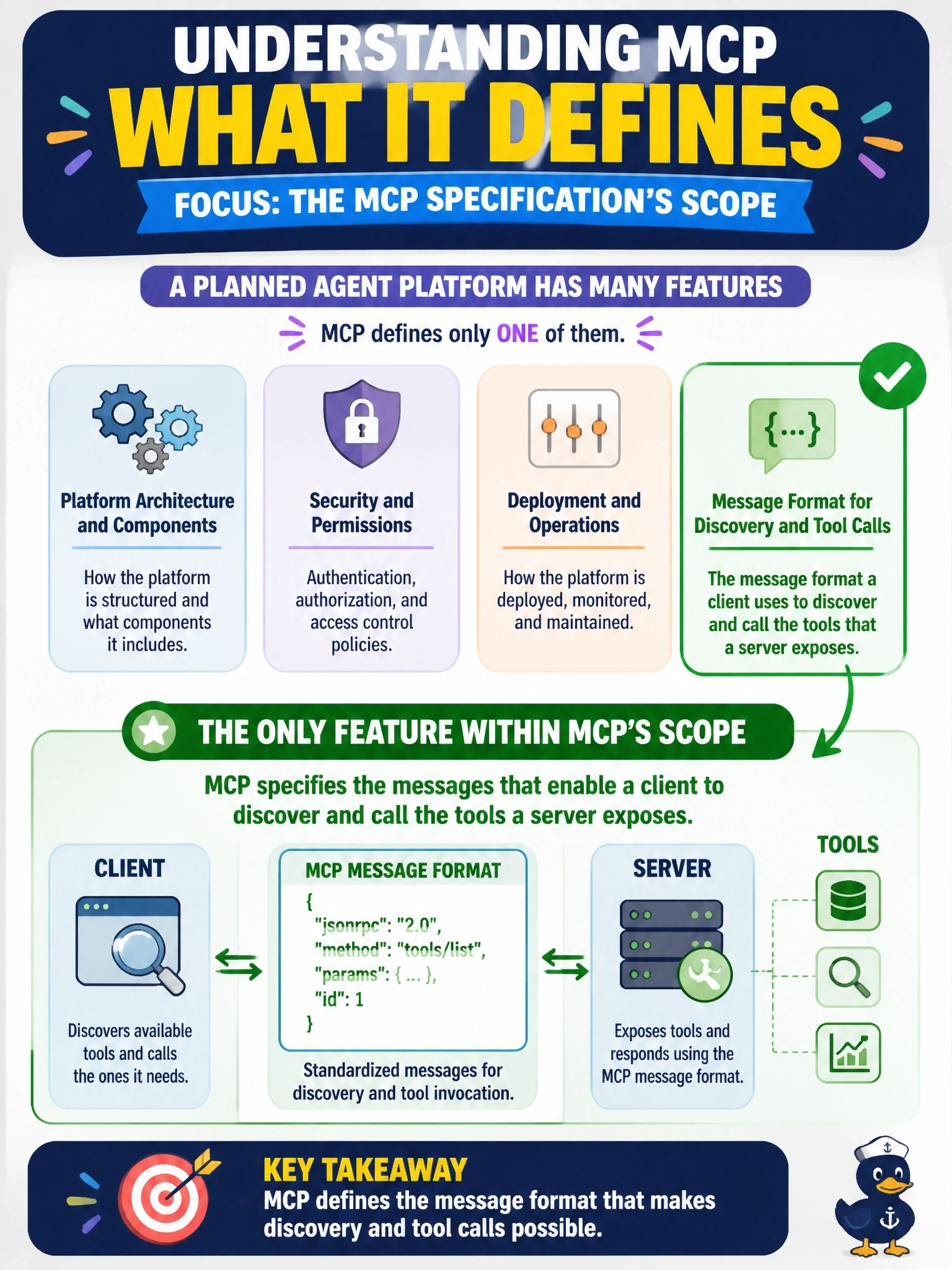
An architect lists four features of a planned agent platform and asks which one the MCP specification itself defines. Which feature is within MCP's scope?
Select an answer to reveal the explanation.
Short Explanation
Picture MCP as the shipping standard between warehouses, not the manager deciding what to ship. You get a defined way to discover and call tools on a server, but planning, memory and model choice are all yours to build. If an option sounds like agent 'brains,' it's outside the spec.
Full Explanation
The MCP specification defines a context-exchange protocol: JSON-RPC messages through which clients discover a server's tools, resources and prompts, retrieve content, execute tools and receive notifications. Discovering tools with tools/list and invoking them with tools/call is squarely within its data layer. An agent's planning loop, which decides the next step and the stopping condition, is application logic that belongs to the host or an agent framework; MCP carries the tool calls such a loop makes but does not define the loop. A conversation memory store that chooses which earlier turns remain in context is likewise host behaviour; the architecture overview states that MCP does not dictate how applications use LLMs or manage the context they receive. A routing policy that selects which model answers a request is also a host decision, and MCP is intentionally model-agnostic. Exam caveat: MCP is often described alongside agent frameworks, so stems may blur the line; the protocol is the interface between components, not the agent itself. Operational check: for each platform feature, ask whether it appears as a method, field or message in the specification; if it only exists inside the host's own code, it is outside MCP's scope.