
During a design review, an architect describes MCP as "a USB-C port for AI applications." A product manager then concludes that adopting MCP will also make the assistant's answers more accurate. Which statement correctly describes what MCP standardizes?
Select an answer to reveal the explanation.
Short Explanation
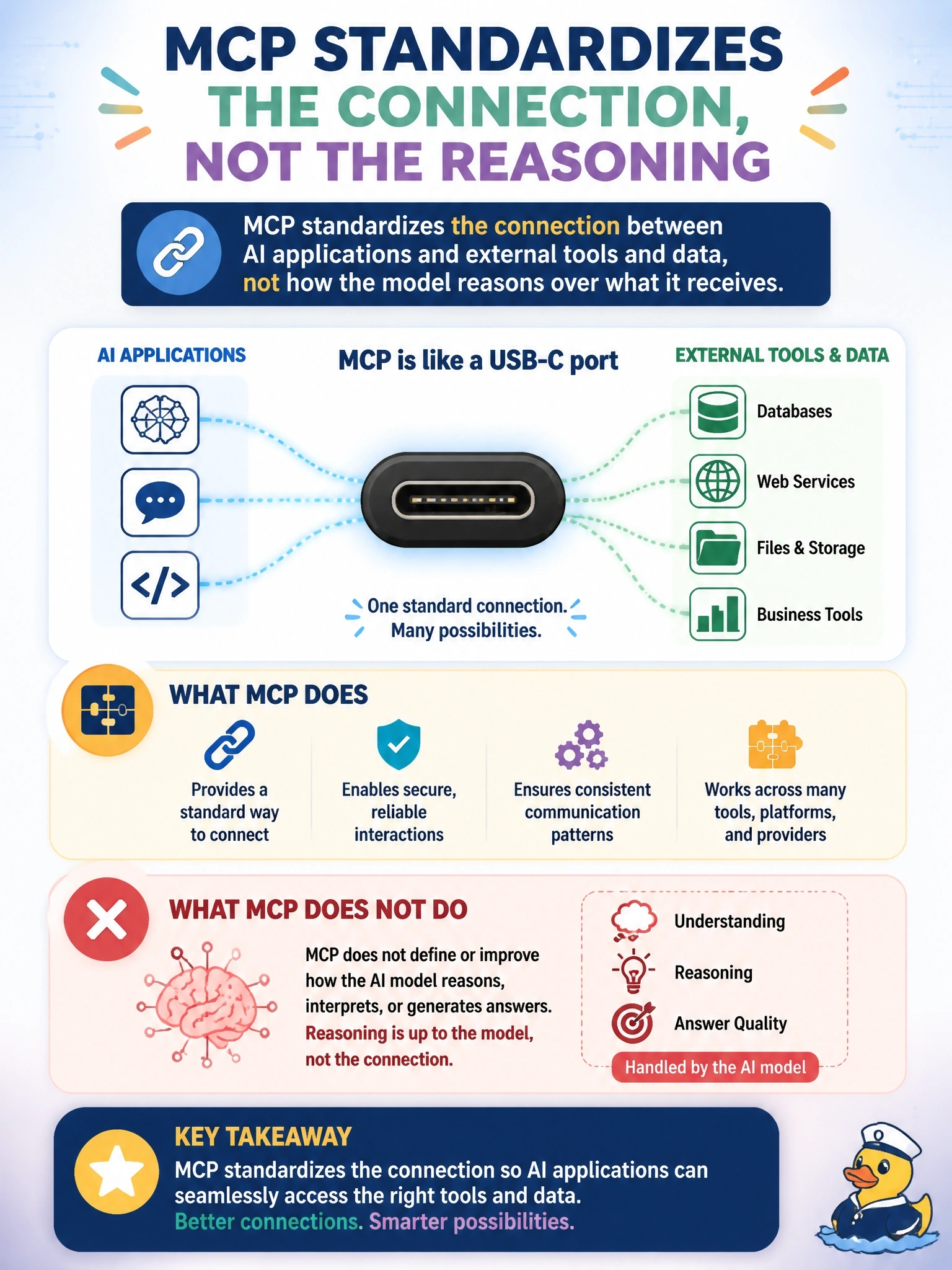
A USB-C port tells you how the cable plugs in, not what the device does with the data once it's connected. MCP is the same: it standardizes how your AI app connects to tools and data, while the model's reasoning stays entirely the host's business. The trap is reading 'standard connector' as 'better answers.'
Full Explanation
MCP is an open protocol for integrating LLM applications with external data sources and tools. Its scope is the exchange of context and capabilities between a host's clients and the servers that provide them: discovery, invocation, retrieval and notifications over JSON-RPC. The architecture documentation states plainly that MCP focuses solely on the protocol for context exchange and does not dictate how AI applications use LLMs or manage the context they receive. Claims that MCP fixes the model's reasoning steps or answer format confuse the connector with the device; answer quality depends on the model and on how the host uses the retrieved context. MCP also does not select or require a particular model, and hosts remain free to use any provider, which is part of the protocol's vendor neutrality. Nor does it replace networking: it rides on existing transports, namely stdio for local subprocesses and Streamable HTTP for remote services. Exam caveat: better context can improve answers, but that is an indirect outcome of the host's design rather than something the protocol guarantees. Operational check: when someone attributes a quality improvement to MCP, ask which part of the improvement came from new context reaching the model and which came from the model or prompt design itself.