
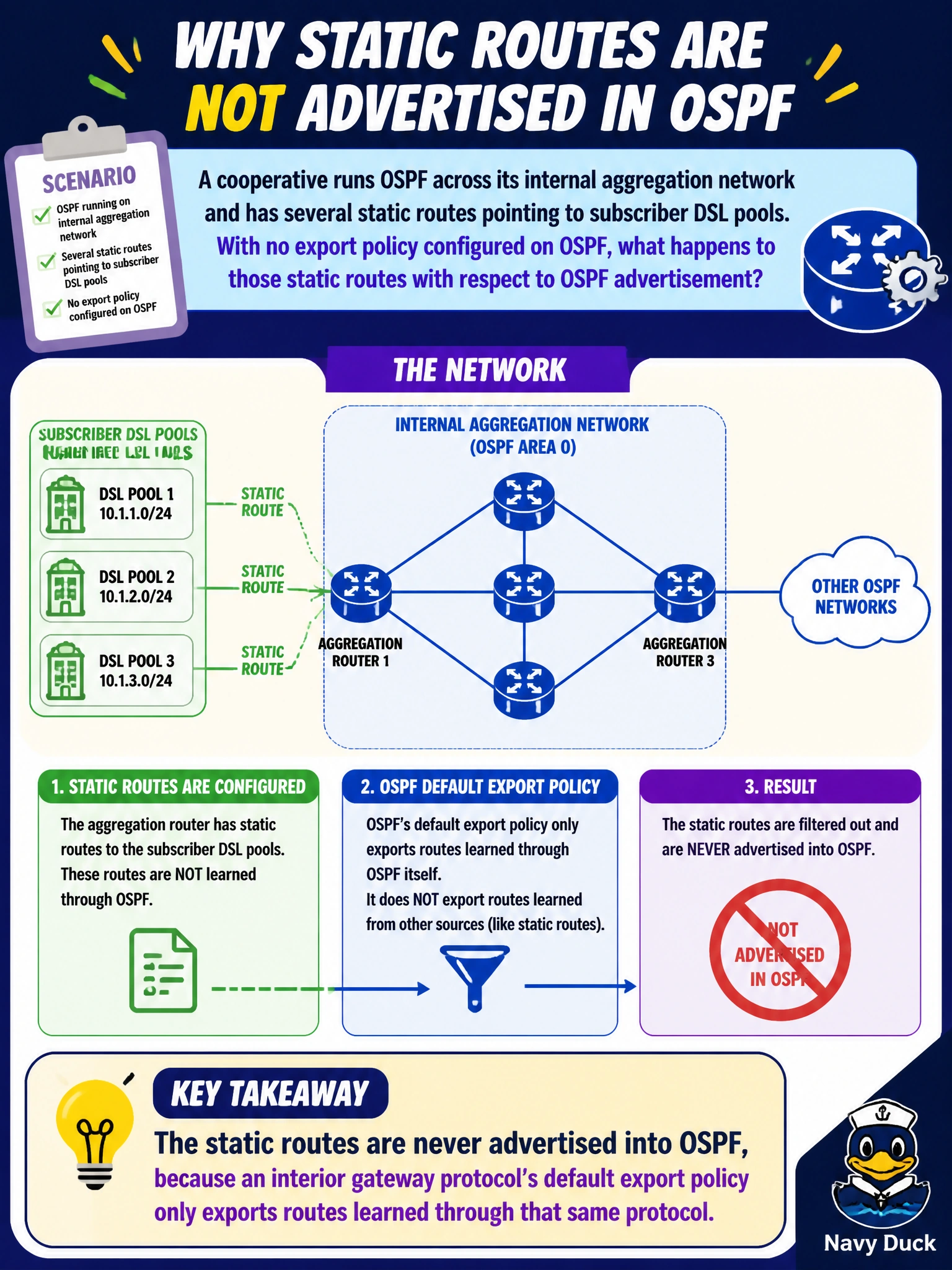
A cooperative runs OSPF across its internal aggregation network and has several static routes pointing to subscriber DSL pools. With no export policy configured on OSPF, what happens to those static routes with respect to OSPF advertisement?
Select an answer to reveal the explanation.
Short Explanation
Interior protocols like OSPF are just as tight-fisted by default as BGP: without an explicit export policy, OSPF only advertises routes it learned itself. A co-op's static routes to a DSL pool stay purely local until someone writes a policy that matches those statics and exports them into OSPF as external routes. There's no automatic redistribution and no special exception based on administrative distance.
Full Explanation
An interior gateway protocol such as OSPF has a default export policy that only advertises routes learned through that same protocol, so static routes pointing to subscriber DSL pools remain confined to the local router's routing table until an administrator writes a policy that explicitly matches them and exports them as OSPF external routes. This default protects the stability of the link-state database, since injecting arbitrary external routes without explicit intent could pollute every router's SPF calculation across the cooperative's core. The first distractor is wrong because there is no automatic redistribution behavior in Junos; every protocol boundary crossing requires an explicit export policy naming the source protocol. The administrative-distance distractor confuses two unrelated concepts: administrative distance, which Junos calls route preference, decides which single source wins when multiple protocols offer the same prefix, but it has no bearing on whether OSPF chooses to export a route it never learned in the first place. The SPF-marking distractor invents a labeling behavior that does not exist; OSPF external routes are tagged as type 1 or type 2 externals for cost calculation purposes, not flagged as untrusted. The operational takeaway is that redistributing subscriber statics into OSPF always needs a policy with a from protocol static match paired with an export application under the OSPF protocol stanza. A concrete check is show route protocol ospf on a downstream router to confirm the static prefix actually appears as an OSPF external route.