
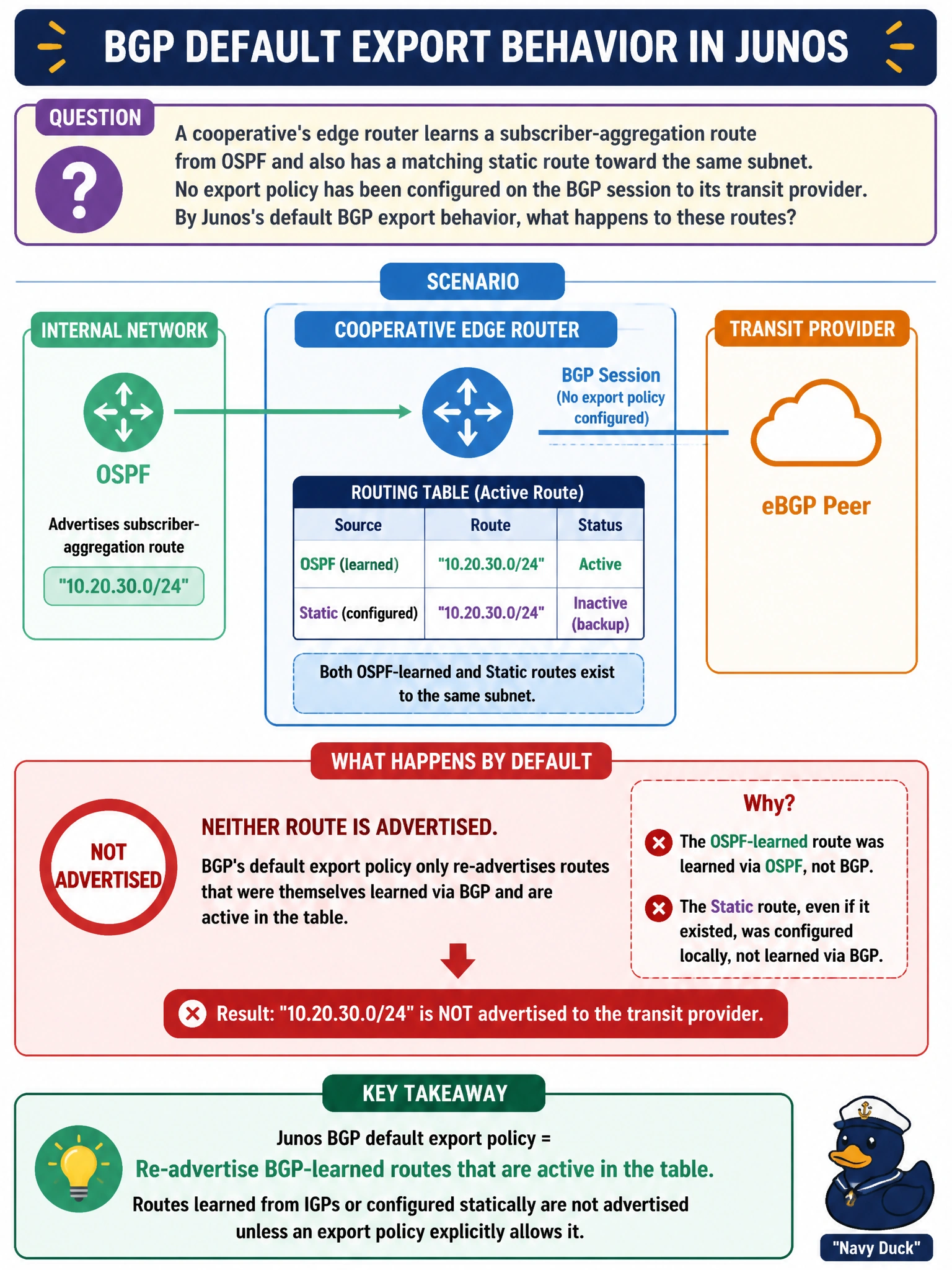
A cooperative's edge router learns a subscriber-aggregation route from OSPF and also has a matching static route toward the same subnet. No export policy has been configured on the BGP session to its transit provider. By Junos's default BGP export behavior, what happens to these routes?
Select an answer to reveal the explanation.
Short Explanation
BGP's default export behavior is famously stingy: think of it like a co-op only forwarding mail it already received from another carrier, not mail it wrote itself. Out of the box, BGP will only re-advertise routes that are active in the table and were themselves learned via BGP. Anything learned from OSPF or configured statically stays home unless an explicit export policy says otherwise.
Full Explanation
Junos's default BGP export policy only advertises routes that are both active in the routing table and were originally learned through BGP itself, so an OSPF-learned subscriber route and a locally configured static route are both withheld from the transit peer without any policy in place. This default exists precisely so that an ISP does not accidentally leak internal IGP routes or static routes toward an external peer just because a session is up. The first distractor is wrong because it assumes BGP freely redistributes anything active, which ignores this protocol-source restriction that is central to BGP's default behavior. The static-route distractor invents a preference rule that does not exist; static routes have no special standing for BGP export and are treated the same as any other non-BGP source, meaning they are excluded by default just like the OSPF route. The local-preference distractor is a red herring because local preference is a BGP path-selection attribute exchanged between routers, not an export filtering mechanism, and it plays no role in whether an unadvertised route gets sent at all. The operational consequence for a cooperative is that redistributing subscriber statics or OSPF routes to a transit provider always requires an explicit export policy naming those sources, typically matched with a from protocol condition. A concrete check is show route advertising-protocol bgp <transit-neighbor>, which will show the static and OSPF routes are absent until a policy is written to permit them.