
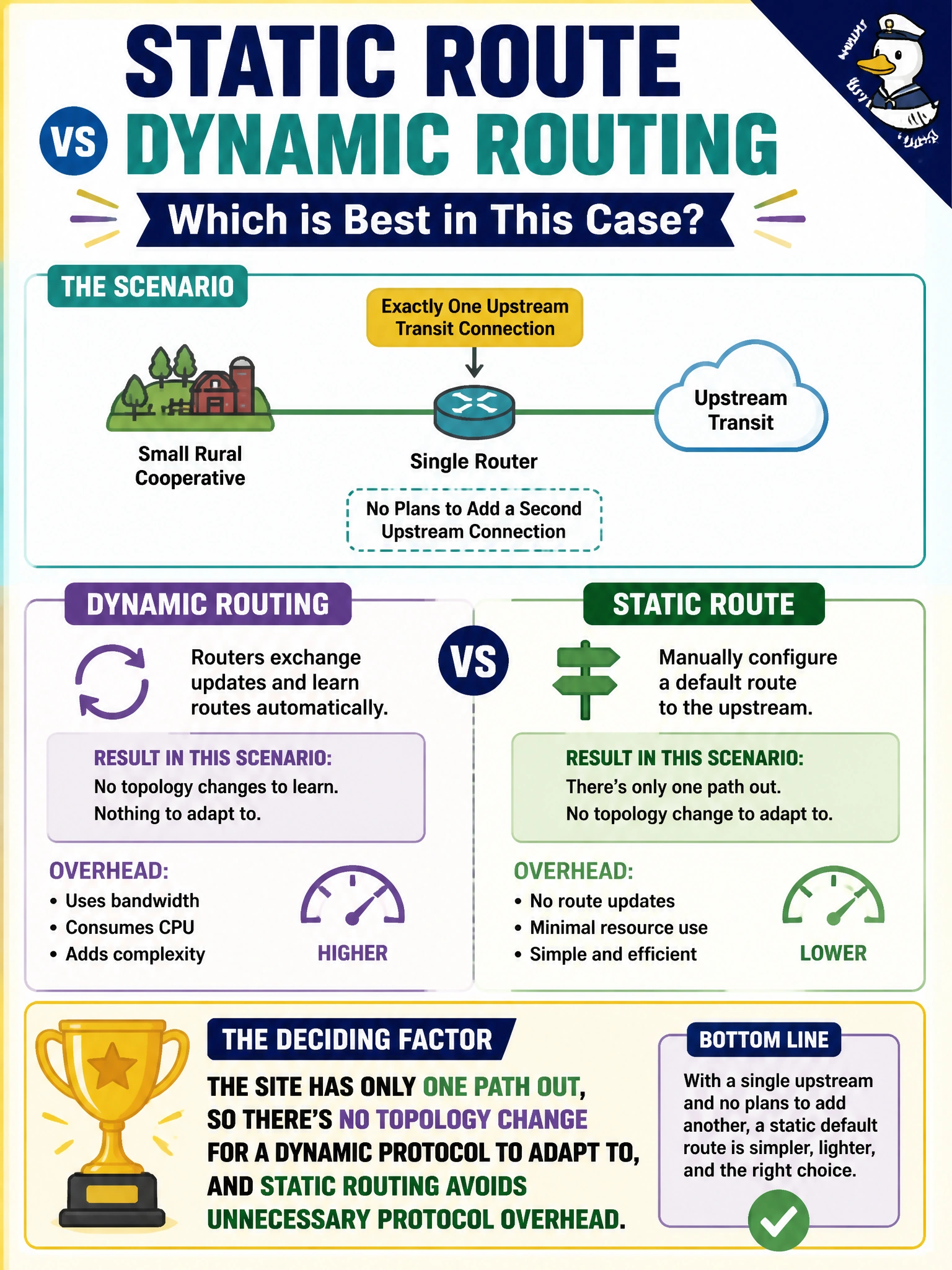
A small rural cooperative operates a single router with exactly one upstream transit connection and no plans to add a second one. The engineer is deciding whether to run a dynamic routing protocol toward that upstream or simply configure a static default route. Which factor most strongly favors the static route in this specific case?
Select an answer to reveal the explanation.
Short Explanation
With one door in and one door out, there's nothing for a dynamic protocol to figure out — the path never changes. Static routing gives you that same guaranteed path with none of the adjacency setup or ongoing protocol overhead a dynamic protocol would add for zero real benefit here.
Full Explanation
For a genuinely single-homed site with exactly one upstream connection and no redundant path, a static default route delivers the same practical outcome as a dynamic protocol — traffic always exits toward the one available next-hop — without the overhead of forming and maintaining a protocol adjacency, exchanging periodic updates, or troubleshooting protocol-specific behavior. Since there's no alternate topology to discover or react to, the main selling point of dynamic routing (automatic adaptation to change) simply doesn't apply here. Claiming static routes always converge faster than any dynamic protocol is an overgeneralization; convergence speed depends on detection mechanisms and specific circumstances, and this isn't a universal property of static routing worth relying on as a rule. Static routing is not the only method Junos supports on stub sites — a single-homed site can run a dynamic protocol toward its upstream if desired, it's simply usually unnecessary overhead, not a technical restriction. There's no restriction requiring at least two upstream connections before a dynamic protocol can be configured; a single-homed router can run OSPF or BGP toward its one upstream if there were a reason to. The caveat worth remembering is that this reasoning flips once a second upstream or redundant path is added, since that's exactly when dynamic routing (or a floating static route) starts adding real value. A practical check is simply asking whether the topology can change in a way that matters — if the answer is no, static is usually the simpler, sufficient choice.