
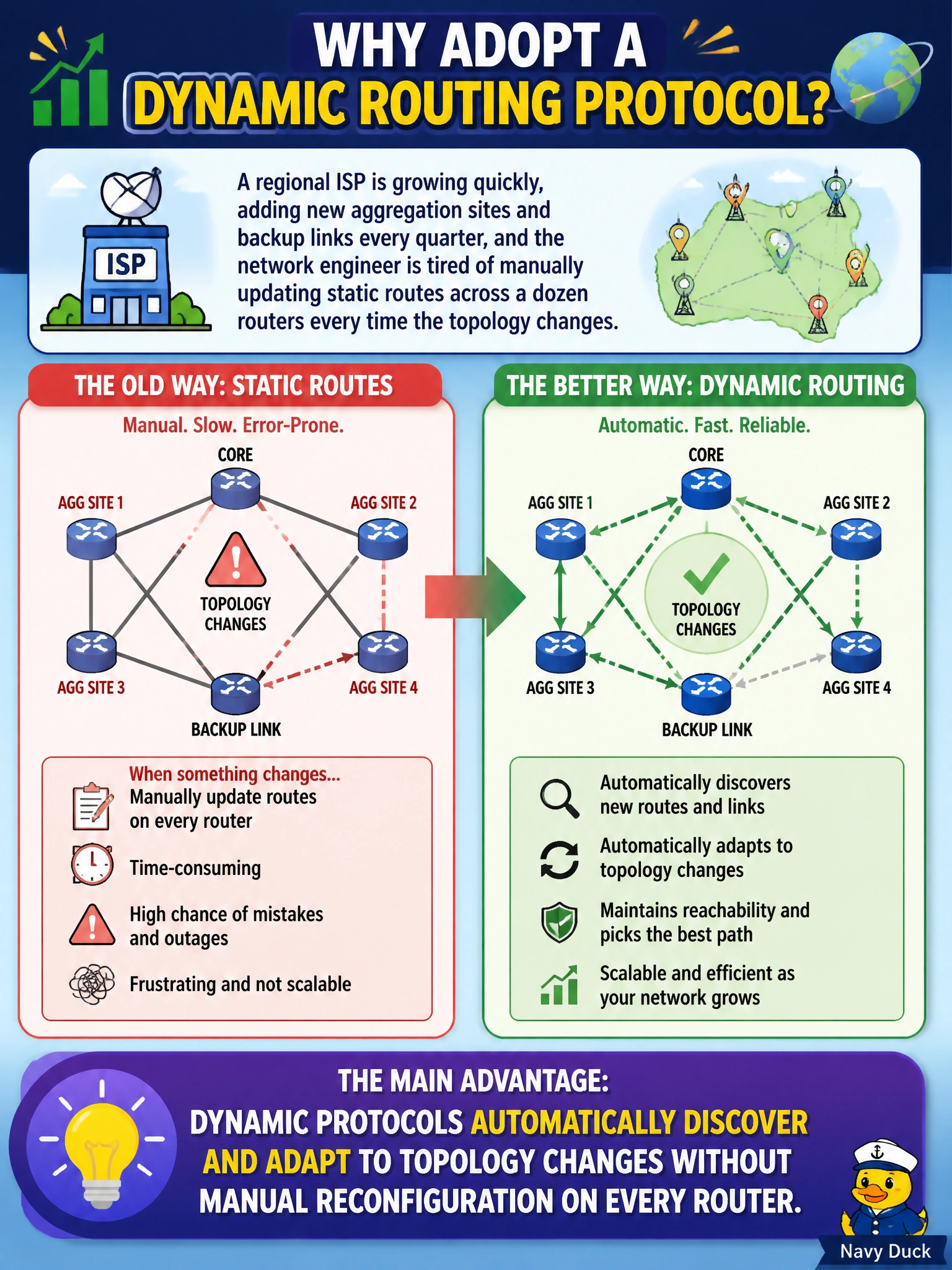
A regional ISP is growing quickly, adding new aggregation sites and backup links every quarter, and the network engineer is tired of manually updating static routes across a dozen routers every time the topology changes. What is the main advantage of adopting a dynamic routing protocol in this situation?
Select an answer to reveal the explanation.
Short Explanation
The whole point of going dynamic is taking the manual busywork off your plate. Instead of an engineer hand-editing a route on every router whenever a link changes, the protocol notices the change itself and updates everyone automatically.
Full Explanation
The core advantage of a dynamic routing protocol in a growing, changing network is automation: routers running the same protocol exchange information about the topology and automatically adjust their routing tables when links or routers change, without requiring an engineer to manually edit static routes across every affected device. This scales far better than static routing as the number of sites, links, and failure scenarios grows, which directly addresses the quarterly-growth pain described. Claiming dynamic protocols guarantee lower preference values than any static route misunderstands preference entirely — Junos assigns default preference values per protocol, and in fact several dynamic IGPs have higher (less preferred) default preference than a static route; there's no blanket rule favoring dynamic protocols. Dynamic protocols don't eliminate the routing table — quite the opposite, they populate it with more entries than static routing typically would, since they discover many more reachable destinations automatically. IP addressing on interfaces remains a fundamental requirement regardless of routing method; no routing protocol, static or dynamic, removes the need for it. The tradeoff worth noting for the exam: dynamic routing brings protocol overhead, adjacency management, and a steeper operational learning curve compared to a handful of static routes on a small stub network. A practical check when evaluating this tradeoff is counting how often the topology actually changes — frequent change favors dynamic, a stable single-homed site may not need it.