
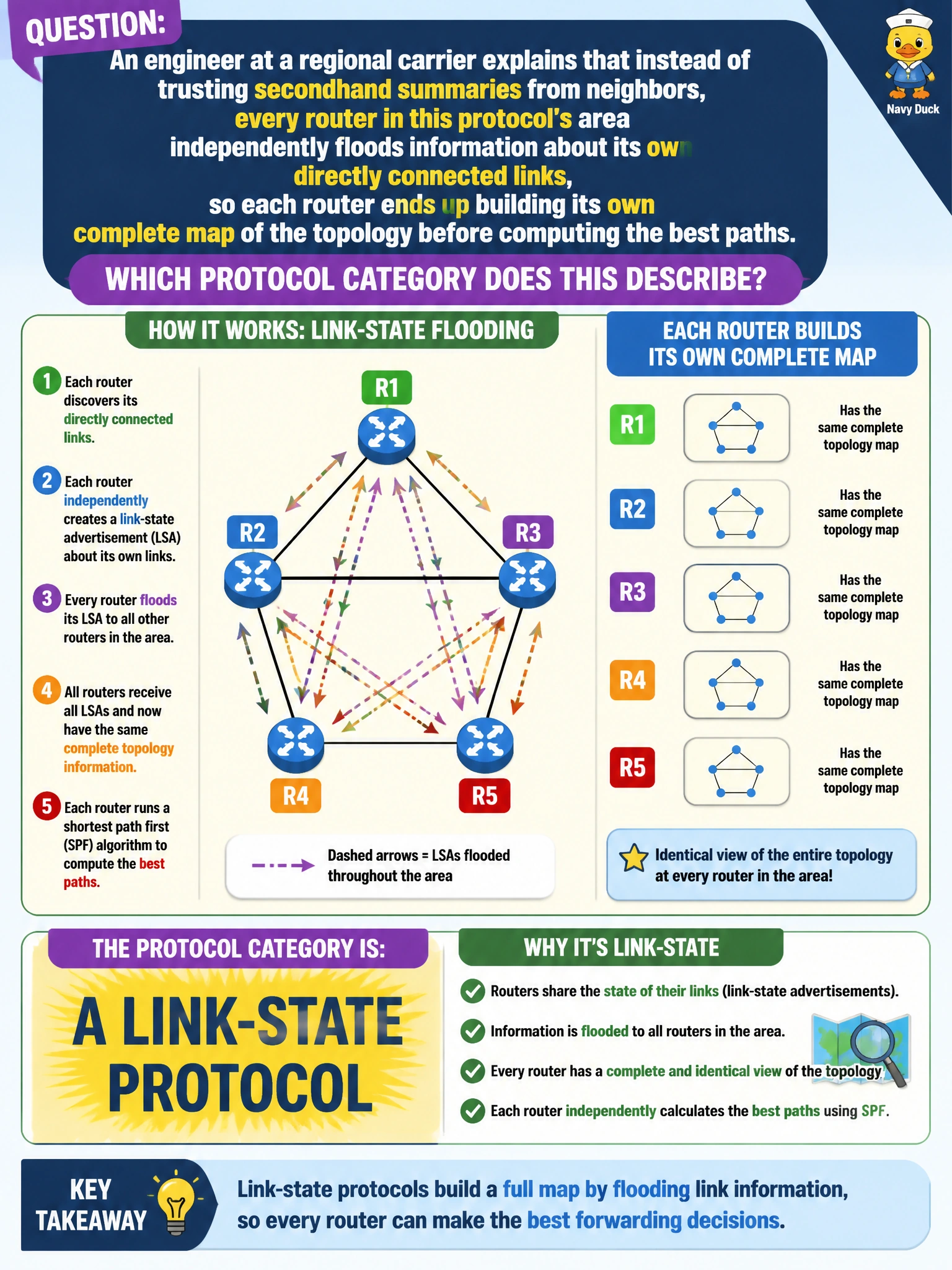
An engineer at a regional carrier explains that instead of trusting secondhand summaries from neighbors, every router in this protocol's area independently floods information about its own directly connected links, so each router ends up building its own complete map of the topology before computing the best paths. Which protocol category does this describe?
Select an answer to reveal the explanation.
Short Explanation
Link-state protocols hand every router its own copy of the full map instead of relying on neighbor rumors. Each router floods what it directly sees, everyone assembles the same topology picture, and then each one calculates its own best paths from that shared view.
Full Explanation
A link-state protocol has every participating router flood link-state information — details about its own directly connected interfaces and their status — to all other routers within the same area, rather than relying on secondhand summaries passed neighbor to neighbor. Because every router receives the same raw link data, each one independently builds an identical, complete topology map and runs a shortest-path calculation over it. This is the direct opposite of a distance-vector protocol, where routers only exchange summarized reachability and metric information with immediate neighbors and never see the full topology themselves. A default routing policy is a Junos routing-policy construct governing which routes get accepted or advertised by default — an entirely different topic from how a dynamic protocol discovers topology, and outside this domain's scope. A routing instance is a logically separate routing table for traffic segregation, unrelated to how any given protocol learns the network's shape. A practical exam-relevant tradeoff: link-state protocols typically converge faster after a topology change because every router recalculates from the same up-to-date map, at the cost of more processing and memory to store that full topology versus a distance-vector protocol's lighter-weight neighbor tables.