
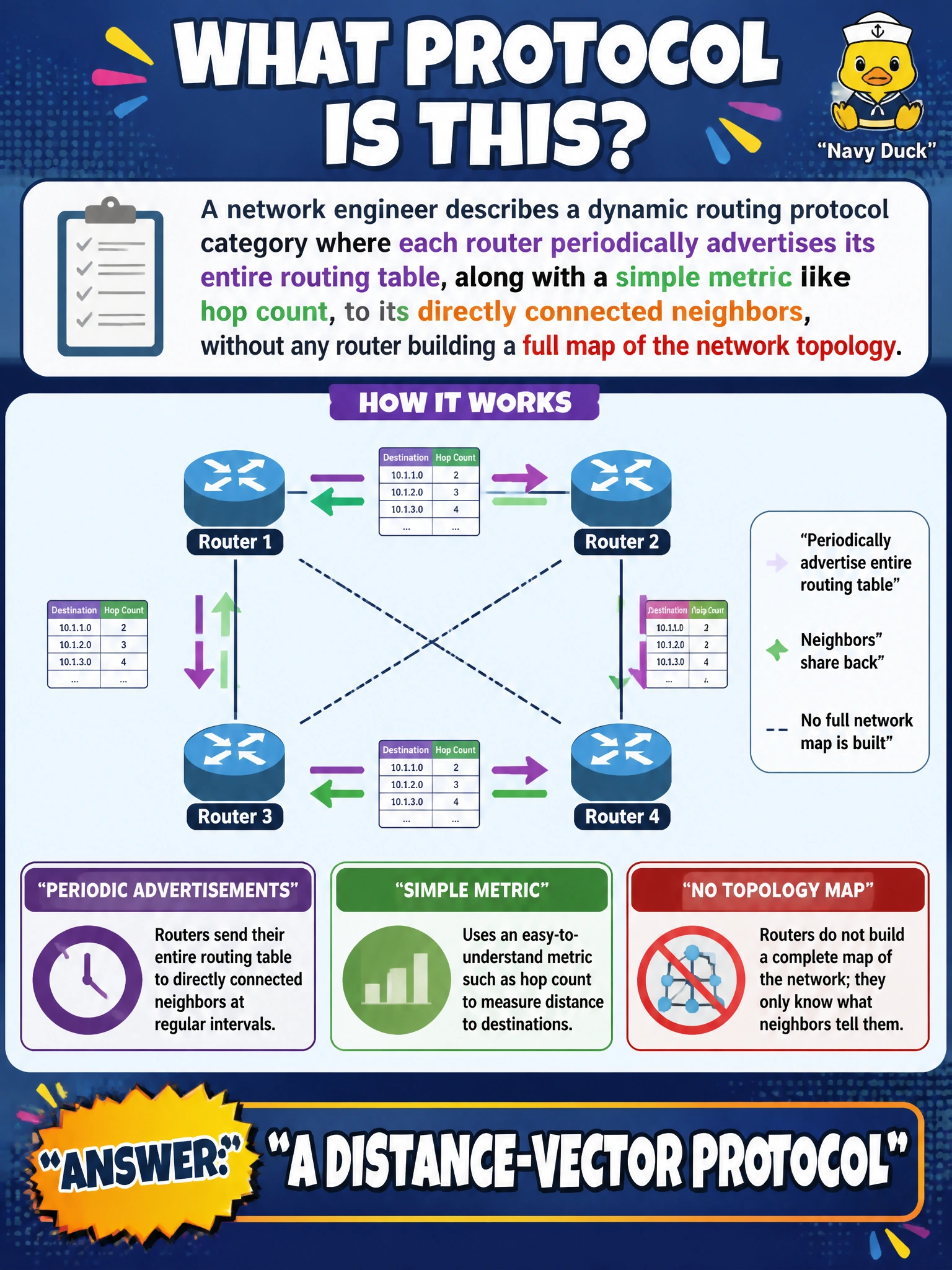
A network engineer describes a dynamic routing protocol category where each router periodically advertises its entire routing table, along with a simple metric like hop count, to its directly connected neighbors, without any router building a full map of the network topology. What category of protocol is being described?
Select an answer to reveal the explanation.
Short Explanation
A distance-vector protocol is basically neighbors trading rumors: each router just tells its neighbors what it knows and how far it is, without anyone drawing a full map. It's simple, but it means no single router sees the whole picture at once.
Full Explanation
Distance-vector routing protocols work by having each router periodically share its own routing table (or a summary of it) with its directly connected neighbors, along with a distance metric such as hop count, rather than exchanging detailed topology information. Each router builds its view of the network secondhand, from what its neighbors report, rather than computing a full map itself. A link-state protocol takes the opposite approach: every router floods information about its own directly connected links to all routers in the area, and each one independently builds a complete topology map before calculating best paths — that's the reverse mechanism from what's described. An exterior gateway protocol is a category defined by scope (routing between autonomous systems, like BGP) rather than by the neighbor-only, table-sharing mechanism described here; a distance-vector protocol can be either interior or, historically, exterior. There's no such thing as a 'static routing protocol' — static routing is manual configuration with no protocol exchange at all, which contradicts the description of periodic neighbor advertisements. A practical exam distinction is convergence speed: distance-vector's neighbor-by-neighbor propagation is typically slower to converge than link-state's topology-flooding approach, since changes take multiple hops to fully propagate.