
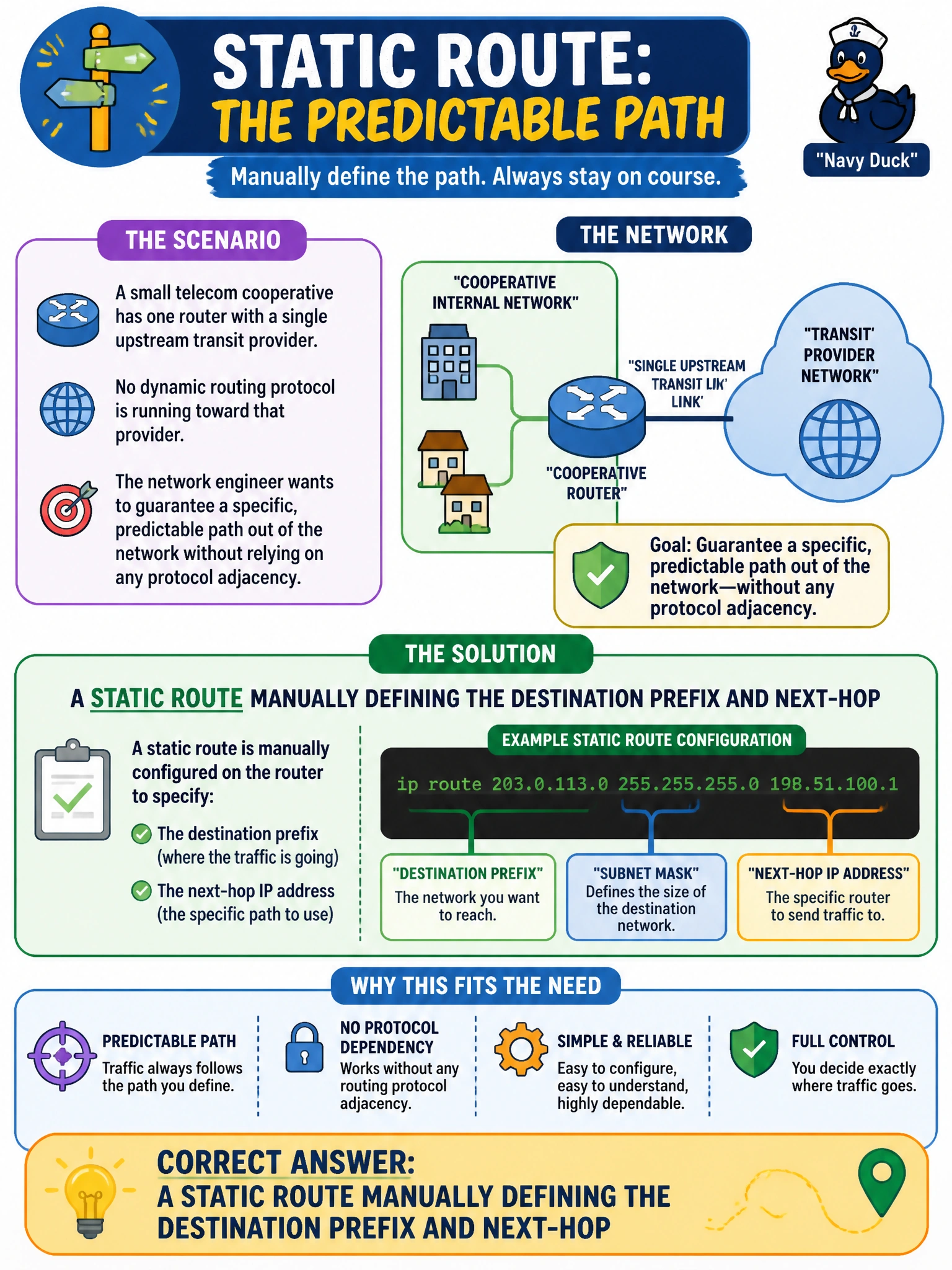
A small telecom cooperative has one router with a single upstream transit provider and no dynamic routing protocol running toward that provider. The network engineer wants to guarantee a specific, predictable path out of the network without relying on any protocol adjacency. Which routing mechanism directly fits this need?
Select an answer to reveal the explanation.
Short Explanation
When you already know exactly where traffic should go and don't want to run a whole protocol conversation to get there, you just write it down: that's a static route. You're the one setting the destination and the next-hop, and Junos follows it exactly.
Full Explanation
A static route is a manually configured entry pairing a destination prefix with a next-hop (an IP address or an outgoing interface), installed directly into the routing table without any dynamic protocol exchange. It's the natural fit for a stub site with a single upstream connection, where the path is fixed and predictable and there's no topology to discover. A firewall filter controls which packets are permitted, dropped, or otherwise acted on based on match criteria — it doesn't establish reachability toward a destination at all, so it solves a different problem. An OSPF area boundary is a link-state protocol construct for organizing routers into hierarchical areas; configuring one requires running OSPF and forming adjacencies, which is exactly the protocol overhead the scenario says to avoid. A routing instance creates a logically separate routing table on the same device, useful for segregating traffic domains, but it doesn't by itself define how to reach a specific destination. The caveat worth remembering: static routes don't automatically detect when their next-hop becomes unreachable unless paired with a mechanism like BFD tracking. An operational check is show route protocol static, confirming the entry is present and marked active toward the intended next-hop.