
Ahead of a large maintenance window at a regional POP, an engineer wants to snapshot the currently active, known-good configuration as a dedicated safety net, separate from the router's normal rollback history. Which action accomplishes that?
Select an answer to reveal the explanation.
Short Explanation
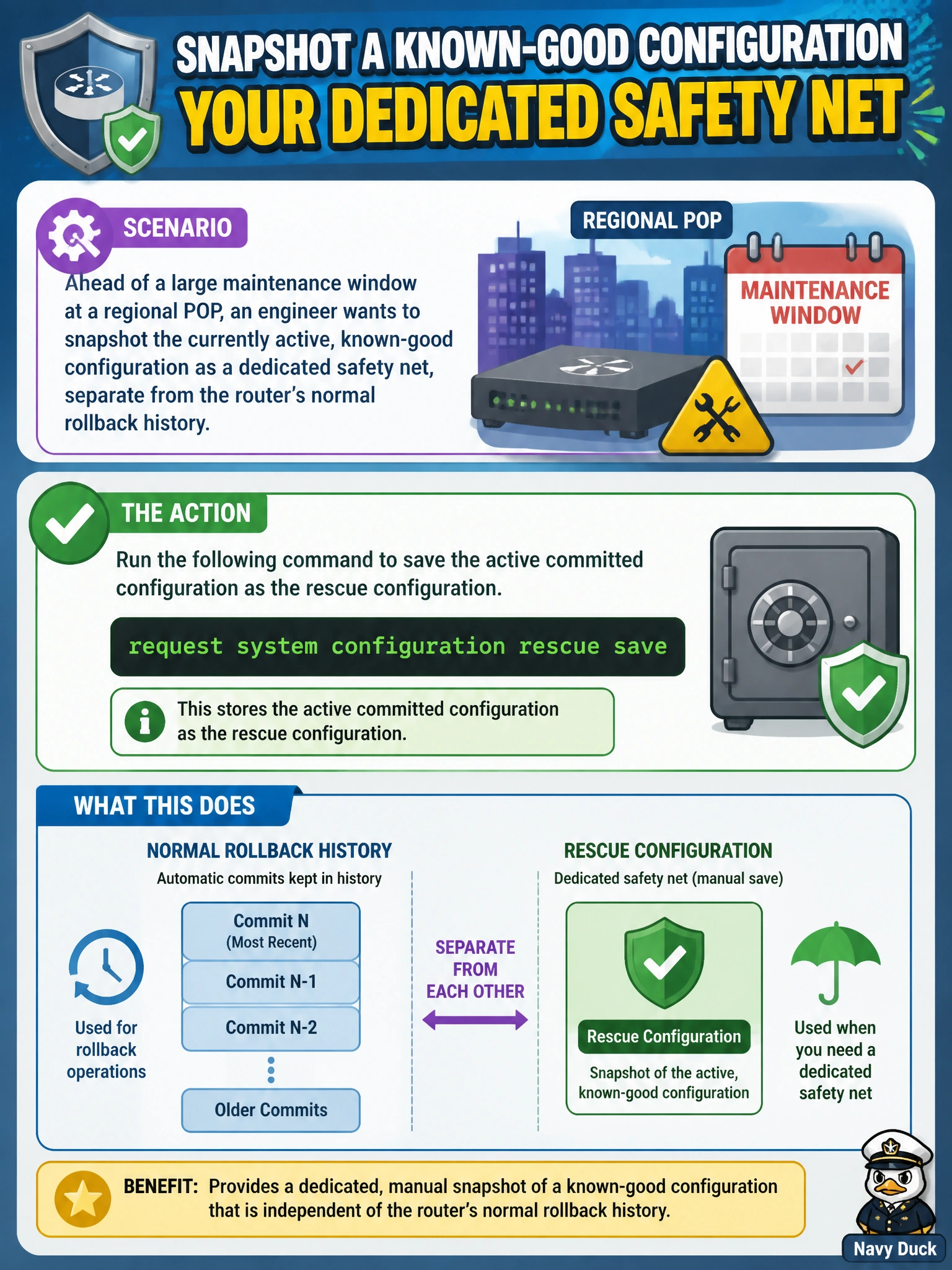
Before you go poking at a live router, you tell it to bookmark exactly what's running right now as its own separate safety copy. request system configuration rescue save is that bookmark.
Full Explanation
The request system configuration rescue save command explicitly copies the currently active, committed configuration into a dedicated rescue configuration slot, distinct from the normal numbered rollback history that Junos keeps automatically after every commit. This gives an engineer a deliberately chosen, known-good baseline to fall back to that will not be overwritten by ordinary rollback churn during a maintenance window. Archival transfer-on-commit is unrelated: it pushes configuration copies to an external server on every commit and has no connection to the router's local rescue configuration slot. rollback 0 simply reloads the most recently committed configuration into the candidate configuration for editing; it does not create or designate a rescue configuration at all. Rescue configuration is not generated automatically at any point and is not a fixed, unchangeable snapshot — it must be explicitly saved by an administrator and can be re-saved later to update the baseline. To confirm the save worked, show system configuration rescue should display the saved configuration content, giving the engineer a verified fallback before the maintenance window begins.