
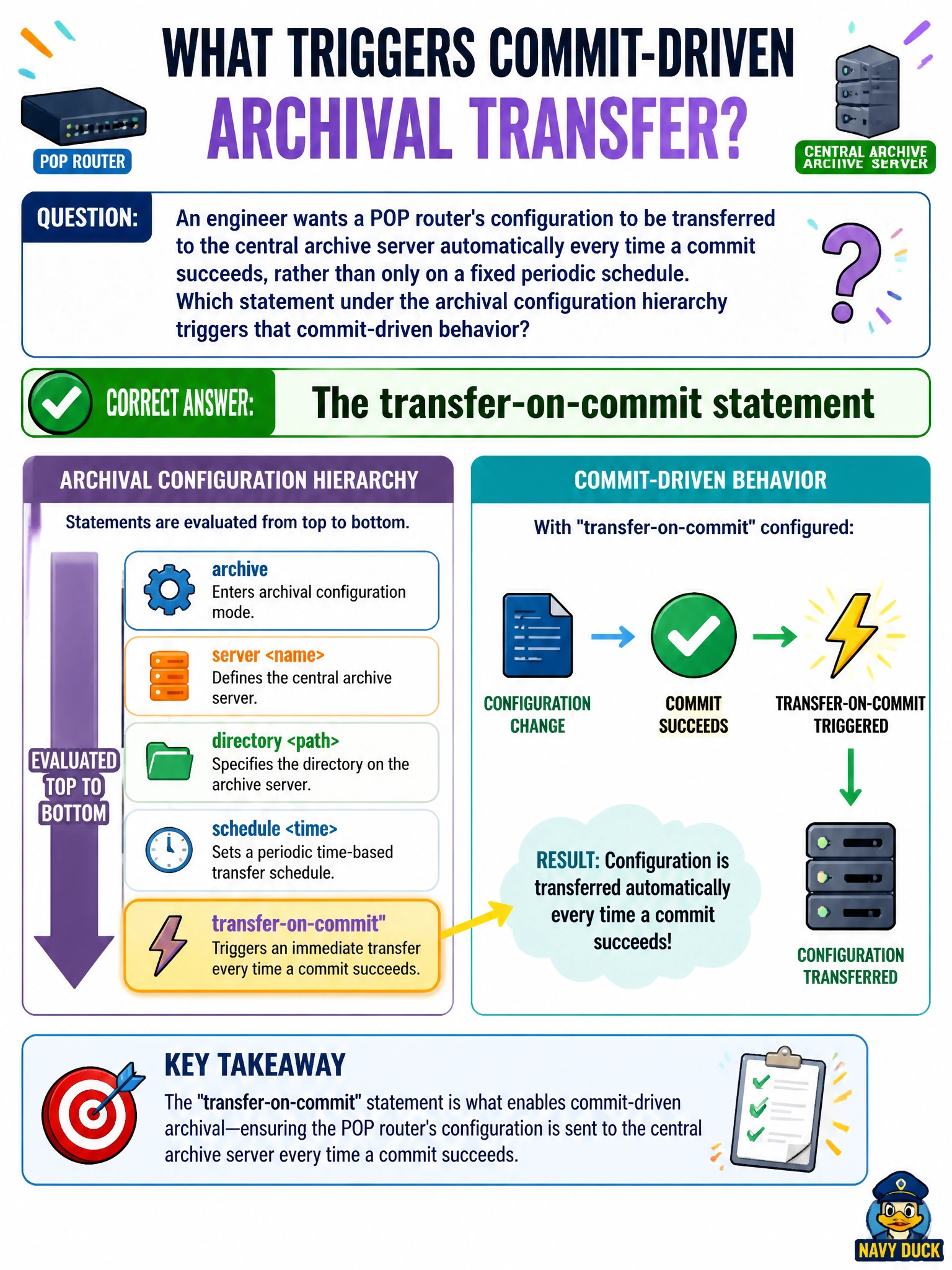
An engineer wants a POP router's configuration to be transferred to the central archive server automatically every time a commit succeeds, rather than only on a fixed periodic schedule. Which statement under the archival configuration hierarchy triggers that commit-driven behavior?
Select an answer to reveal the explanation.
Short Explanation
You want the transfer tied to the act of committing itself, not to a clock. transfer-on-commit is the one statement that ties the archive push directly to that moment.
Full Explanation
The transfer-on-commit statement, configured under system archival configuration, is what specifically ties the archive transfer to the moment a commit succeeds, so the router pushes a fresh copy of the configuration to the configured destination immediately after every commit rather than waiting for a separate periodic timer. This is the correct mechanism when the requirement is commit-driven rather than schedule-driven archival. The rescue configuration save command is an entirely separate, manually invoked action that snapshots the active configuration locally on the router as a recovery baseline; it has no relationship to transferring files to an external server. An interface-range statement configures shared properties across a group of physical interfaces and has nothing to do with archival behavior. A static route only affects how traffic destined for the archive server's address is forwarded through the network; it does not initiate or trigger any archival transfer itself, and archival would still not fire on commit without transfer-on-commit configured. To confirm the behavior, review show configuration system archival configuration for the transfer-on-commit line, then perform a trivial commit and check the archive server for a new file timestamped immediately afterward.