
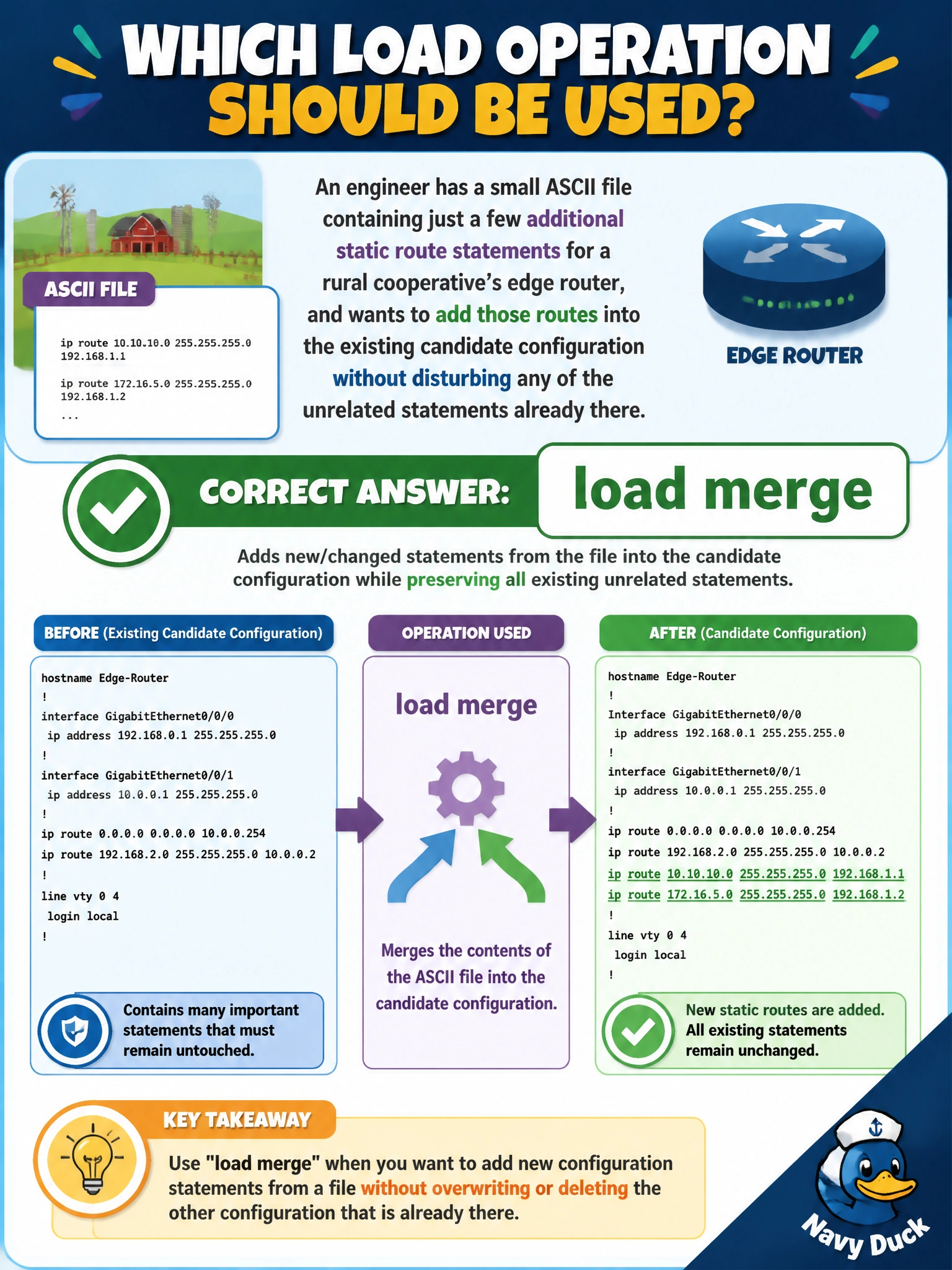
An engineer has a small ASCII file containing just a few additional static route statements for a rural cooperative's edge router, and wants to add those routes into the existing candidate configuration without disturbing any of the unrelated statements already there. Which load operation should be used?
Select an answer to reveal the explanation.
Short Explanation
load merge is additive. It layers the new file's statements on top of whatever's already in the candidate, like adding a page to a binder instead of swapping the whole binder out.
Full Explanation
load merge filename combines the statements in the specified file with the existing candidate configuration, adding new statements and overwriting only the specific statements that directly conflict, while leaving everything else in the candidate untouched — ideal for a small incremental addition like a handful of static routes. load override discards the entire existing candidate configuration and replaces it wholesale with the contents of the file, which would wipe out unrelated settings the engineer explicitly wants to keep, the opposite of what's needed here. load replace is used with files that contain explicit replace: tags marking which specific hierarchy sections should be swapped out, a more surgical but structurally different mechanism than a plain additive merge of arbitrary new statements. load patch applies a set of differences generated by a prior compare operation, rather than merging in a freestanding configuration file of new statements. Caveat: load merge can still produce a conflict if the file redefines a statement that must be singular, such as an interface's primary address, so the result should always be reviewed before committing. Check: after loading, run show | compare to confirm only the intended static routes were added and nothing unrelated was disturbed.