
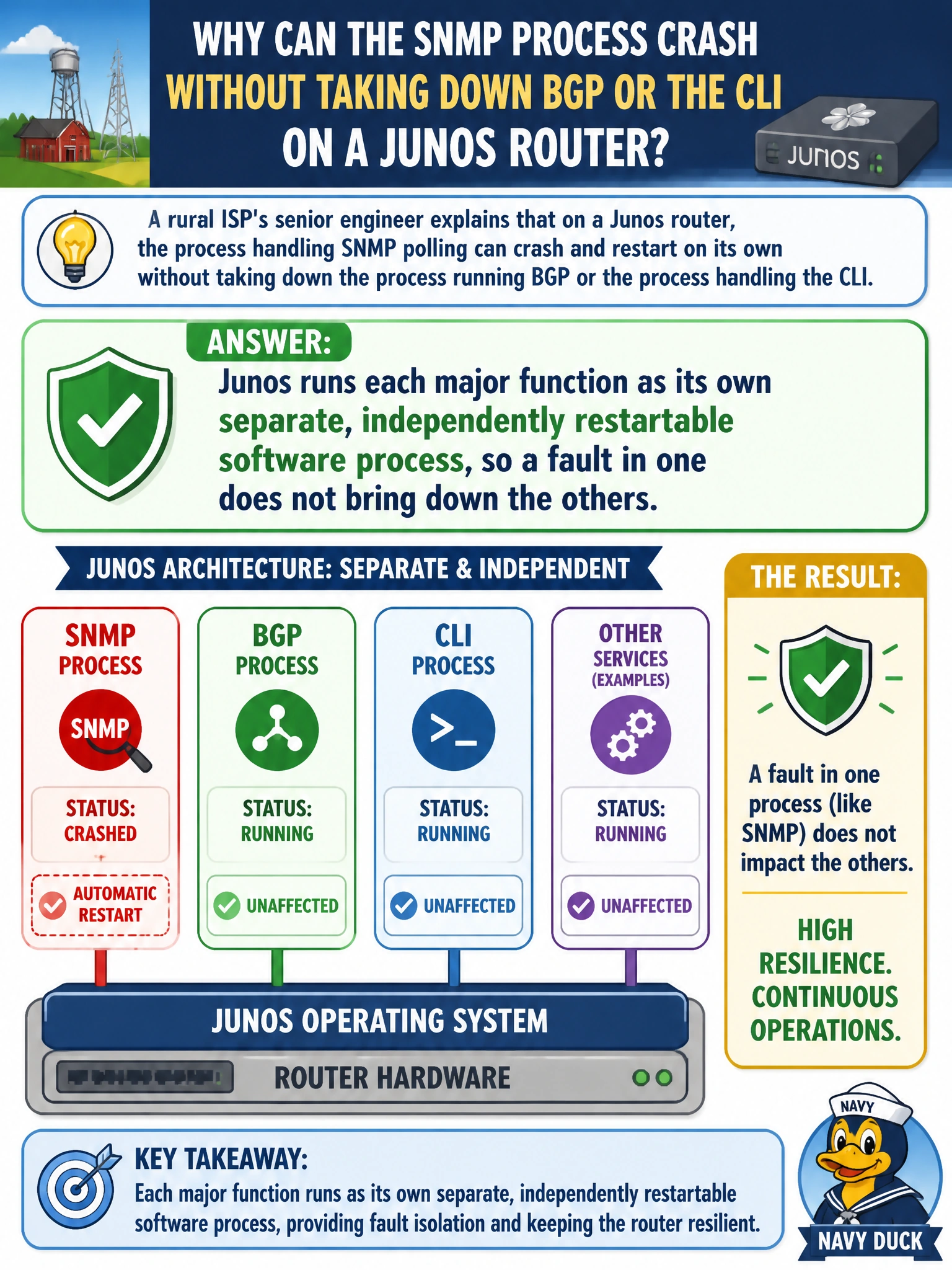
A rural ISP's senior engineer explains that on a Junos router, the process handling SNMP polling can crash and restart on its own without taking down the process running BGP or the process handling the CLI. What architectural fact explains this resilience?
Select an answer to reveal the explanation.
Short Explanation
Junos doesn't run as one giant program where a single hiccup takes everything down with it — each major job, like SNMP, BGP, or the CLI, lives in its own separate process. Think of it like separate departments in an office: if one has a bad day, the others keep working right through it.
Full Explanation
Junos's modular software design assigns distinct functions, such as SNMP, routing protocols, CLI and configuration management, and chassis monitoring, to their own separate software processes running on the Routing Engine, so a fault or restart in one process is isolated and does not require restarting the others, which is exactly the resilience described. Claiming Junos runs as a single monolithic process reverses what was actually observed; a truly monolithic design would mean the SNMP crash necessarily takes BGP and the CLI down with it, not leaves them untouched. Claiming the Routing Engine and Packet Forwarding Engine share one combined process describes a different architectural boundary entirely, the control-plane and forwarding-plane hardware separation, and doesn't explain why one control-plane daemon can fail independently of another control-plane daemon. Claiming each daemon gets its own dedicated CPU core misattributes the isolation to hardware provisioning; process isolation in Junos is an operating-system design choice, and multiple daemons commonly share the same general-purpose Routing Engine CPU resources rather than each owning a physical core. A caveat worth remembering is that this isolation only protects against one process's fault spreading to others; if the shared Routing Engine CPU itself becomes overloaded, every process competing for it can still slow down together. An operational check after any restart event is reviewing the system log for the specific daemon name reported as having restarted, confirming the incident was isolated rather than assuming the entire control plane reset.