
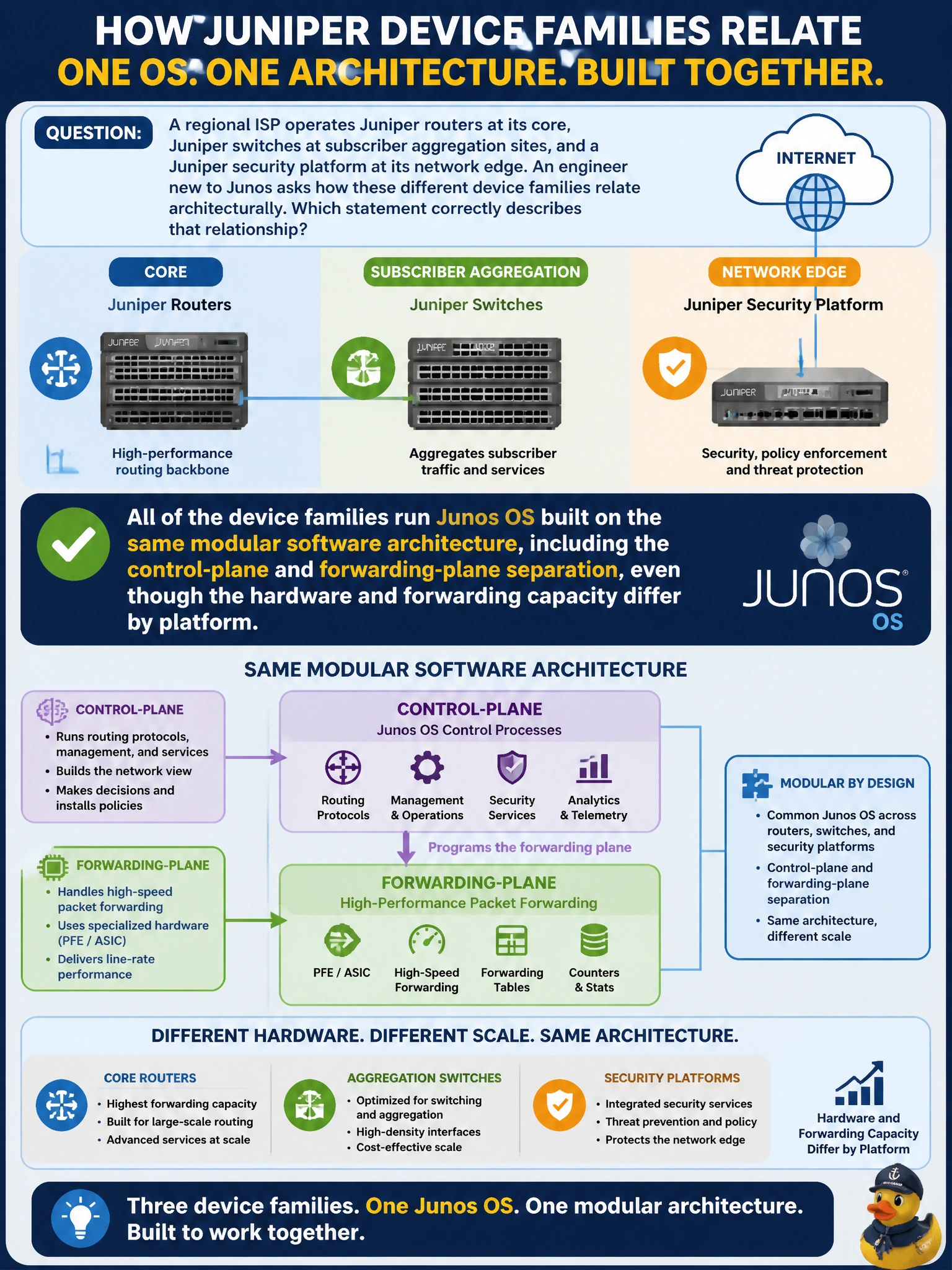
A regional ISP operates Juniper routers at its core, Juniper switches at subscriber aggregation sites, and a Juniper security platform at its network edge. An engineer new to Junos asks how these different device families relate architecturally. Which statement correctly describes that relationship?
Select an answer to reveal the explanation.
Short Explanation
Underneath very different-looking boxes - a core router, an aggregation switch, an edge security platform - Junos is doing the same basic job everywhere: a Routing Engine handling control-plane software, and a forwarding plane moving packets in hardware. The chassis and forwarding capacity change with the platform, but the underlying architecture doesn't. That's what makes Junos knowledge portable across a co-op's whole device lineup.
Full Explanation
Junos's device families - routers, switches, and security platforms - all run the same underlying modular operating system, sharing the same core architectural pattern of a control plane running on a Routing Engine and a forwarding plane executing in dedicated hardware, even though the specific hardware, forwarding capacity, and available feature set vary by platform and product line. This is the practical payoff of the one-software-track design: architectural concepts like control and forwarding plane separation, the daemon model, and configuration behavior transfer across the co-op's entire fleet rather than being platform-specific trivia to relearn. The distractors describe architectures Junos does not have: claiming each family runs an entirely separate OS ignores the shared codebase that defines Junos; claiming only routers run genuine Junos while switches and a security platform run something merely similar misstates how Juniper actually built these product lines; and claiming the forwarding plane is optional or router-only misunderstands that every Junos platform, including switches and security platforms, has a forwarding plane doing hardware-based packet processing - forwarding entirely in software would defeat the performance goals these platforms are built for. A useful conceptual check when evaluating a new Junos platform is looking for the same control and forwarding split and daemon-based structure, since finding it confirms the platform genuinely runs Junos rather than a look-alike interface.