
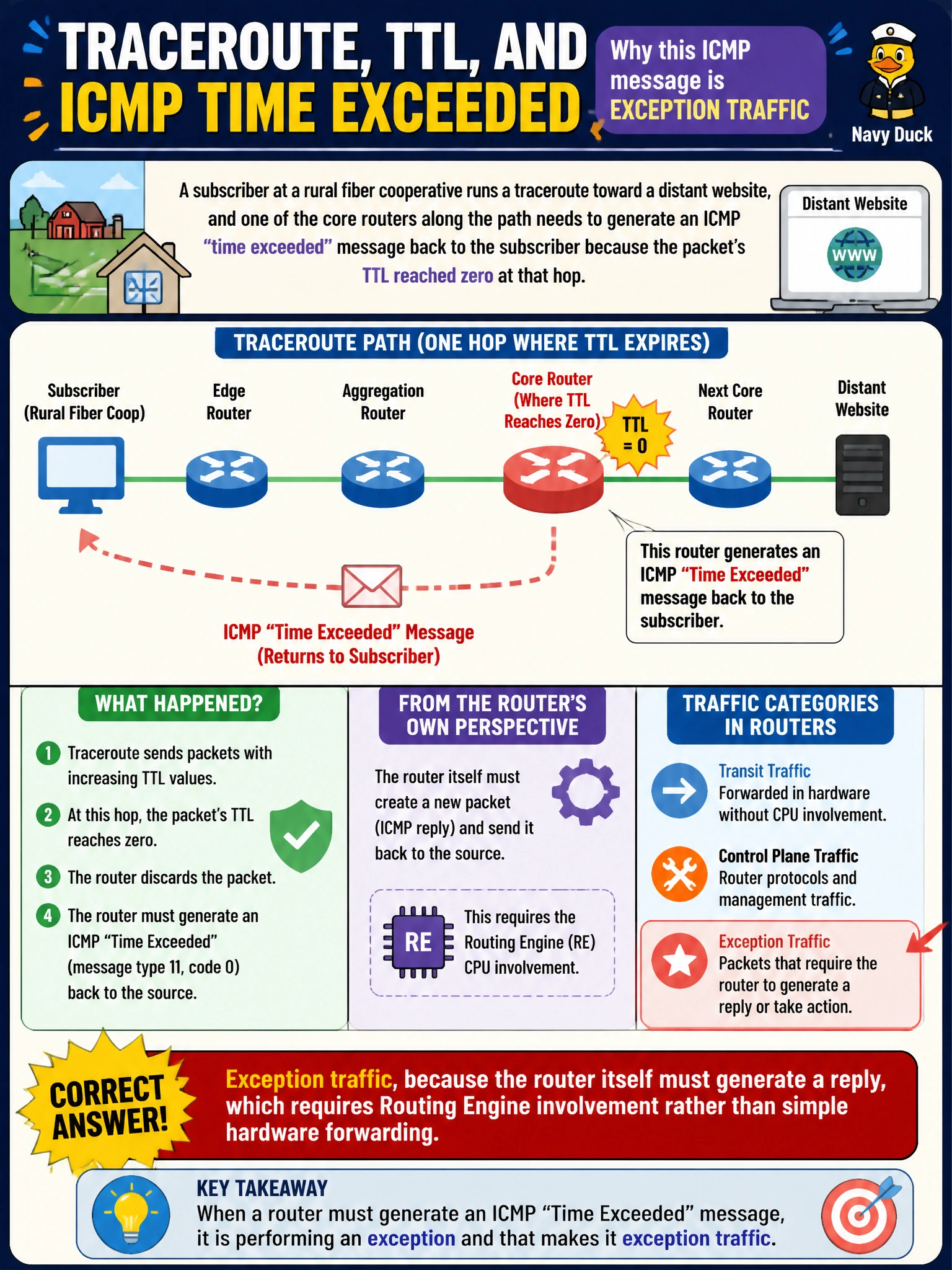
A subscriber at a rural fiber cooperative runs a traceroute toward a distant website, and one of the core routers along the path needs to generate an ICMP "time exceeded" message back to the subscriber because the packet's TTL reached zero at that hop. Which category of traffic does this generated ICMP message represent from the router's own perspective?
Select an answer to reveal the explanation.
Short Explanation
A router doesn't have a reply button built into its fast hardware path - generating a brand-new ICMP message is something only the software side can do. That means detecting the expired TTL and crafting the response gets punted up to the Routing Engine, making it exception traffic rather than an ordinary pass-through packet. The original packet died at that hop; what goes back to the subscriber is something the router itself created.
Full Explanation
Generating an ICMP time-exceeded message is a clear case of exception traffic because the Packet Forwarding Engine's hardware forwarding path can switch existing packets toward a destination, but it cannot originate a brand-new packet on the router's own behalf - that requires software logic running on the Routing Engine, which detects the expired TTL, builds the ICMP message, and sends it back toward the traceroute's source. The distractors misclassify the event: while the original inbound packet that triggered the TTL expiry could be considered ordinary transit traffic up until that point, the event described here is specifically the router's own generated reply, which is not transit traffic since the router itself is now the source; local traffic refers to traffic destined to or from the router's own management or protocol addresses, not merely traffic that originated somewhere inside the co-op's network; and ICMP messages are not inherently routing protocol exchanges - this one has nothing to do with routing adjacencies at all. A useful exam habit is to ask whether the router is only relaying a packet or actually creating one; creating one almost always signals exception-traffic handling. An operational check worth knowing is that a healthy traceroute showing consistent replies from each hop confirms that exception-traffic handling for TTL expiry is functioning normally along that path.