
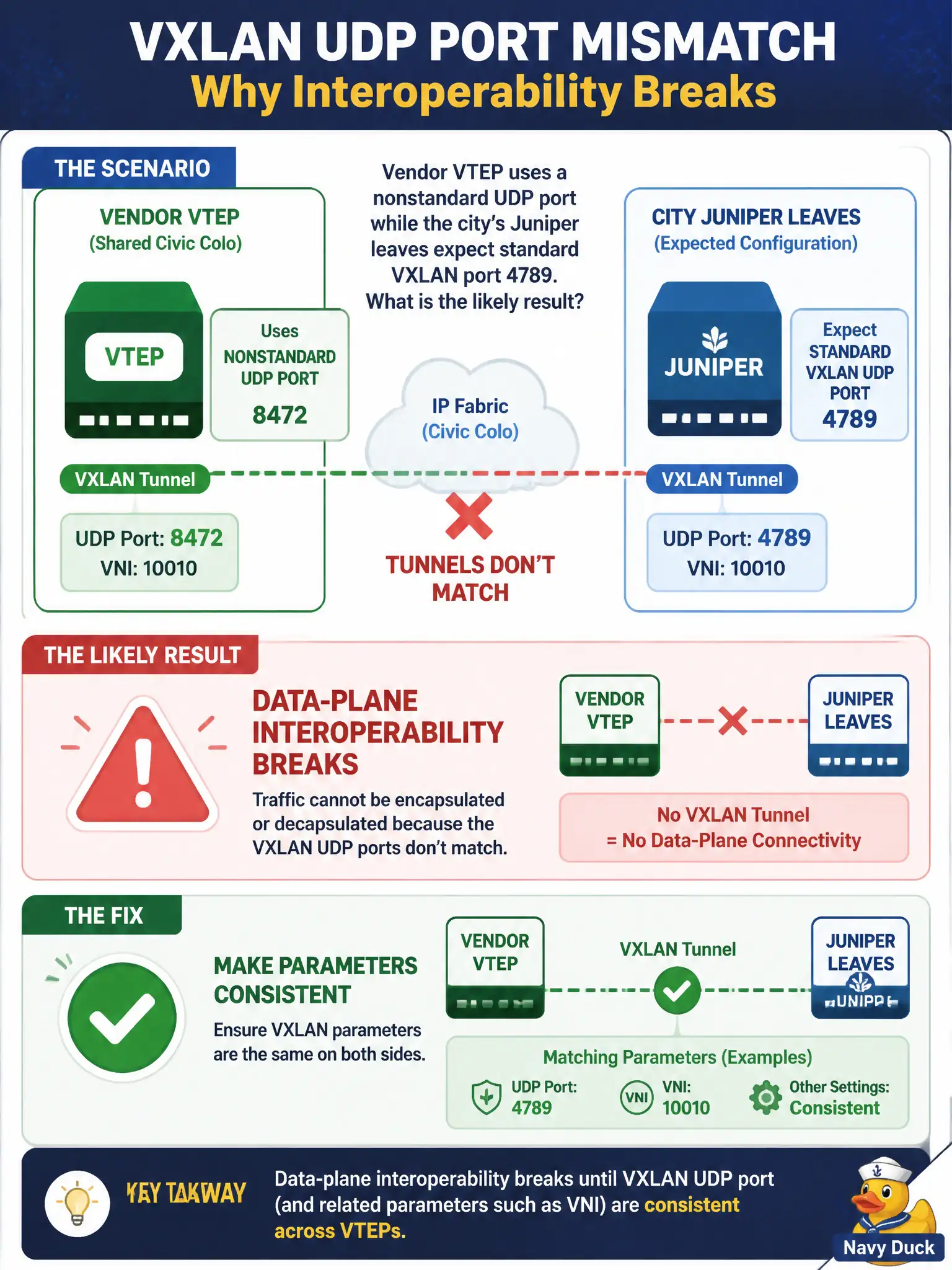
A vendor VTEP in a shared civic colo uses a nonstandard UDP port while the city’s Juniper leaves expect standard VXLAN port 4789. What is the likely result?
Select an answer to reveal the explanation.
Short Explanation
If one dock expects gate 4789 and the other ships to gate 4790, the freight never clears. VXLAN parameters—especially UDP port and VNI—must match for decap to work. Consistency beats clever one-offs in a shared colo.
Full Explanation
When a vendor VTEP in a shared civic colo uses a nonstandard UDP port while the city’s Juniper leaves expect standard VXLAN port 4789, data-plane interoperability breaks until VXLAN UDP port and related parameters such as VNI are consistent across VTEPs. Remote VTEPs ignore or drop traffic that does not match their expected VXLAN listener.
Junos does not auto-translate any UDP port to 4789 when the VNI matches. The mismatch does not affect only telemetry while unicast overlay traffic still decapsulates. Spines do not rewrite the UDP destination port based on LLDP chassis ID.
Exam caveat: interconnection agreements should lock standard port 4789 unless every VTEP is explicitly reconfigured the same way.
Operational check: capture between the vendor VTEP and a city leaf, compare UDP destination ports, align configuration to 4789 (or a mutually agreed port on all devices), and retest decapsulation counters on both sides. Add UDP port conformance to the colo onboarding checklist for third-party VTEPs. Refuse production cutover until a bilateral capture proves matching encapsulation parameters. Record the validated outcome in the municipal fabric runbook for the next change window. Record the validated outcome in the municipal fabric runbook for the next change window.