
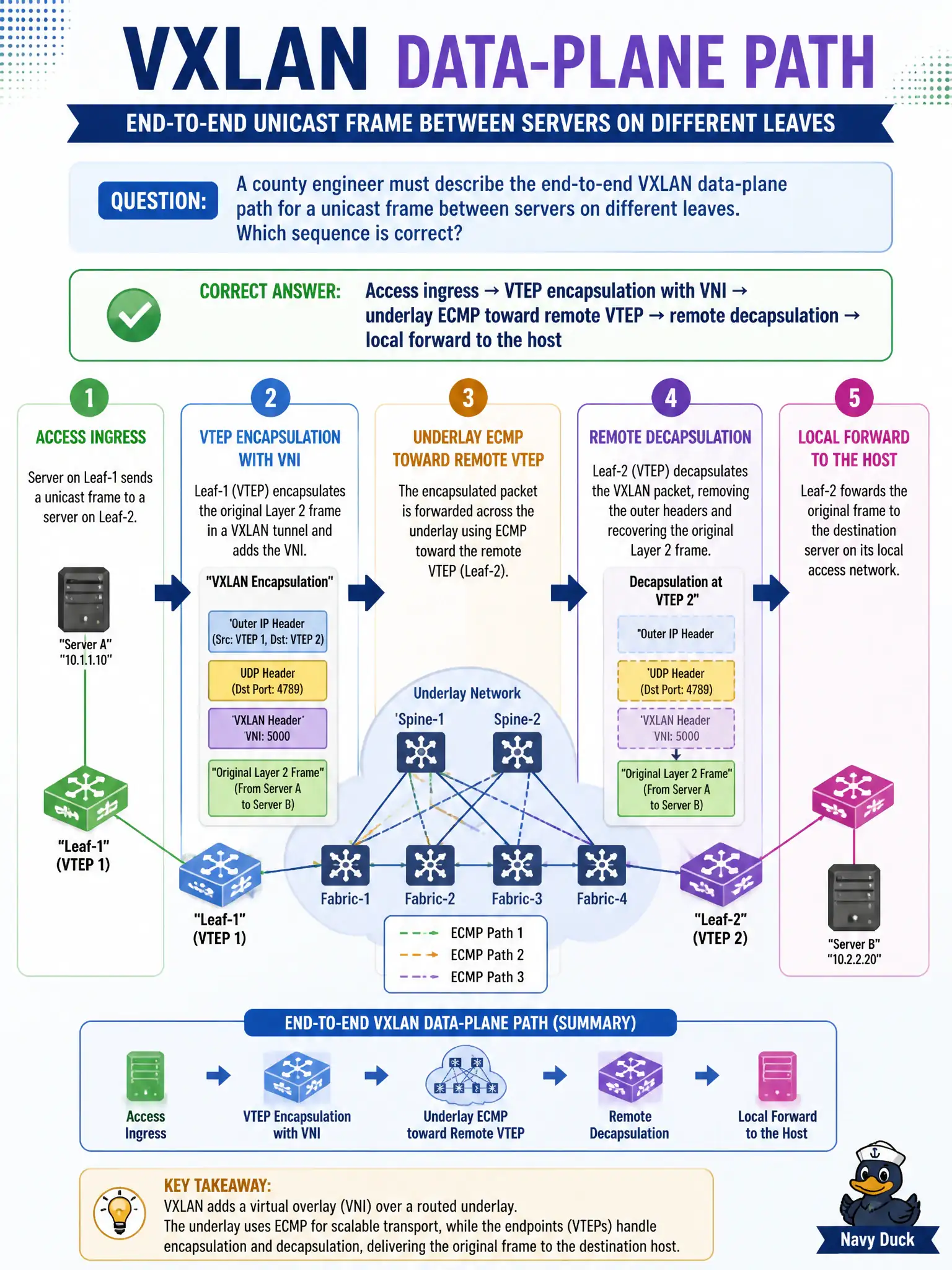
A county engineer must describe the end-to-end VXLAN data-plane path for a unicast frame between servers on different leaves. Which sequence is correct?
Select an answer to reveal the explanation.
Short Explanation
Walk the package: pick up at the server, wrap at the local leaf, ride equal-cost underlay roads, unwrap at the far leaf, hand off locally. That’s the VXLAN leaf-spine story in one breath. Spines are the highway—not where you tear open the tenant envelope on every ramp.
Full Explanation
A county engineer describing the end-to-end VXLAN data-plane path for a unicast frame between servers on different leaves should state: access ingress → VTEP encapsulation with VNI → underlay ECMP toward remote VTEP → remote decapsulation → local forward to the host. Intermediate spines forward outer IP and do not need to terminate tenant overlay state for this ordinary packet walk.
The path is not access ingress → spine tenant bridging with no encapsulation → leaf MPLS swap → host. It is not host → underlay OSPF adjacency to the remote server → VXLAN only for keepalives → host. It is not access ingress → EVPN route reflector decapsulation on every hop → host without leaf VTEPs.
Exam caveat: memorize the encapsulation–underlay–decapsulation mental model; it anchors municipal fabric troubleshooting orders.
Operational check: trace a unicast flow with captures at access ingress, leaf uplink showing outer VTEP IPs and VNI, and remote access egress; confirm spines show outer-IP transit without tenant MAC tables for that flow. Break the path on purpose at underlay reachability, then at VNI membership, to show different symptom classes. File the packet-walk diagram in the county onboarding guide for new fabric engineers.