
The civic NOC asks what head-end replication means for VXLAN BUM when the underlay has no multicast. Which explanation is accurate?
Select an answer to reveal the explanation.
Short Explanation
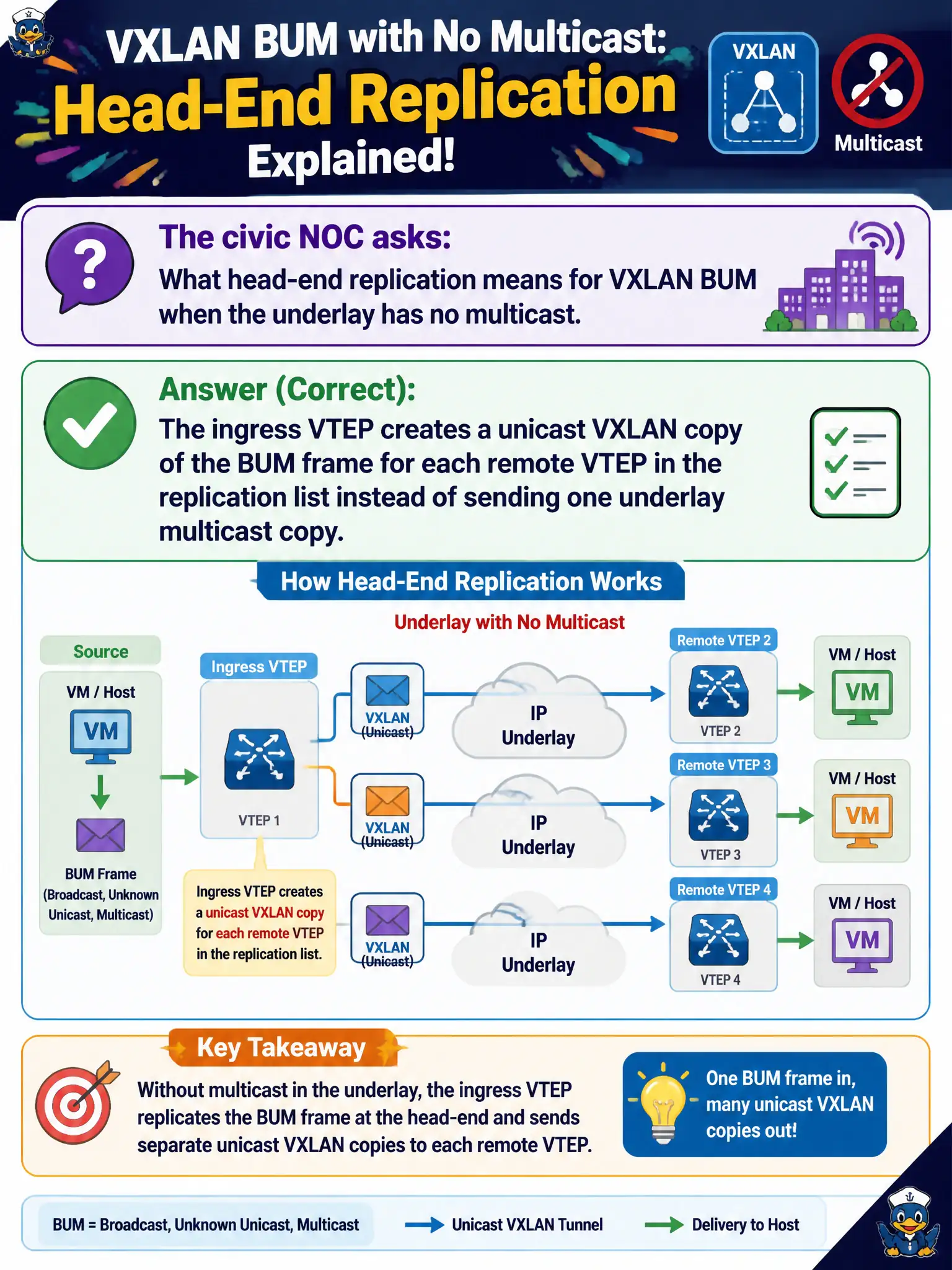
Head-end replication is the leaf doing the photocopying itself—one BUM frame in, a unicast VXLAN copy out to every remote VTEP on the list. You use it when the underlay has no multicast megaphone. It is ordinary tenant BUM handling, not a SPAN-only trick, and spines are not turning those frames into OSPF LSAs.
Full Explanation
Head-end replication for VXLAN BUM on a civic fabric without underlay multicast means the ingress VTEP creates a unicast VXLAN copy of each BUM frame for every remote VTEP in the replication list instead of sending one underlay multicast copy. EVPN commonly builds and distributes that list so leaves know which VTEPs participate in a VNI and must receive broadcast, unknown unicast, and multicast overlay traffic.
BUM frames are not dropped at the ingress VTEP on the false claim that multicast is mandatory for all VXLAN designs—HER exists so multicast can be optional. Spines do not convert every BUM packet into an OSPF LSA that leaves flood as link-state updates. Head-end replication is not limited to mirrored SPAN sessions; it is a primary tenant broadcast-domain delivery mode in many EVPN-VXLAN municipal fabrics.
Exam caveat: HER equals unicast fan-out of BUM to the VTEP list; JNCIP-DC expects this contrast with underlay multicast BUM distribution.
Operational check: inspect the ingress-replication or flood list for a VNI on a civic leaf, send an ARP broadcast, and confirm unicast VXLAN copies toward each listed remote VTEP while underlay multicast for VXLAN remains disabled.
In civic fabric operations, retain the correct idea—The ingress VTEP creates a unicast VXLAN copy of the BUM frame for each remote VTEP in the replication list instead of sending one underlay multicast copy—and reject distractors that confuse layers or tools. Specifically, do not treat “Each BUM frame is dropped at the ingress VTEP because multicast is mandatory for all VXLAN designs.” as valid, do not accept “Spines convert every BUM packet into an OSPF LSA that leaves flood as link-state updates.” as a substitute design, and do not operationalize “Head-end replication only applies to mirrored SPAN sessions and never to tenant broadcast domains.” in production runbooks. Re-validate after changes with show commands for sessions, routes, VTEP reachability, and a simple tenant traffic test appropriate to the VNI under review.