
A county enables VXLAN between leaves but deploys no EVPN or other MAC/IP control plane. What is the primary remote-learning implication?
Select an answer to reveal the explanation.
Short Explanation
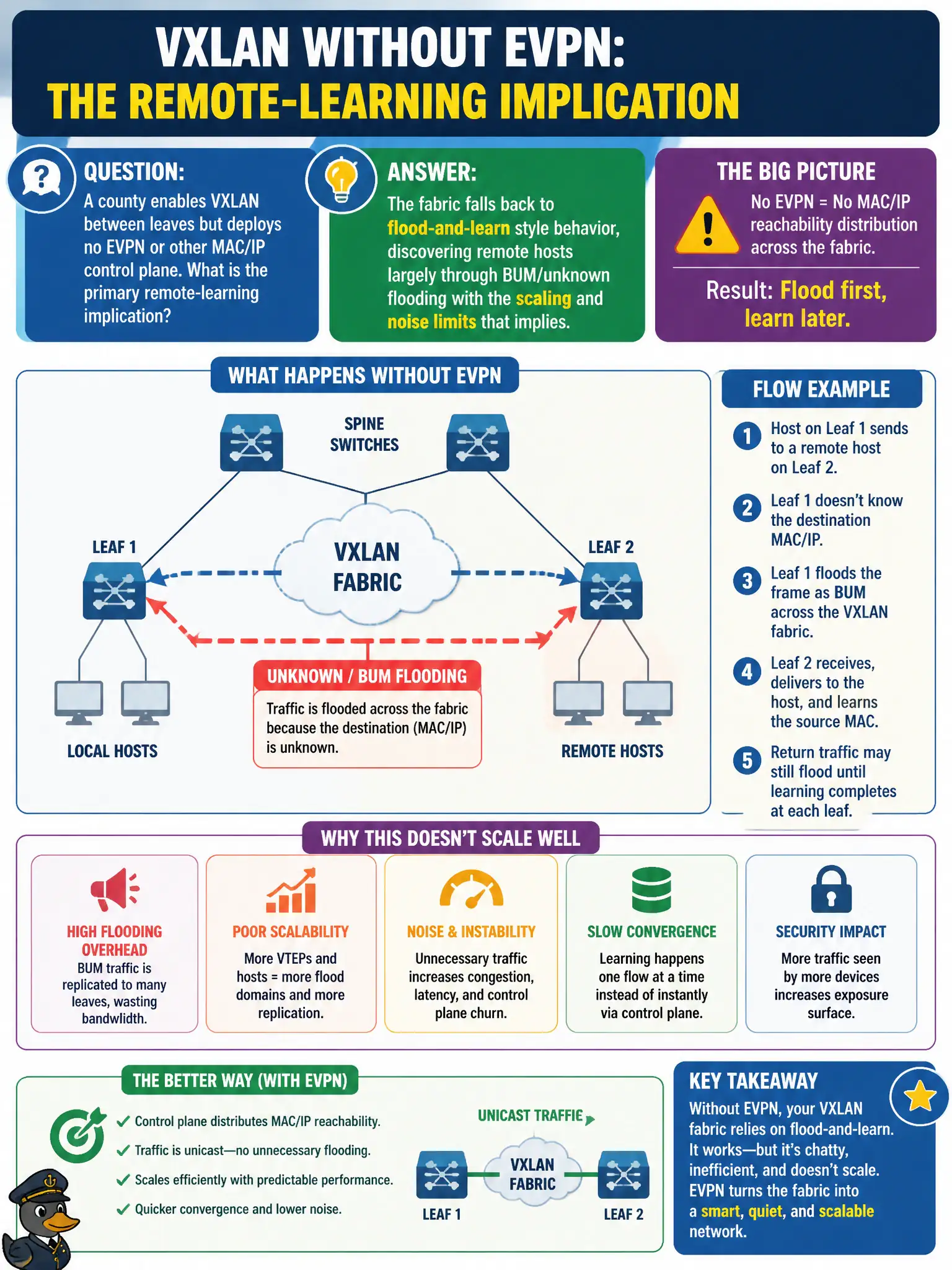
No control plane means the county is back to learning the hard way—flood until someone answers. That flood-and-learn habit can work in a lab, but it gets chatty and brittle as civic pods grow. You do not magically get EVPN Type-2 routes or Type-5-only behavior just by turning VXLAN on.
Full Explanation
A county that enables VXLAN between leaves but deploys no EVPN or other MAC/IP control plane primarily falls back to flood-and-learn style remote learning: unknown unicasts and other BUM frames are flooded so remote VTEPs can learn source MACs from the data plane. That approach works at small scale but increases overlay/underlay BUM load and noise compared with BGP EVPN MAC/IP advertisement as the civic fabric grows.
Remote MACs do not appear instantly through BGP Type-2 routes when EVPN was never configured. VXLAN encapsulation remains possible without an SDN controller pushing every MAC to every leaf—flood-and-learn historically discovered hosts via flooding. Tenant traffic does not automatically convert to Layer-3-only EVPN Type-5 routes merely because no control plane was deployed.
Exam caveat: VXLAN data plane without an EVPN-like control plane implies flooding-based discovery and its scaling limits—that is the primary remote-learning implication.
Operational check: in a lab without EVPN, clear MAC tables, generate unknown unicast, and observe flood-based learning; contrast with EVPN-enabled leaves where Type-2 installs remote MACs with substantially less unknown-unicast flooding.