
Design review for a new municipal Clos insists on symmetric leaf-to-spine cabling and clearly labeled ports. Why is that an IP fabric best practice?
Select an answer to reveal the explanation.
Short Explanation
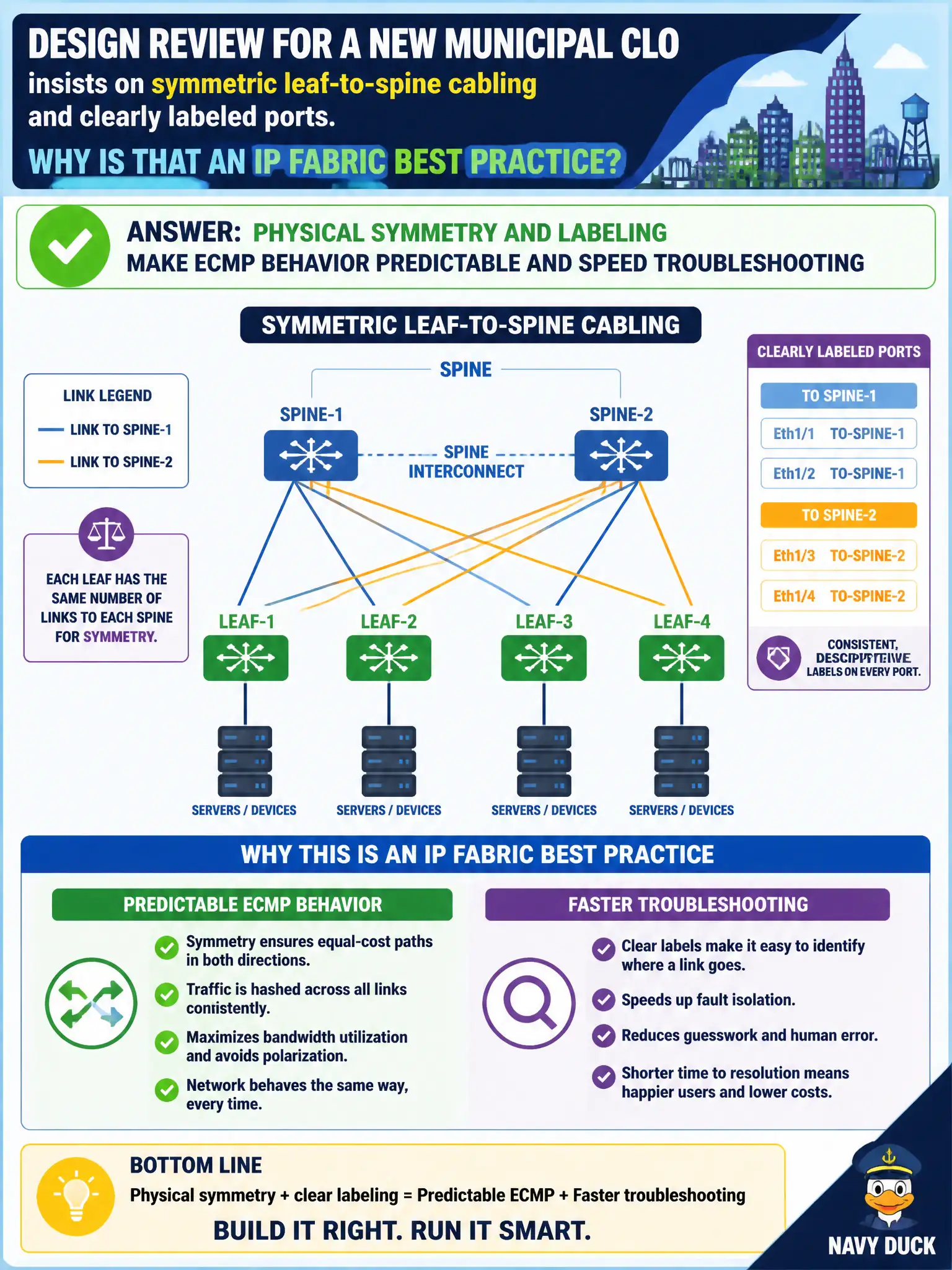
If half the leaves have three uplinks and half have five with mystery patch cords, ECMP stops being a clean recipe and ops turns into a treasure hunt. Symmetric, labeled fabric cabling keeps Clos behavior boring—in a good way.
Full Explanation
Symmetric leaf-to-spine cabling with clearly labeled ports is an IP fabric best practice because physical symmetry and labeling make ECMP behavior predictable and accelerate troubleshooting. Clos capacity and hash planning assume regular uplink counts; when half the municipal leaves have three uplinks and half have five with unlabeled cords, multipath sets become uneven and incident response turns into a physical treasure hunt during outages.
Asymmetric cabling does not beneficially increase ECMP entropy as a preferred design for hash diversity—it complicates operations and capacity math. Port labels matter for fabric uplinks, not only copper access ports facing servers. Spines should not be cabled in a random mesh so operators cannot predict forwarding; predictability is a reliability feature in civic fabrics, not something to randomize away.
Exam caveat: physical regularity and labeling are part of Clos best practice, not optional aesthetics after BGP is established.
Operational check: audit each leaf’s uplink count toward each spine against the design drawing, remediate asymmetries, verify port labels match the runbook, and confirm RIB equal-cost next-hop counts match the intended physical Clos.