
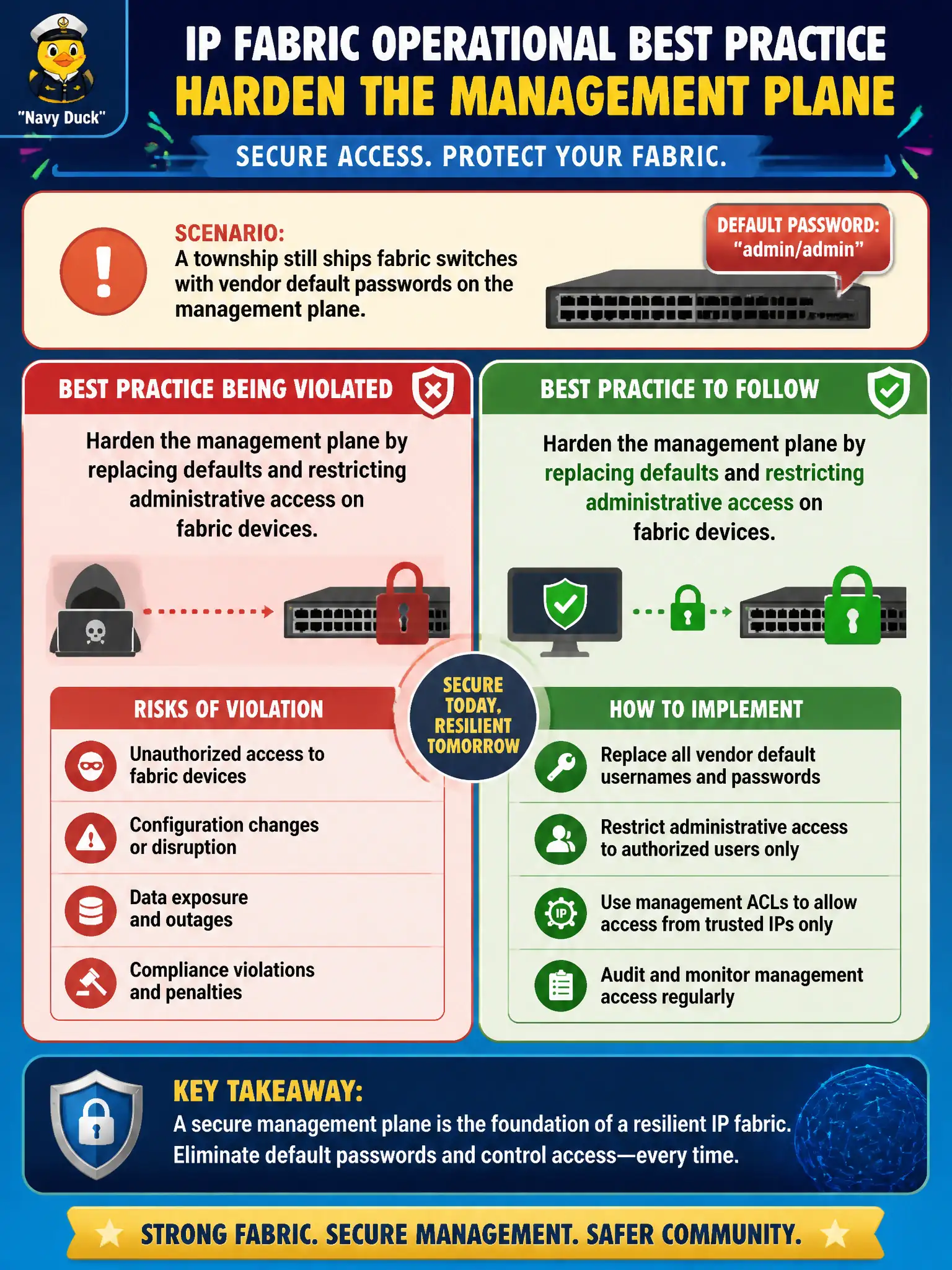
A township still ships fabric switches with vendor default passwords on the management plane. Which IP fabric operational best practice is being violated?
Select an answer to reveal the explanation.
Short Explanation
Leaving factory passwords on leaf and spine gear is like leaving the data-center badge printer on “guest.” Lock down the management plane—new credentials, tight access—before celebrating the Clos diagram.
Full Explanation
A township that still ships fabric switches with vendor default passwords on the management plane is violating IP fabric operational best practice: harden the management plane by replacing defaults and restricting administrative access on leaves and spines. Civic data-center fabrics concentrate routing, overlay, and automation trust; factory logins are an operational and security failure even if they seemed convenient during ZTP bring-up.
Default credentials do not remain acceptable “until the first major incident,” and they are not justified as a permanent ZTP speed optimization. Hardening is not limited to data-plane interfaces while management ports keep factory logins—attackers target management planes specifically. Management hardening is not spine-only because leaves supposedly never face operators; leaves are managed daily by the same NOC and automation toolchain.
Exam caveat: management-plane hygiene is fabric-wide; “leave defaults for speed” is the wrong professional tradeoff.
Operational check: verify unique credentials or AAA, disabled factory accounts, and restricted management ACLs or management-VRF filters on sample leaves and spines; attempt login with vendor defaults and confirm failure before calling the Clos production-ready.