
Spine TCAM utilization climbs as CRB host routes and IRB state concentrate centrally. What scale tradeoff does that illustrate versus ERB?
Select an answer to reveal the explanation.
Short Explanation
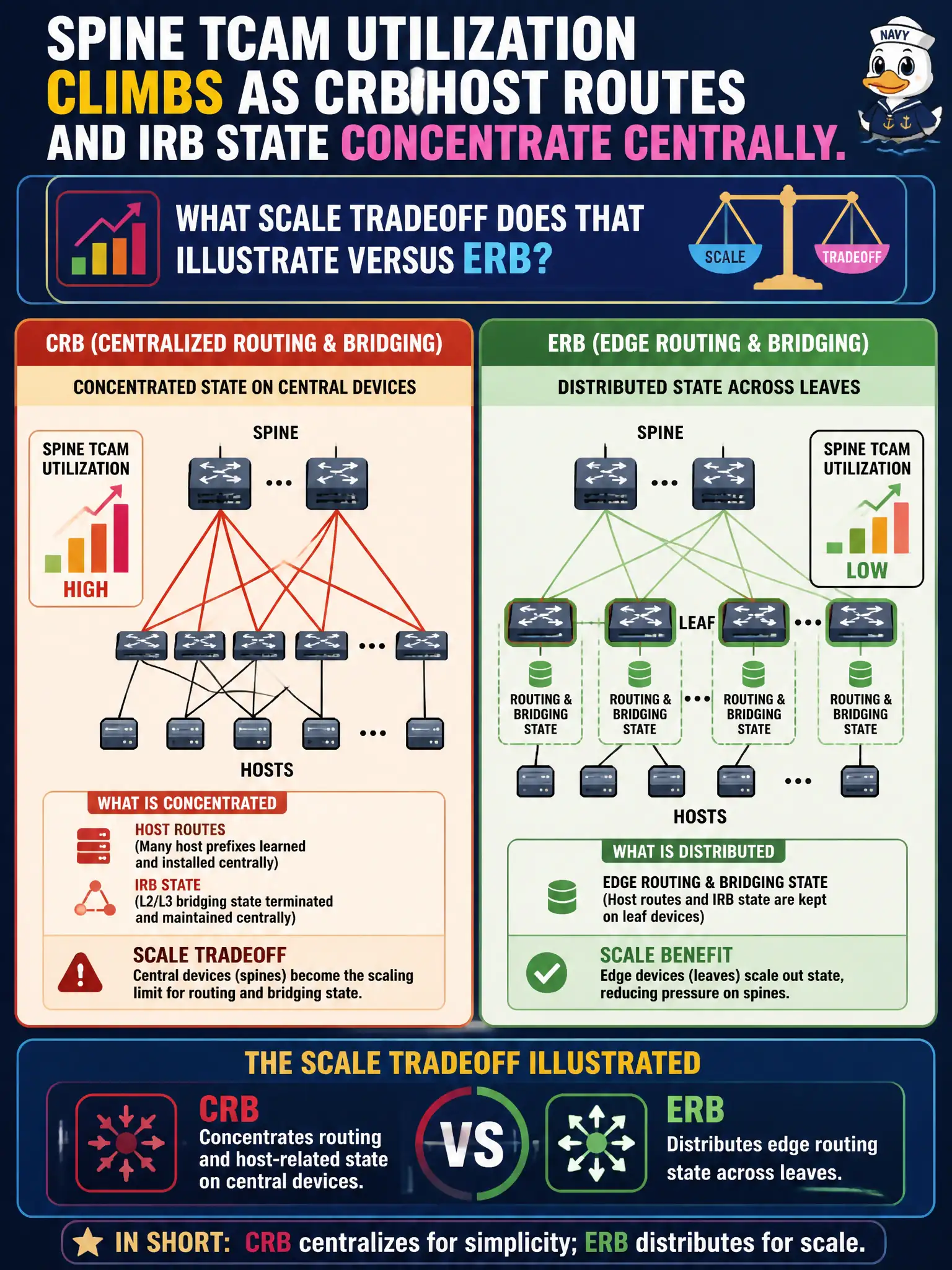
CRB piles the routing homework on the spines, so their TCAM can fill up with host and IRB state. ERB spreads that homework across the leaves instead. That is the scale tradeoff — not a reason to scrap VXLAN or park MACs in the IGP.
Full Explanation
When spine TCAM and host/IRB-related state climb in a CRB design, the scale tradeoff versus ERB becomes visible: CRB concentrates routing and host-related state on central devices, while ERB distributes edge routing state across leaves. That is the lesson when municipal CRB spines show rising utilization. ERB does not always use more spine TCAM than CRB for the same host count; typically CRB stresses spines more. CRB does not store all MAC learning only in the underlay IGP. TCAM pressure is not a signal to replace VXLAN with QinQ at the spines. Exam caveat: borders in ERB designs can still concentrate north-south state—distributed east-west does not remove all central capacity planning. Operational check: compare hardware or forwarding-table scale on CRB spines versus ERB leaves under the same municipal host count, identify which role hits limits first, and align architecture choice with that measurement. Graph spine versus leaf forwarding scale monthly so architecture debates use municipal telemetry rather than vendor slogans. Graph spine versus leaf forwarding scale monthly so architecture debates use municipal telemetry rather than vendor slogans. Graph spine versus leaf forwarding scale monthly so architecture debates use municipal telemetry rather than vendor slogans.