
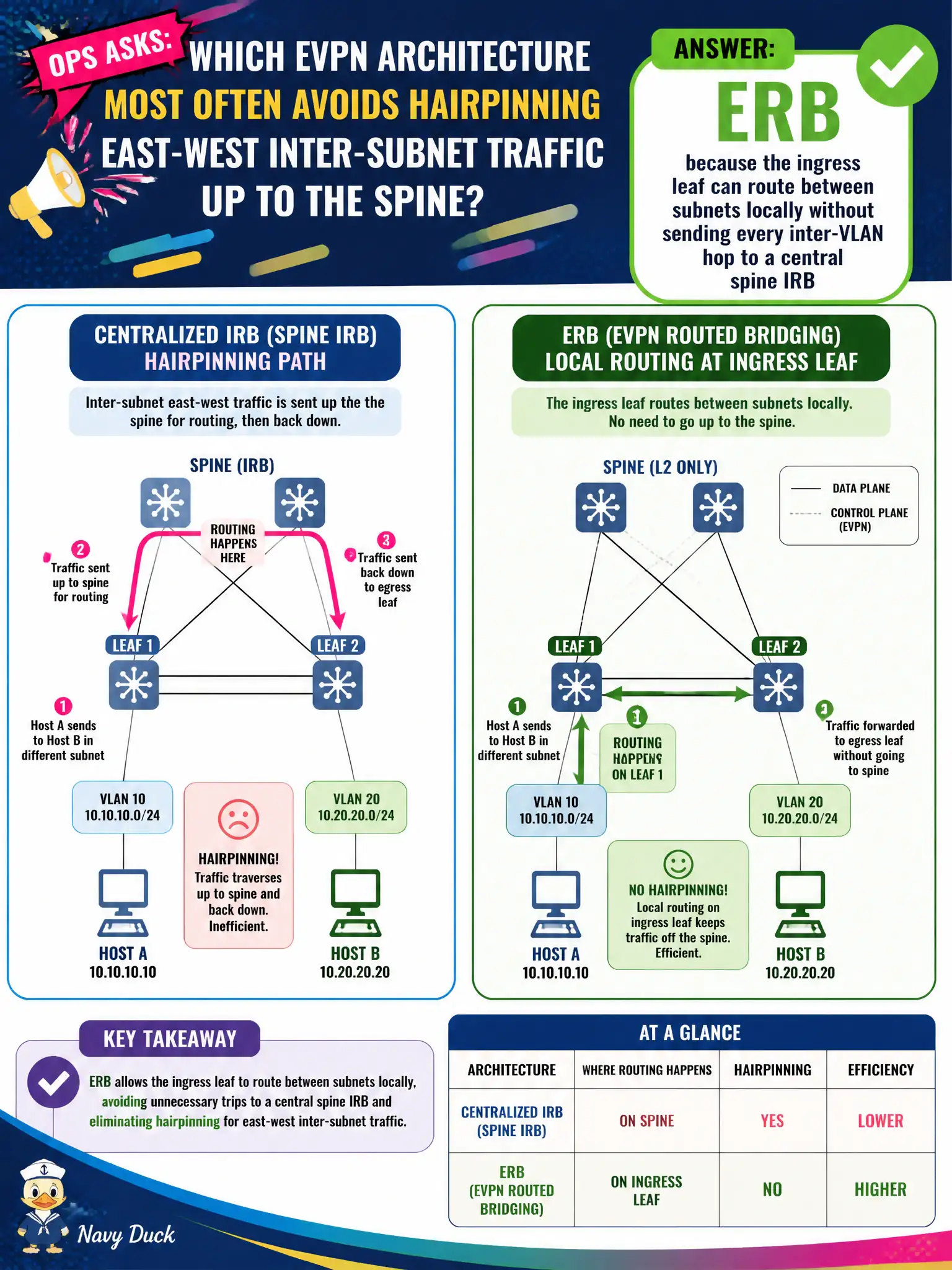
Ops asks which EVPN architecture most often avoids hairpinning east-west inter-subnet traffic up to the spine. What should the engineer answer?
Select an answer to reveal the explanation.
Short Explanation
Hairpinning is the long trip uptown just to turn around — CRB often does that for inter-subnet east-west. ERB lets the leaf route locally so hosts next door do not need the spine detour. Killing L3 VNIs or cloning VNIs does not fix the path.
Full Explanation
ERB avoids hairpinning east-west inter-subnet traffic up to a central spine IRB because the ingress leaf can route between subnets locally or via L3 VNI to the egress leaf using edge IRBs. That is the architecture ops should name when asking which design most often avoids spine hairpinning. CRB does the opposite: spines hold IRBs and often route inter-VLAN traffic centrally; CRB does not mean spines only bridge. Disabling all L3 VNIs so every subnet floods through the underlay IGP is not an EVPN answer. Using identical VNIs for every tenant does not make hairpinning irrelevant and breaks isolation. Exam caveat: even with ERB, north-south traffic and asymmetric paths can still involve borders; no hairpinning refers to typical east-west inter-subnet inside the fabric, not every flow in the city. Operational check: capture an east-west inter-subnet flow between two leaves, confirm the spine only sees VXLAN/underlay transit without tenant IRB decap, and compare against a CRB lab where the spine IRB appears in the traceroute. Use east-west traceroutes as acceptance tests when claiming ERB removed spine hairpinning for inter-subnet civic workloads. Use east-west traceroutes as acceptance tests when claiming ERB removed spine hairpinning for inter-subnet civic workloads.