
The city prefers anycast IRB default gateways on every leaf so spines mainly forward underlay transit. Which EVPN architecture matches that preference?
Select an answer to reveal the explanation.
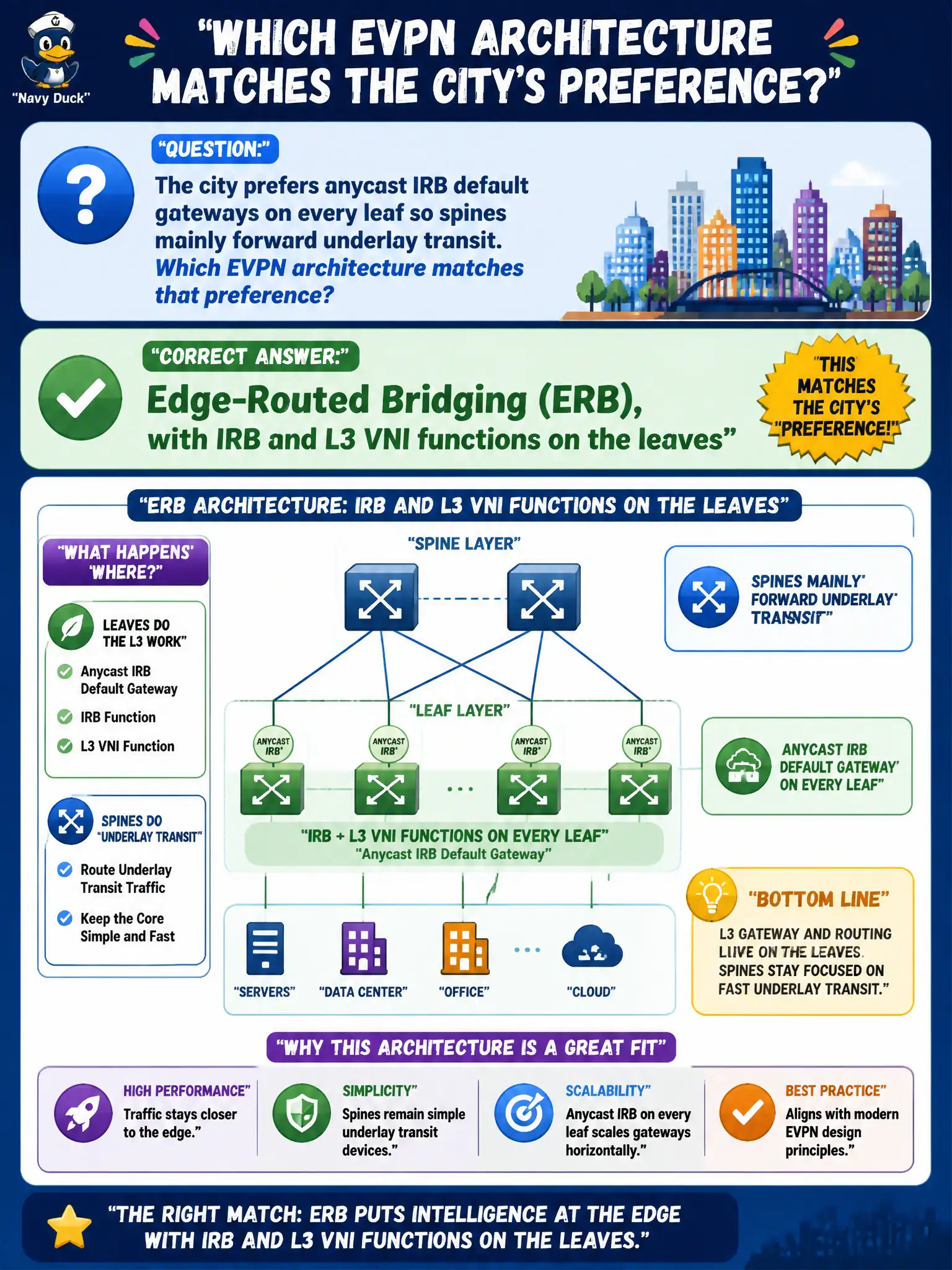
Short Explanation
ERB puts the front door (anycast gateway) right on each leaf so traffic can route at the edge. Spines stay mostly underlay transit. CRB would drag those gateways back to the spines.
Full Explanation
Edge-Routed Bridging (ERB) places IRB default gateways and L3 VNI functions on the leaves so routing happens at the fabric edge while spines mainly forward underlay transit. When the city prefers anycast IRB on every leaf, ERB is the matching architecture. Centrally-Routed Bridging keeps tenant IRBs on spines, the opposite placement. STP-rooted bridging without EVPN Type-2 is not an EVPN ERB design. MPLS L3VPN without VXLAN VNIs is a different VPN technology, not ERB EVPN-VXLAN. Exam caveat: ERB improves east-west paths and distributes state, but every leaf must be built and operated with consistent anycast gateway, L3 VNI, and VRF configuration—first-build complexity can be higher than CRB. Operational check: verify identical anycast IRB IP/MAC on municipal leaves for the tenant, confirm L3 VNI membership, traceroute east-west inter-subnet without forcing a spine IRB hop, and ensure spines lack those tenant IRBs if the design is pure ERB. Enforce anycast gateway MAC/IP identity checks in CI for ERB leaves before they attach production municipal VLANs. Enforce anycast gateway MAC/IP identity checks in CI for ERB leaves before they attach production municipal VLANs. Enforce anycast gateway MAC/IP identity checks in CI for ERB leaves before they attach production municipal VLANs.