
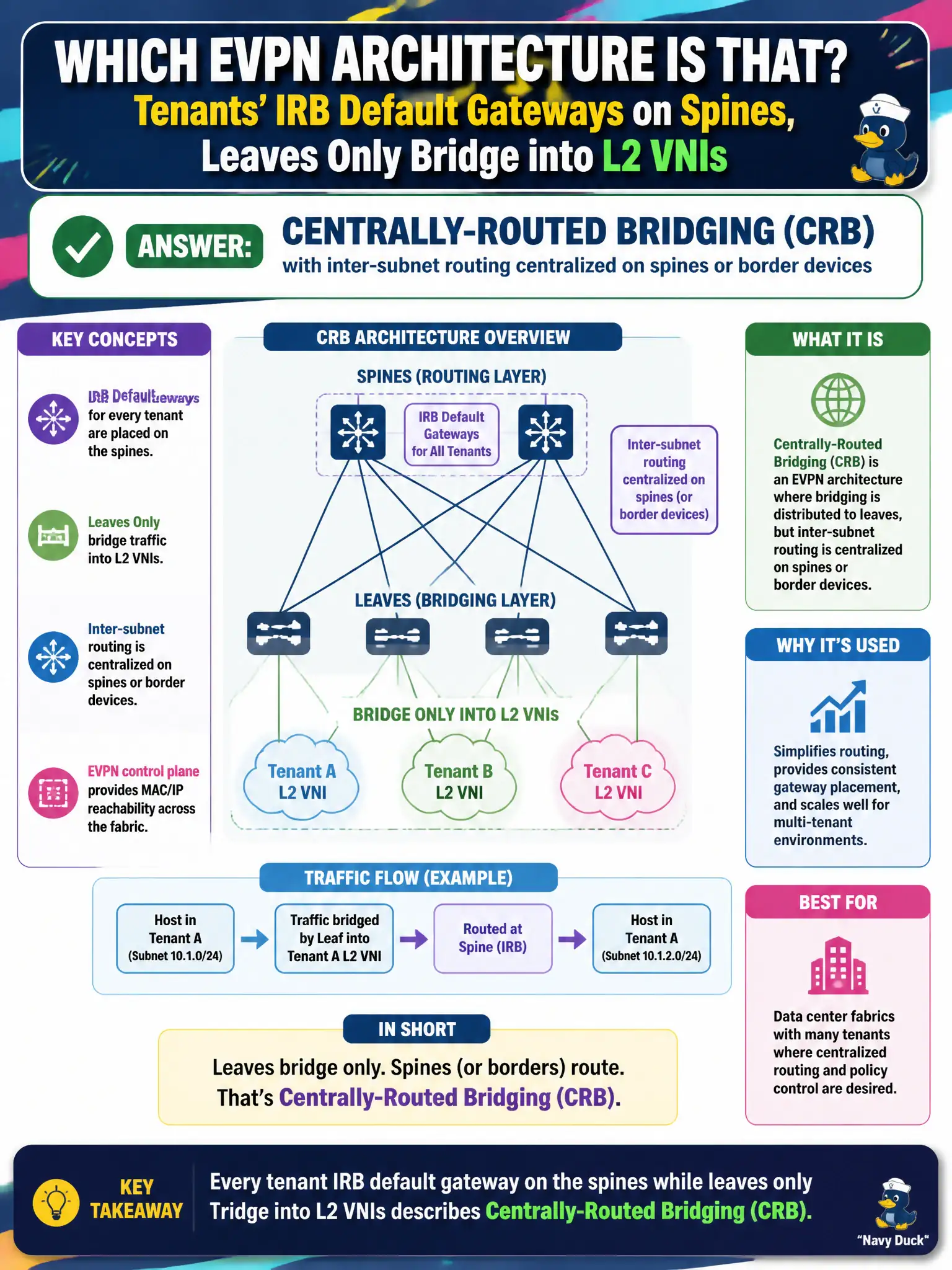
A municipal design places every tenant IRB default gateway on the spines while leaves only bridge into L2 VNIs. Which EVPN architecture is that?
Select an answer to reveal the explanation.
Short Explanation
CRB parks the default gateways downtown on the spines while leaves just bridge the neighborhood streets. Inter-subnet hops go to that central IRB. ERB would put those gateways out on the leaves instead.
Full Explanation
Centrally-Routed Bridging (CRB) places tenant IRB default gateways and inter-subnet routing on spines or border devices while leaves primarily bridge into L2 VNIs. When a municipal design puts every tenant IRB on the spines and leaves only bridge, that is CRB. It is not Edge-Routed Bridging, which puts anycast IRBs on leaves. It is not asymmetric IRB as a synonym for spines never terminate VXLAN; asymmetric versus symmetric refer to routing models for inter-subnet encapsulation, orthogonal to naming CRB versus ERB gateway placement. It is not a pure underlay Clos with no EVPN control plane. Exam caveat: CRB simplifies leaf feature load but hairpins east-west inter-subnet traffic through central IRBs and concentrates host/IRB state centrally—know that tradeoff versus ERB. Operational check: confirm IRB interfaces for the tenant VLAN exist on spines or borders only, that leaves bridge the L2 VNI without tenant IRB, traceroute inter-subnet east-west and observe the central hop, and verify EVPN Type-2 still advertises MACs from the leaves. Document which tenants are CRB in the city architecture register so leaf engineers do not add IRBs that fight the spine gateways. Document which tenants are CRB in the city architecture register so leaf engineers do not add IRBs that fight the spine gateways.