
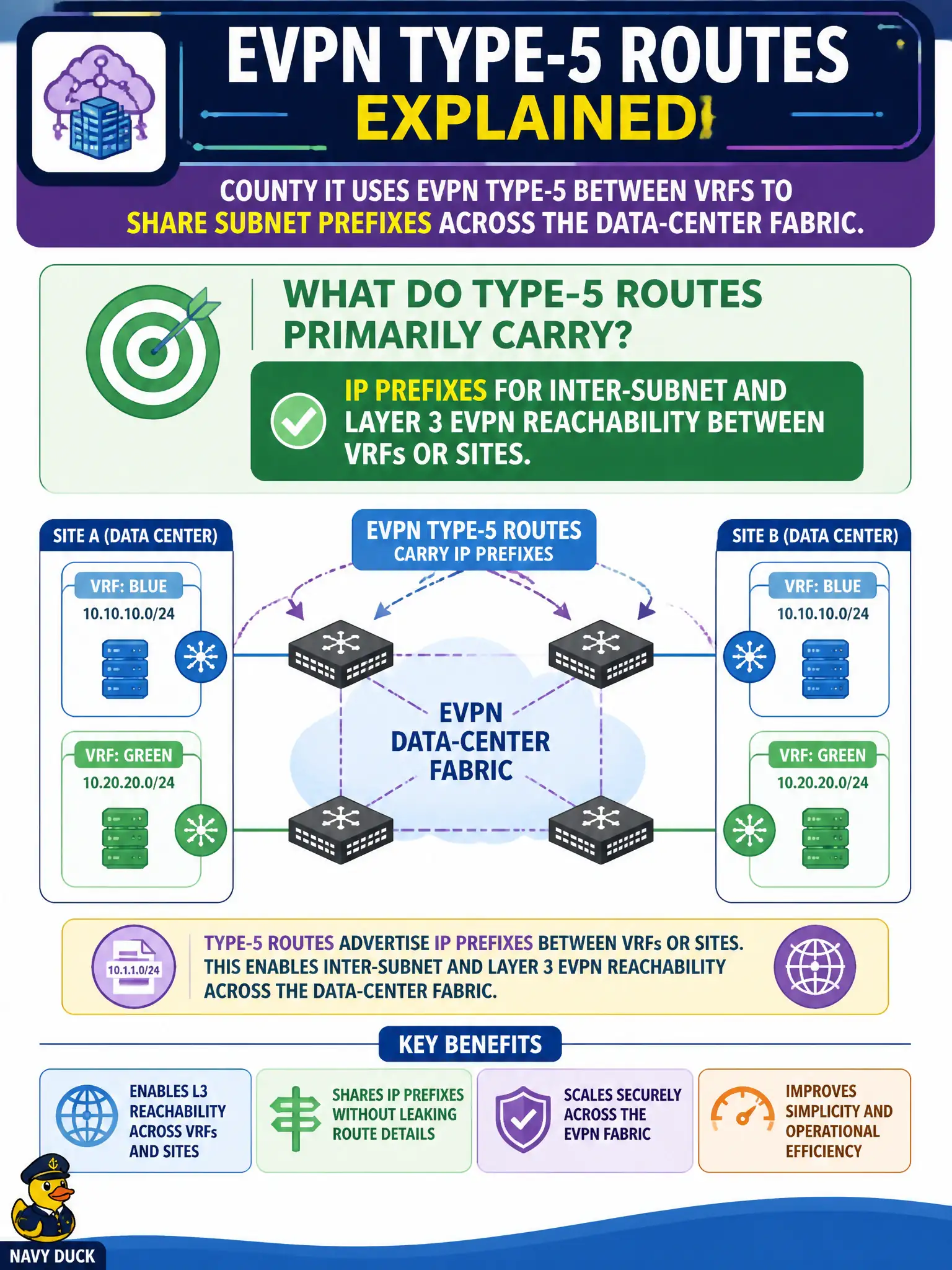
County IT uses EVPN Type-5 between VRFs to share subnet prefixes across the data-center fabric. What do Type-5 routes primarily carry?
Select an answer to reveal the explanation.
Short Explanation
Type-5 is the subnet highway sign, not the street-address plaque. When the county wants prefixes between VRFs, Type-5 carries those IP routes for L3 EVPN. MACs live in Type-2; ESI/DF is elsewhere; underlay loopbacks are fabric IP, not Type-5 tenant prefixes.
Full Explanation
EVPN Type-5 IP Prefix routes advertise IPv4 or IPv6 prefixes in the overlay so tenant VRFs can route between subnets, between VRFs, or across sites without relying on Type-2 host routes alone. County fabrics commonly use Type-5 when the design goal is Layer 3 EVPN reachability—subnet highways rather than stretching a single broadcast domain. That is why Type-5 primarily carries IP prefixes for inter-subnet and Layer 3 EVPN reachability between VRFs or sites. Pure Layer 2 stretch of MACs uses Type-2 (with Type-3 for BUM membership) rather than Type-5 alone; Type-5 is not a MAC-only L2 stretch vehicle. ESI values and Designated Forwarder election lean on Ethernet Segment and Auto-Discovery constructs (Type-4/Type-1), not on Type-5 prefix NLRI. Underlay loopback /32 or /128 reachability that lets VTEPs form the Clos is an IP-fabric underlay problem solved with IGP or BGP IPv4/IPv6 unicast—not by treating Type-5 as a replacement for underlay BGP. Exam caveat: Type-5 can coexist with Type-2 in IRB designs; seeing Type-5 does not imply L2 VNI stretch, and missing Type-5 when only host routes exist can still allow some L3 forwarding via MAC/IP Type-2 depending on the model—know which mechanism your municipal design actually relies on. Operational check: advertise a tenant subnet as Type-5 from a leaf or border, confirm remote VRFs import it with matching route targets, traceroute or ping across subnets without expecting a shared L2 flood domain, and verify the underlay still has separate loopback reachability for VXLAN outer headers.