
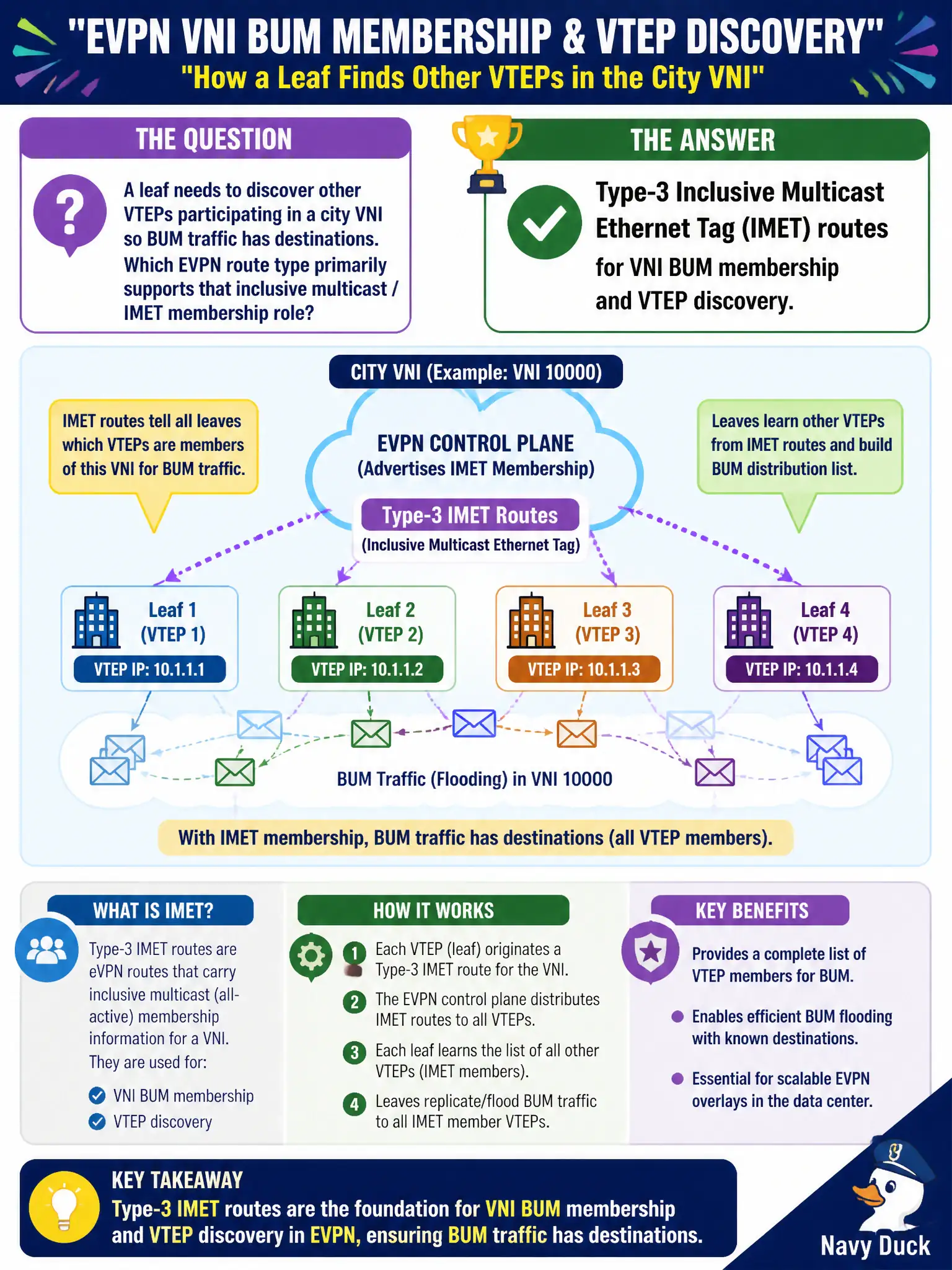
A leaf needs to discover other VTEPs participating in a city VNI so BUM traffic has destinations. Which EVPN route type primarily supports that inclusive multicast / IMET membership role?
Select an answer to reveal the explanation.
Short Explanation
When a leaf needs the guest list for a VNI's BUM party, Type-3 IMET is the RSVP. It says "I am in this VNI—send me floods." Type-5 is about prefixes, Type-2 about hosts, and Type-4 about the Ethernet segment—not the inclusive multicast roll call.
Full Explanation
Inclusive Multicast Ethernet Tag (IMET) Type-3 routes advertise that a VTEP participates in a given Ethernet tag/VNI so other VTEPs know where to send BUM for that overlay segment. In the city's EVPN-VXLAN fabric this is the usual control-plane mechanism behind inclusive BUM distribution, commonly implemented with ingress replication lists built from IMET membership. That is why Type-3 IMET routes for VNI BUM membership and VTEP discovery are the correct answer when a leaf must discover other VTEPs in a city VNI. Type-5 IP prefix routes carry tenant prefixes for Layer 3 EVPN and inter-subnet reachability; they do not replace IMET as the VNI BUM membership signal. Type-2 MAC(/IP) routes list hosts for unicast reachability and related L2/L3 host functions; listing every host does not by itself publish inclusive multicast membership for the VNI. Type-4 Ethernet Segment routes support multihomed ES discovery and DF-related context; they do not abolish the need for BUM signaling among VNI members. Exam caveat: platforms may also support selective multicast (SMET-style) interest signaling to shrink BUM fan-out, but that refinement still builds on EVPN multicast concepts rather than substituting Type-5 or Type-4 for IMET's membership role. Operational check: enable a tenant VNI on two municipal leaves, verify each advertises Type-3 IMET for that VNI, confirm remote leaves install the peer VTEPs in the BUM replication list, then generate unknown unicast or broadcast and confirm copies go only to IMET members—not to unrelated VNIs.