
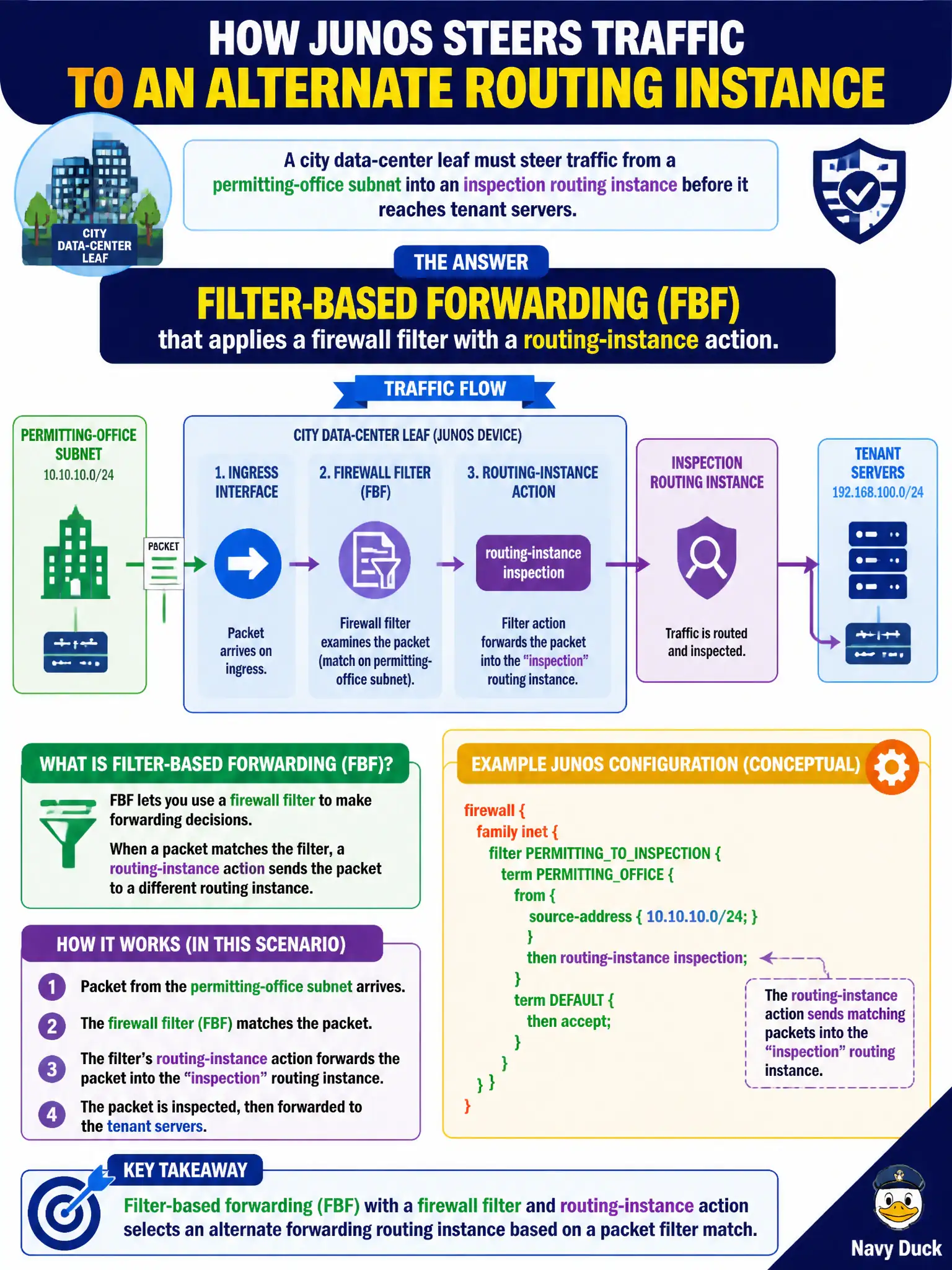
A city data-center leaf must steer traffic from a permitting-office subnet into an inspection routing instance before it reaches tenant servers. Which Junos mechanism selects an alternate forwarding routing instance based on a packet filter match?
Select an answer to reveal the explanation.
Short Explanation
Think of FBF like a traffic cop who reads a plate and sends that car down a side ramp to inspection—not into a ditch. The filter matches the city’s subnet and hands those packets to another routing instance. Drop filters only kill traffic; FBF steers it.
Full Explanation
When a city data-center leaf must steer traffic from a permitting-office subnet into an inspection routing instance before it reaches tenant servers, the Junos mechanism that selects an alternate forwarding routing instance based on a packet filter match is filter-based forwarding (FBF) that applies a firewall filter with a routing-instance action. FBF evaluates match conditions on the packet and, on hit, performs a lookup in the designated routing instance so the permitting flows take the inspection path while other civic traffic continues on the normal tenant path. A static discard term that blackholes the subnet at the IRB drops packets instead of redirecting them to inspection, so it fails the steering requirement. A pure MAC VRF Type-2 advertisement with no filter attachment only distributes Layer 2 reachability and does not classify or redirect selected IP flows into another instance. Underlay EBGP multipath alone without any filter or routing-instance action may share underlay links but does not implement policy-based instance selection for a permitting subnet. Exam caveat: FBF is the describe-level tool for filter-selected alternate forwarding contexts on Junos DC leaves; do not confuse it with simple discard or underlay ECMP. Operational check: attach an FBF filter that matches the permitting subnet, confirm filter hit counters increment, verify the routing-instance action, and traceroute or capture to prove those packets enter the inspection VRF while unmatched tenant traffic stays on the original instance.
Prefer to study offline? Printable PDF study book + test engine ($7.50, unofficial). These questions stay free here.