
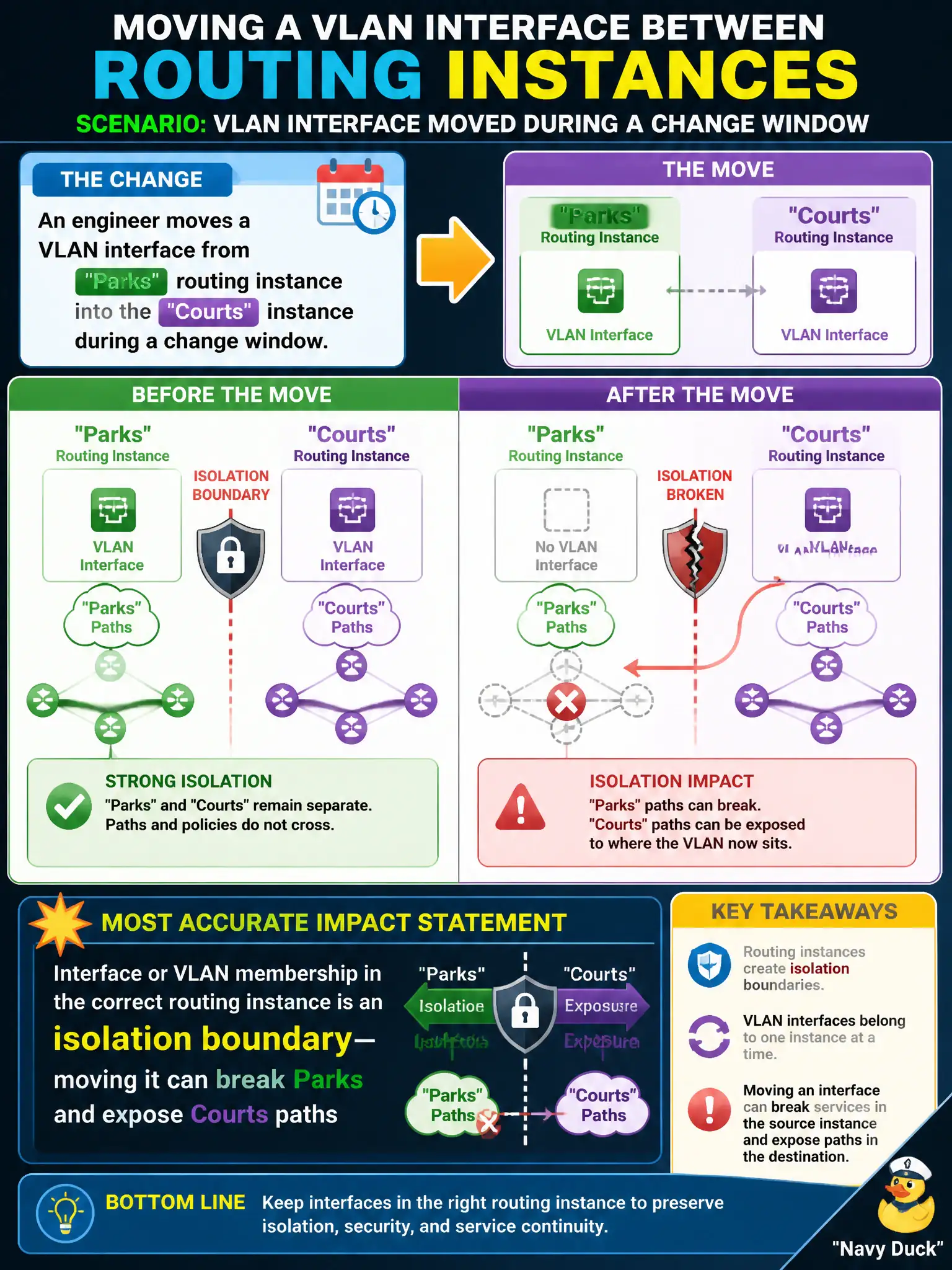
An engineer moves a VLAN interface from the Parks routing instance into the Courts instance during a change window. What is the most accurate impact statement?
Select an answer to reveal the explanation.
Short Explanation
Moving the VLAN interface is moving the front door to another agency's suite. Parks loses its gateway/attachment, and Courts may suddenly see traffic that never belonged there. Instance membership is the isolation boundary—treat it like production wiring, not a rename refactor.
Full Explanation
When an engineer moves a VLAN interface from the Parks routing instance into the Courts instance during a change window, the accurate impact is that interface or VLAN membership in the correct routing instance is an isolation boundary—moving it can break Parks reachability and expose unintended Courts paths. The L2 attachment carries traffic into whichever L3 and EVPN context owns it, so a mistaken re-home is a multitenancy incident rather than a cosmetic edit. It is false that only SNMP ifIndex values change while forwarding and isolation remain identical. The underlay VTEP loopback is not rewritten to the Courts ASN automatically merely because a VLAN moves between tenant instances. EVPN Type-1 routes are not deleted fabric-wide until a full reboot of all spines as a necessary consequence of that local move; the immediate harm is the mis-attached civic segment. Exam caveat: treat VLAN or IRB-to-instance membership like a hard agency boundary, equivalent to moving a cable between departments. Operational check: before any municipal VLAN re-home, validate the target routing instance and change ticket, perform the move in a controlled window, verify Parks connectivity and Courts isolation with ping and ARP tests, and roll back immediately if Parks endpoints appear in Courts EVPN tables.