
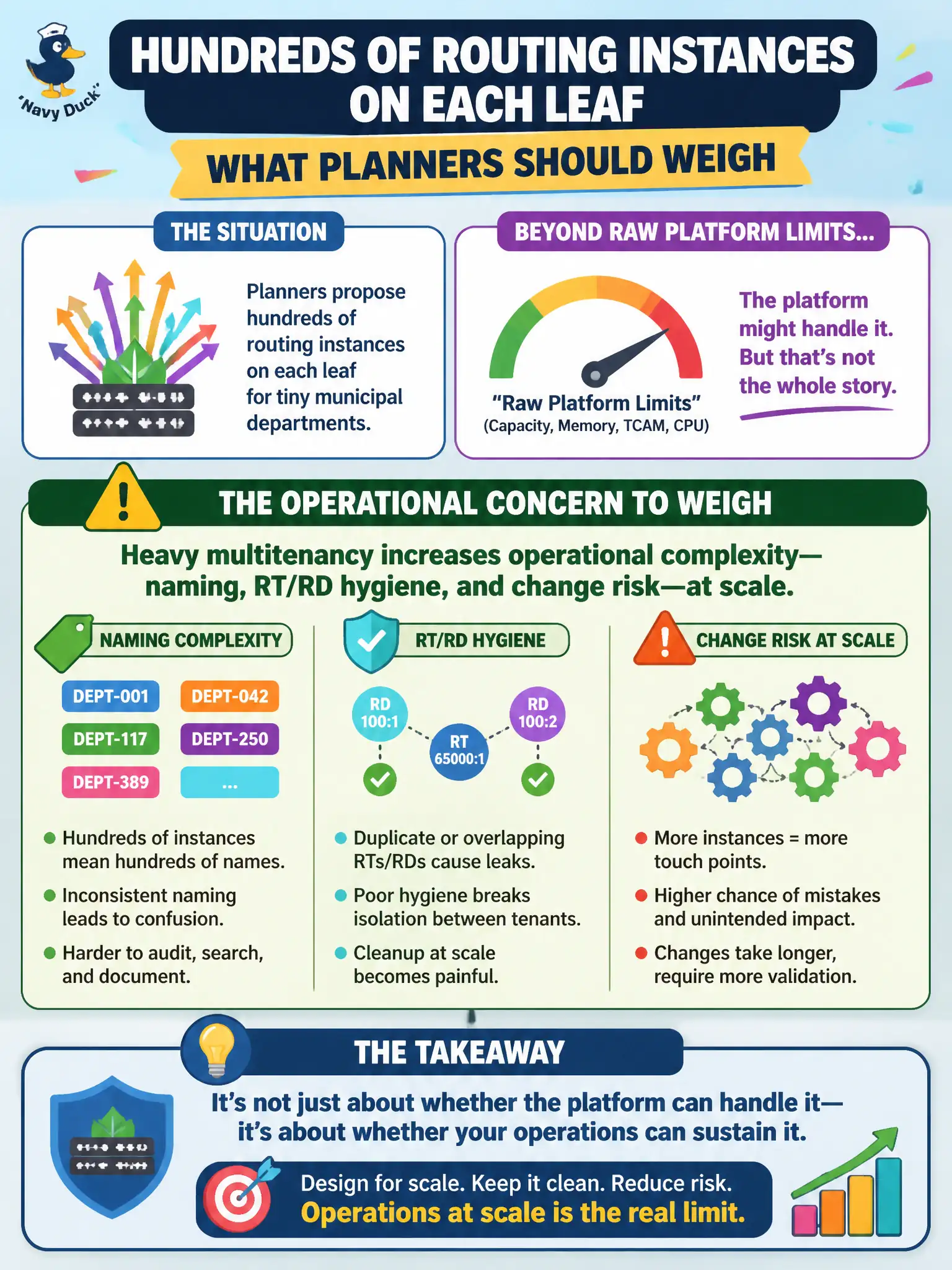
Planners propose hundreds of routing instances on each leaf for tiny municipal departments. Beyond raw platform limits, what operational concern should they weigh?
Select an answer to reveal the explanation.
Short Explanation
Hundreds of mini-VRFs sound tidy until change control becomes a spreadsheet museum. Scale limits matter, but so does ops gravity: more instances mean more RT/RD landmines. Sometimes fewer, well-chosen tenants beat a VRF per broom closet.
Full Explanation
When planners propose hundreds of routing instances on each leaf for tiny municipal departments, they should weigh—beyond raw platform limits—that heavy multitenancy increases operational complexity: naming, RT/RD hygiene, and change risk at scale. Each extra civic cabinet is another place to mis-attach an IRB or leak a route, which can outweigh the theoretical purity of one VRF per closet.
Each extra instance does not double the underlay OSPF hello interval automatically. Routing instances are not capped at four per chassis on any QFX ever shipped as a universal exam fact. EVPN does not stop functioning if more than eight instances exist on a leaf; the real issue is operability and scale discipline for the NOC.
Exam caveat: scale questions often want operational complexity answers, not invented hard-coded instance maxima.
Operational check: right-size tenants to real isolation boundaries, standardize naming/RT/RD templates, and review change procedures for instance attachment before proliferating micro-VRFs across the city fabric. Prefer consolidating tiny departments that share the same security policy into one tenant rather than one VRF per hallway closet. Retain before-and-after show commands in the change ticket so the municipal NOC can prove the isolation or steering outcome without relying on memory.