
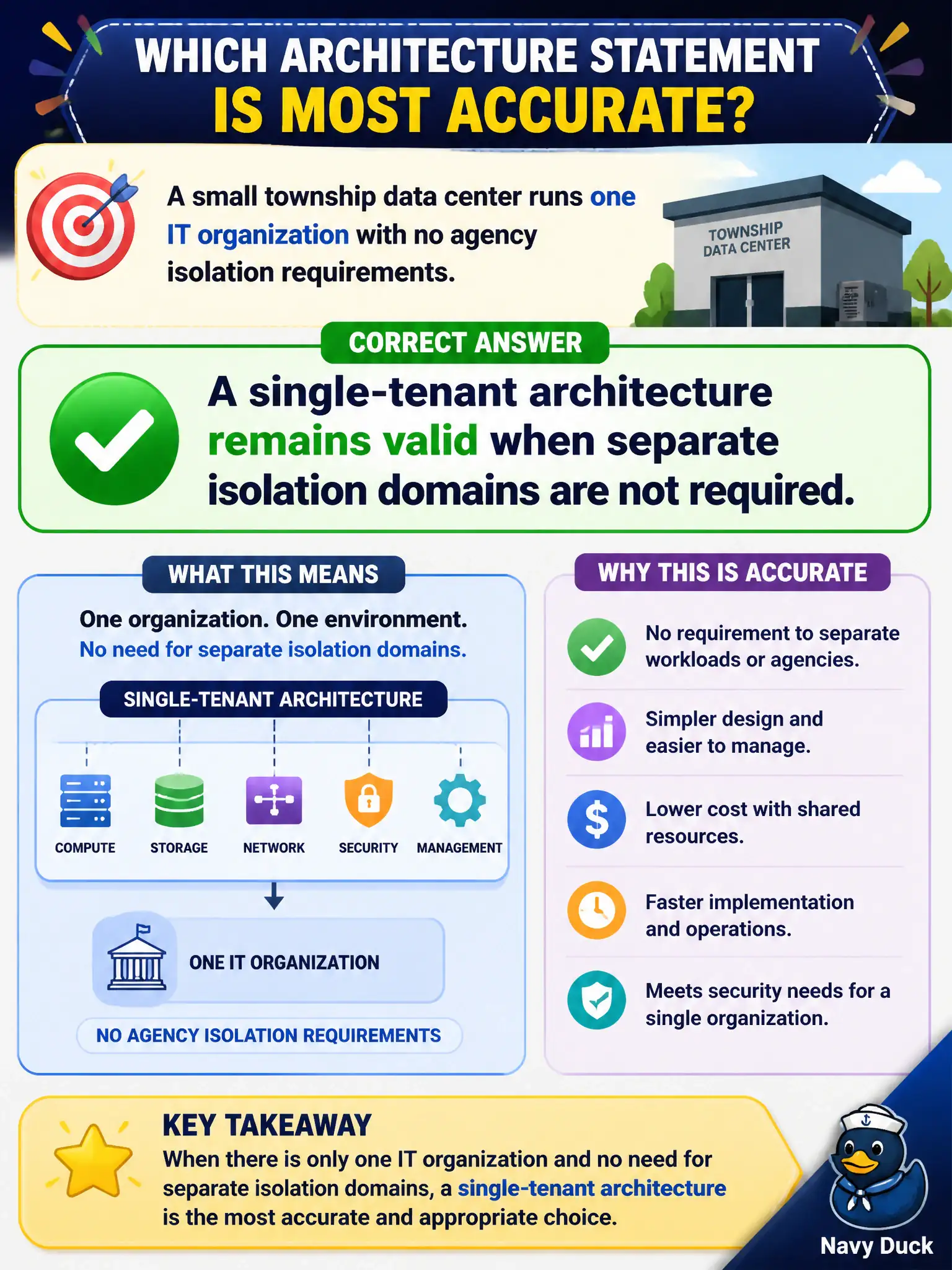
A small township data center runs one IT organization with no agency isolation requirements. Which architecture statement is most accurate?
Select an answer to reveal the explanation.
Short Explanation
Not every town hall needs a skyscraper of VRFs. If there is truly one isolation domain, a single-tenant fabric is honest engineering—not a failed multitenancy quiz. Add instances when policy demands them, not because a template guilt-trips you.
Full Explanation
A small township data center that runs one IT organization with no agency isolation requirements can correctly use a single-tenant architecture; that design remains valid when separate isolation domains are not required. JNCIP-DC does not mandate artificial multitenancy where policy does not need it, and a simple civic fabric can still run EVPN-VXLAN for one logical tenant.
JNCIP-DC fabrics are not invalid unless at least fifty routing instances exist. Every Junos QFX leaf need not define unused VRFs for future tenants. Single-tenant designs do not forbid EVPN or force only VLAN trunking—EVPN-VXLAN is still a valid fabric choice for one tenant.
Exam caveat: multitenancy is a requirement-driven design choice, not a vanity metric of instance count.
Operational check: document that only one forwarding context is intended, keep naming and RT/RD simple, and avoid creating empty VRFs that operators might accidentally attach later during rush changes. If a future agency arrives, introduce VRFs deliberately then—not by leaving half-configured placeholder instances in production now. Retain before-and-after show commands in the change ticket so the municipal NOC can prove the isolation or steering outcome without relying on memory.