
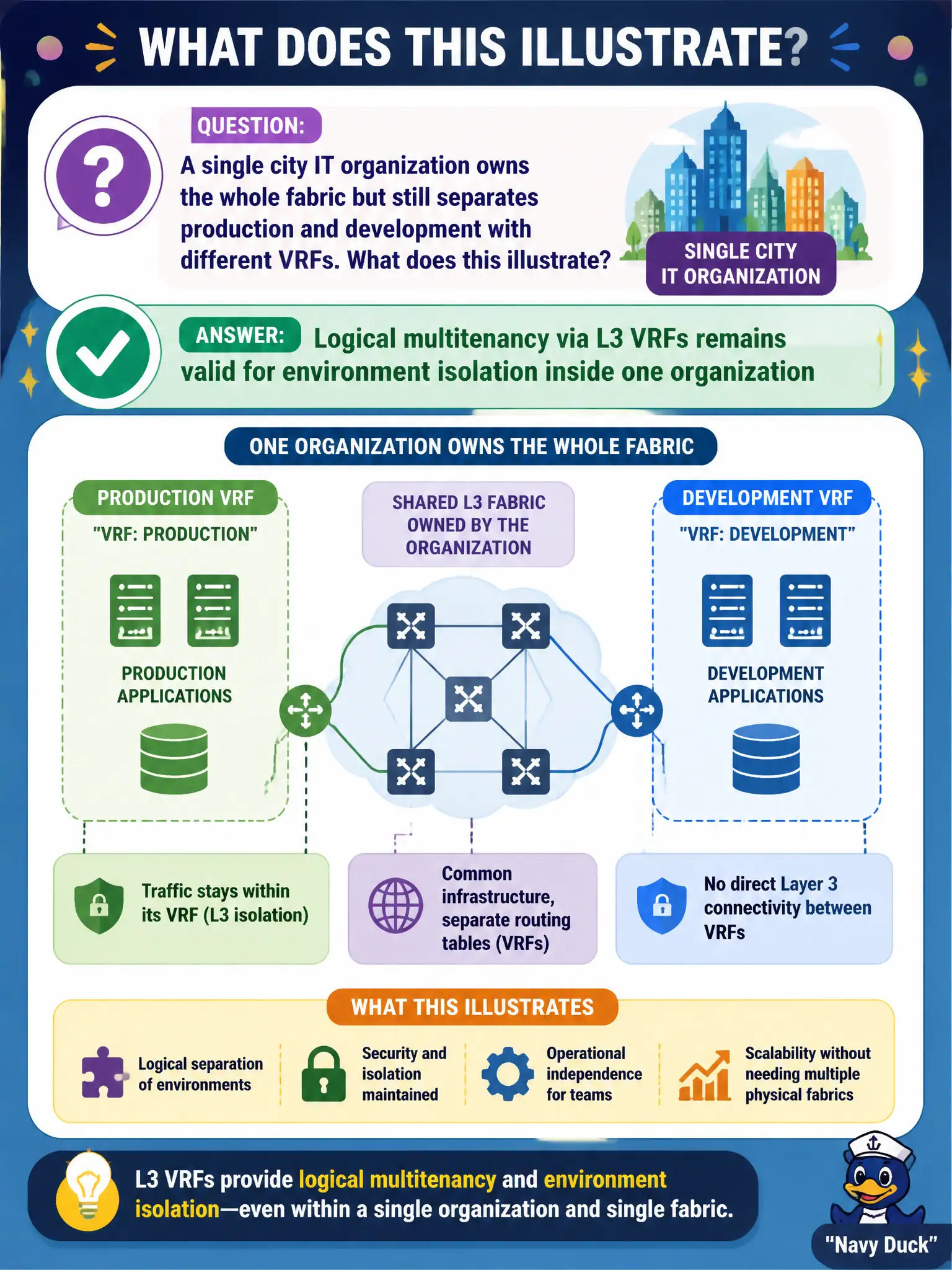
A single city IT organization owns the whole fabric but still separates production and development with different VRFs. What does this illustrate?
Select an answer to reveal the explanation.
Short Explanation
One landlord, two locked wings. Even when the city is the only tenant of record, prod and dev still deserve separate VRFs so a lab typo cannot route into payroll. Ownership and isolation domains are related but not identical ideas.
Full Explanation
A single city IT organization that still separates production and development with different VRFs illustrates that logical multitenancy via L3 VRFs remains valid for environment isolation inside one organization. Ownership of the fabric does not require every workload to share one routing table; prod and lab still need locked wings so a development typo cannot route into payroll systems.
VRFs are not illegal unless at least two legal entities sign the lease—legal tenancy and logical routing-instance tenancy are different ideas. Single-tenant ownership does not forbid routing-instance separation. Production and development must not be forced to share inet.0 merely to keep default routes “consistent”; consistency is achieved with deliberate policy, not by collapsing isolation.
Exam caveat: “one organization” stems still accept VRF-based environment isolation; do not require multiple companies for multitenancy to be valid.
Operational check: show distinct prod and dev routing instances, confirm no unintended route leaks, and prove a lab prefix does not install in the production VRF before change windows. Keep a simple matrix of which environments may leak routes, and re-validate after every routing-instance change window.