
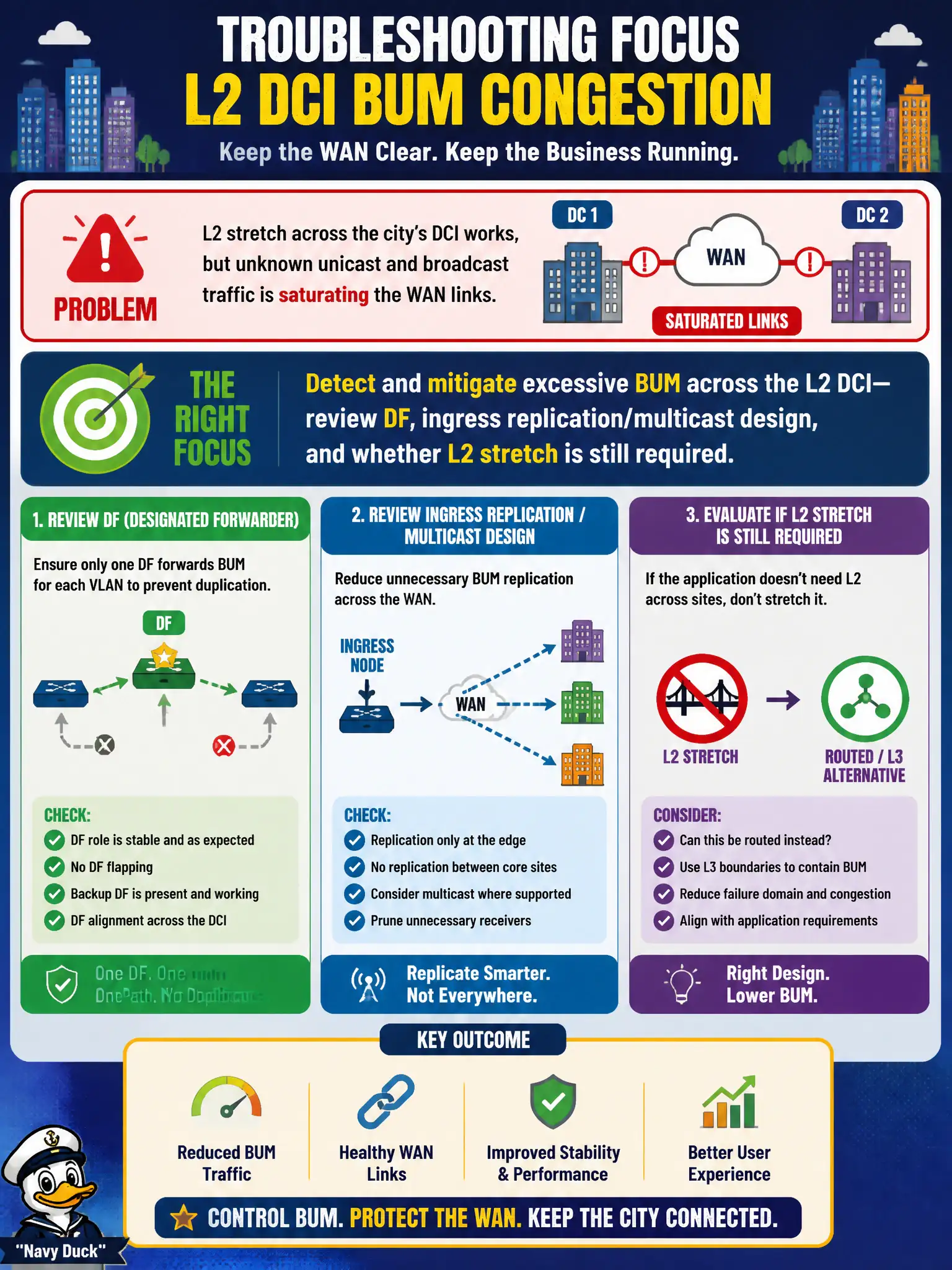
L2 stretch across the city’s DCI works, but unknown unicast and broadcast traffic is saturating the WAN links. What troubleshooting focus is appropriate?
Select an answer to reveal the explanation.
Short Explanation
L2 stretch turns the WAN into another flood domain for BUM if you are not careful—like leaving every firehose pointed at the metro pipe. Hunt DF behavior, replication design, and whether that segment truly needs L2 across sites. Sometimes Type-5 L3 DCI is the calmer fix.
Full Explanation
If L2 stretch across the city’s DCI works but unknown unicast and broadcast traffic saturates WAN links, troubleshooting should focus on detecting and mitigating excessive BUM across the L2 DCI—review DF behavior, ingress replication or multicast design, and whether L2 stretch is still required for the civic application. Stretched Ethernet domains replicate BUM toward remote sites; without disciplined designated forwarders and sensible replication, metro links fill with noise. Disabling all EVPN Type-5 routes because they are supposedly the sole source of BUM on L2 stretch misattributes L3 prefix routes as the BUM culprit and can break L3 interconnect while ignoring L2 flood paths. Increasing spanning-tree max-age citywide as the only supported BUM control for VXLAN DCI applies an STP knob to a problem usually governed by EVPN multi-homing and replication design. Shutting down every VTEP loopback so BUM cannot encapsulate toward the remote site is a destructive outage masquerading as mitigation. Exam caveat: WAN saturation under L2 DCI points to BUM/replication/DF and to questioning whether L2 stretch is justified versus Type-5 L3. Operational check: identify top talker BUM VNIs on the municipal borders, verify a single DF per Ethernet Segment, measure ingress-replication fan-out, and if the app allows, migrate the tenant to L3 DCI; document the decision and WAN utilization before/after.