
The municipal NOC’s DCI dashboard must prove the remote DC gateway is still exchanging EVPN with the local border. What should operators monitor first?
Select an answer to reveal the explanation.
Short Explanation
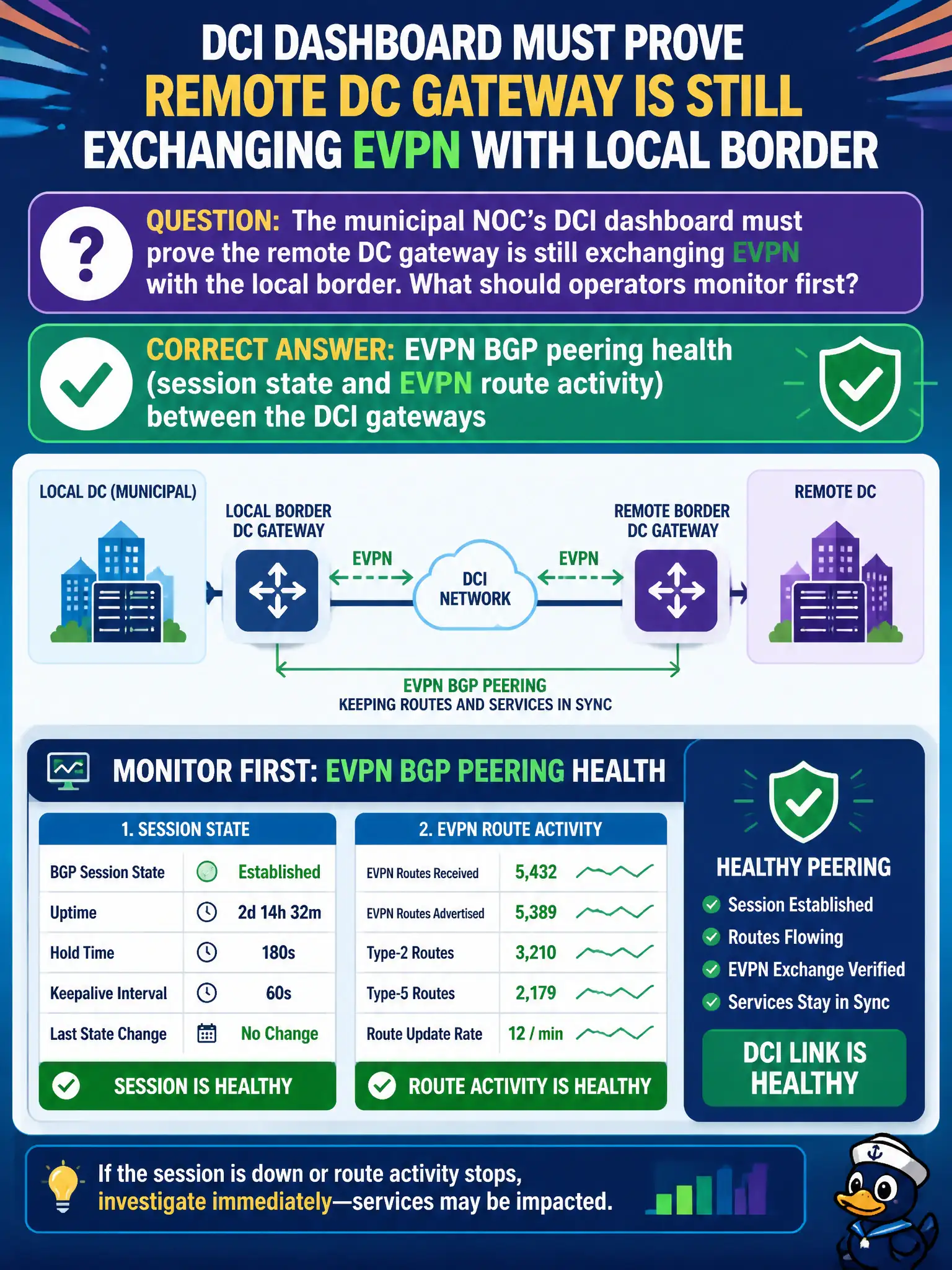
If the EVPN peer to the far gateway drops, the overlay phone line is dead even if the dark fiber still lights up. Watch BGP EVPN session state and route activity between DCI borders first. Optics matter too—but they are not the overlay control-plane check.
Full Explanation
For a municipal NOC DCI dashboard that must prove the remote DC gateway is still exchanging EVPN with the local border, operators should monitor EVPN BGP peering health first—session state and EVPN route activity between the DCI gateways. Session drops, flaps, or stalled Type-2/Type-5 counters are the earliest reliable signal that multi-site overlay signaling has failed for city services even when dark fiber still lights. Monitoring only optical receive power on dark fiber, with no BGP state collection, can show a lit path while EVPN is down, filtered, or stuck in Idle/Active and remote MAC/IP learning has already frozen. Watching only the number of VLANs configured on unused access ports is unrelated to interconnect control-plane health and distracts on-call staff with access inventory noise. Tracking only DHCP pool utilization on the ZTP management network measures provisioning capacity for new leafs, not whether DCI EVPN exchange is alive between production borders. Exam caveat: interconnect liveness for EVPN-VXLAN DCI starts with EVPN BGP health and route activity; add optical and underlay metrics as supporting telemetry, not as the primary proof of overlay signaling. Operational check: alert on EVPN neighbor state changes and sudden route-count collapses on municipal stitch borders, correlate with underlay VTEP reachability, and rehearse dashboard drill-down during the monthly NOC failover exercise so responders open BGP state before chasing optics alone.