
During a civic DCI design review, engineers debate “seamless stitch” versus re-encapsulation between overlay domains. What is the sound high-level takeaway for JNCIP-DC?
Select an answer to reveal the explanation.
Short Explanation
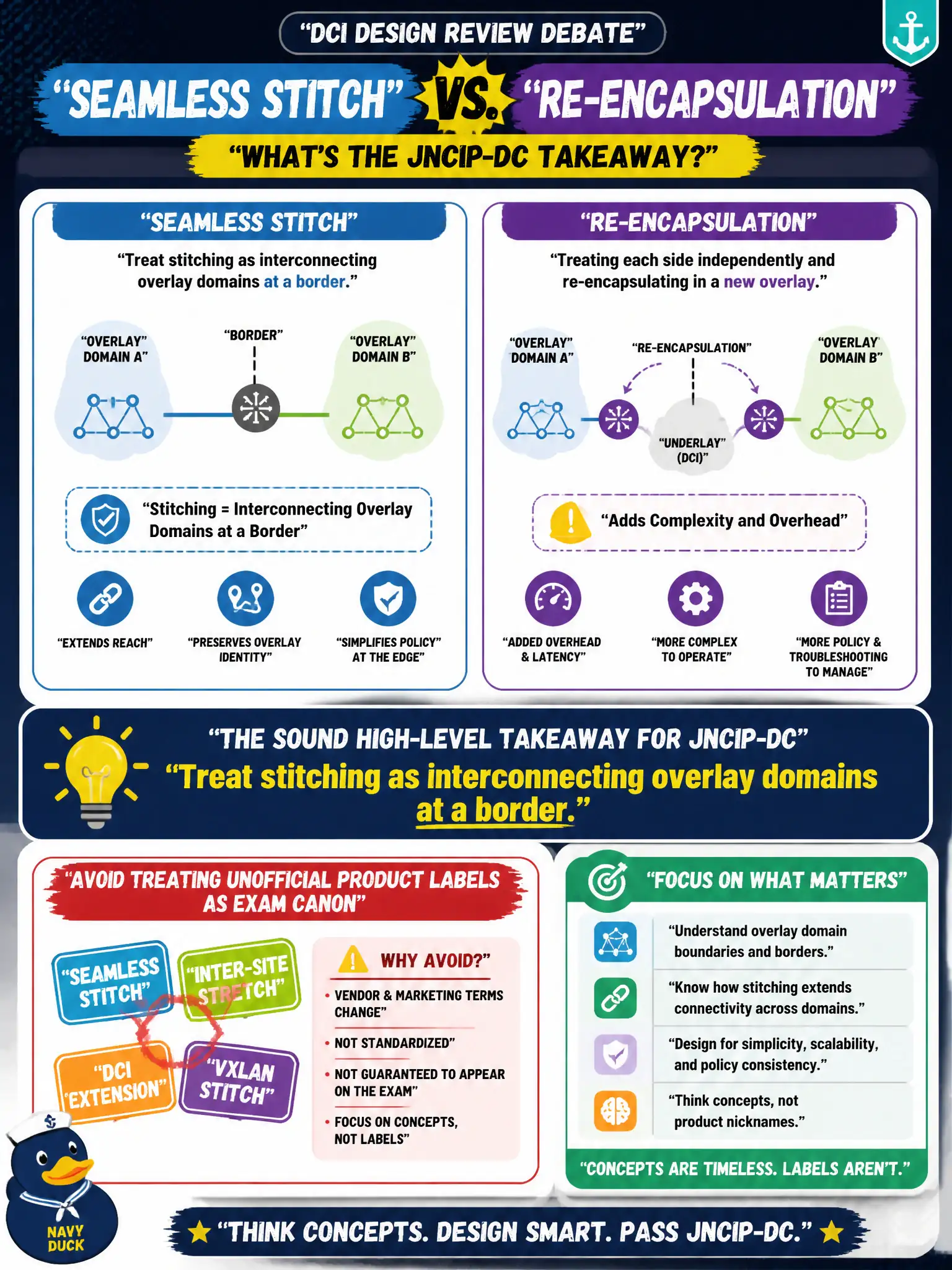
Stitching is the border’s job of joining two overlay neighborhoods—sometimes with a clean handoff, sometimes with a re-wrap of the packet. Learn the concept, not a marketing nickname parade. Keep the focus on interconnecting domains the right way.
Full Explanation
During a civic DCI design review, the sound JNCIP-DC takeaway is to treat stitching as interconnecting overlay domains at a border and to avoid treating unofficial product labels as exam canon. Whether marketing language says “seamless” or operators discuss re-encapsulation, the exam-relevant idea is joining EVPN-VXLAN domains so tenant intent continues across municipal sites with a controlled border function. Insisting that only proprietary product codenames define stitching, or that Juniper blueprints never describe interconnecting overlays, invents a branding gate that is not how blueprint objectives are tested. Claiming seamless stitch always means stretching native VLANs end-to-end with no EVPN involvement collapses modern DCI back into metro VLAN extension and ignores EVPN signaling. Declaring re-encapsulation illegal in EVPN-VXLAN DCI and forbidden in any design discussion is false; borders may translate or re-encapsulate between domains depending on VNI and policy design. Exam caveat: learn the interconnect concept—overlay domain join at a border—not vendor buzzword checklists. Operational check: in the municipal design packet, define which VNIs/VRFs are stitched, whether VNI translation occurs, and which EVPN route types cross the DCI; validate with route tables and a data-plane test rather than arguing product nicknames in the review meeting.