
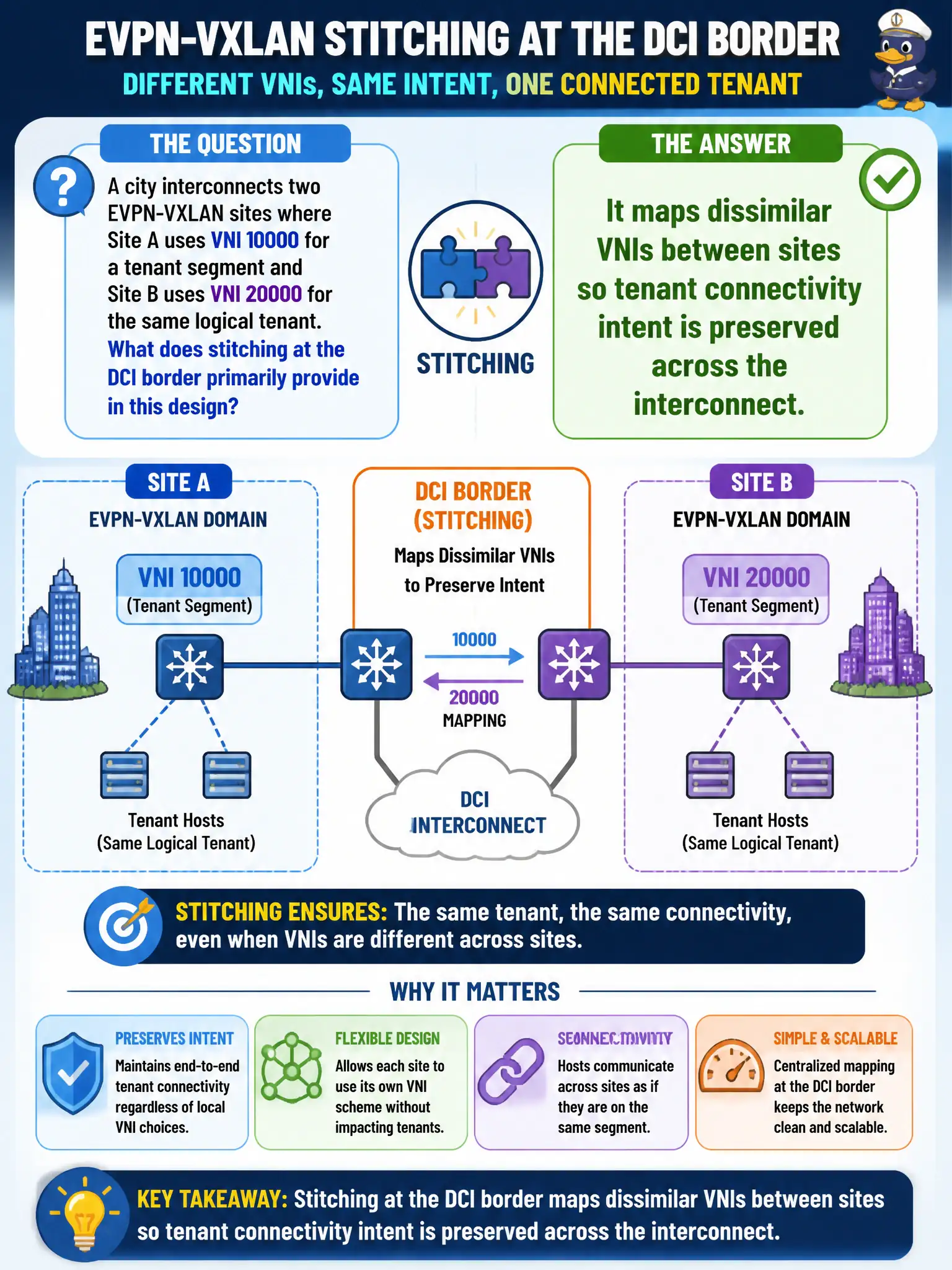
A city interconnects two EVPN-VXLAN sites where Site A uses VNI 10000 for a tenant segment and Site B uses VNI 20000 for the same logical tenant. What does stitching at the DCI border primarily provide in this design?
Select an answer to reveal the explanation.
Short Explanation
Think of two city buildings that numbered the same department differently—stitching is the bilingual receptionist at the border. The DCI gateway translates VNI 10000 to VNI 20000 so the tenant still talks without forcing a citywide renumber. Overlay identity can differ per site while the business segment stays connected.
Full Explanation
In a municipal EVPN-VXLAN DCI, stitching at the border primarily maps dissimilar VNIs so the same logical tenant remains connected when Site A uses VNI 10000 and Site B uses VNI 20000. The stitch gateway translates overlay membership and continues MAC/IP reachability without forcing identical VNI namespaces in every civic building. Replacing both VNIs with one fabric-wide VLAN ID that every leaf must share underlay-wide collapses the overlay model into a brittle global VLAN dependency and is not what VNI stitching is for. Forcing Site B to renumber every local VNI before any traffic flows is an unnecessary citywide renumber project; stitching exists so local numbering can differ while business segments still interconnect. Disabling VXLAN and forwarding the tenant as native Ethernet across the WAN abandons the overlay data plane that EVPN-VXLAN DCI is built on and expands the Layer-2 blast radius onto the metro path. Exam caveat: stitching preserves tenant intent across sites—it is VNI/domain translation at the border, not a mandate for identical VNIs or native WAN Ethernet. Operational check: on both stitch borders, confirm the tenant maps between local and remote VNIs, verify EVPN Type-2/Type-5 routes install for the intended membership, and send a controlled ping between endpoints in each site while capturing that VXLAN still encapsulates across the interconnect. Record the VNI map in the municipal runbook so future on-call staff know which civic departments share which translated overlays.