
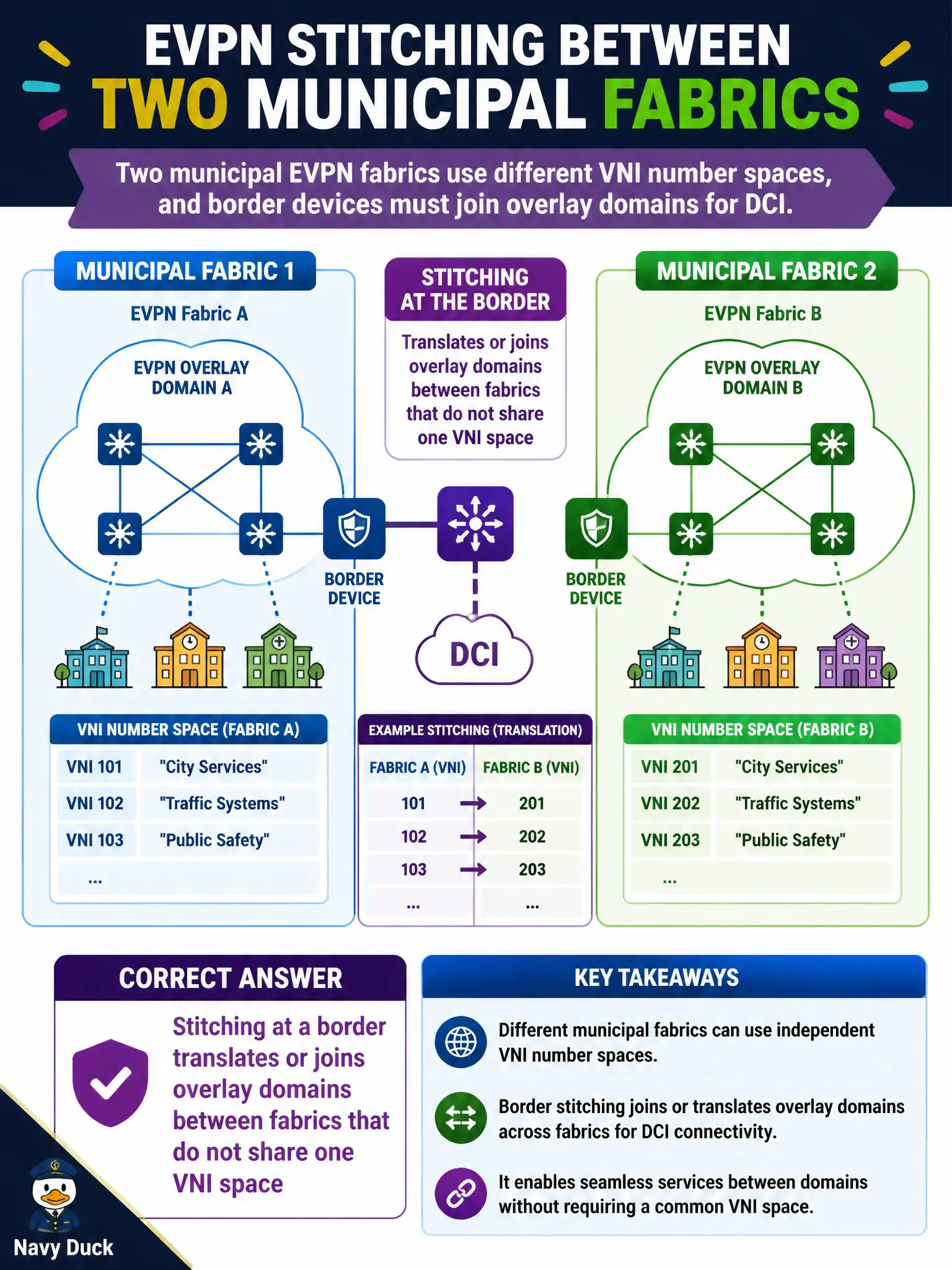
Two municipal EVPN fabrics use different VNI number spaces, and border devices must join overlay domains for DCI. Which stitching concept applies?
Select an answer to reveal the explanation.
Short Explanation
Different VNI spaces are like different room-numbering schemes in two buildings. Stitching at the border is how you join those overlay domains without pretending they were always one fabric.
Full Explanation
When two municipal EVPN fabrics use different VNI number spaces, border stitching translates or joins overlay domains so DCI can form without forcing a single global VNI plan inside each fabric. Stitching at the border is the concept that reconciles distinct overlay namespaces. Both fabrics need not renumber every VNI to a global underlay VLAN before DCI forms. Stitching does not mean advertising underlay IGP routes as EVPN Type-2 MAC entries only. Different VNI spaces do not make DCI impossible until both sites become one leaf-spine fabric. Exam caveat: stitching points become critical failure and policy enforcement points—RT translation mistakes can leak tenants between cities. Operational check: define VNI/RT mapping on border stitch devices, verify tenant A in fabric 1 reaches tenant A in fabric 2 without leaking to tenant B, and document the mapping table in the DCI runbook. Version-control VNI/RT stitch maps at the border and test tenant non-leakage after every mapping change between fabrics. Version-control VNI/RT stitch maps at the border and test tenant non-leakage after every mapping change between fabrics. Version-control VNI/RT stitch maps at the border and test tenant non-leakage after every mapping change between fabrics.