
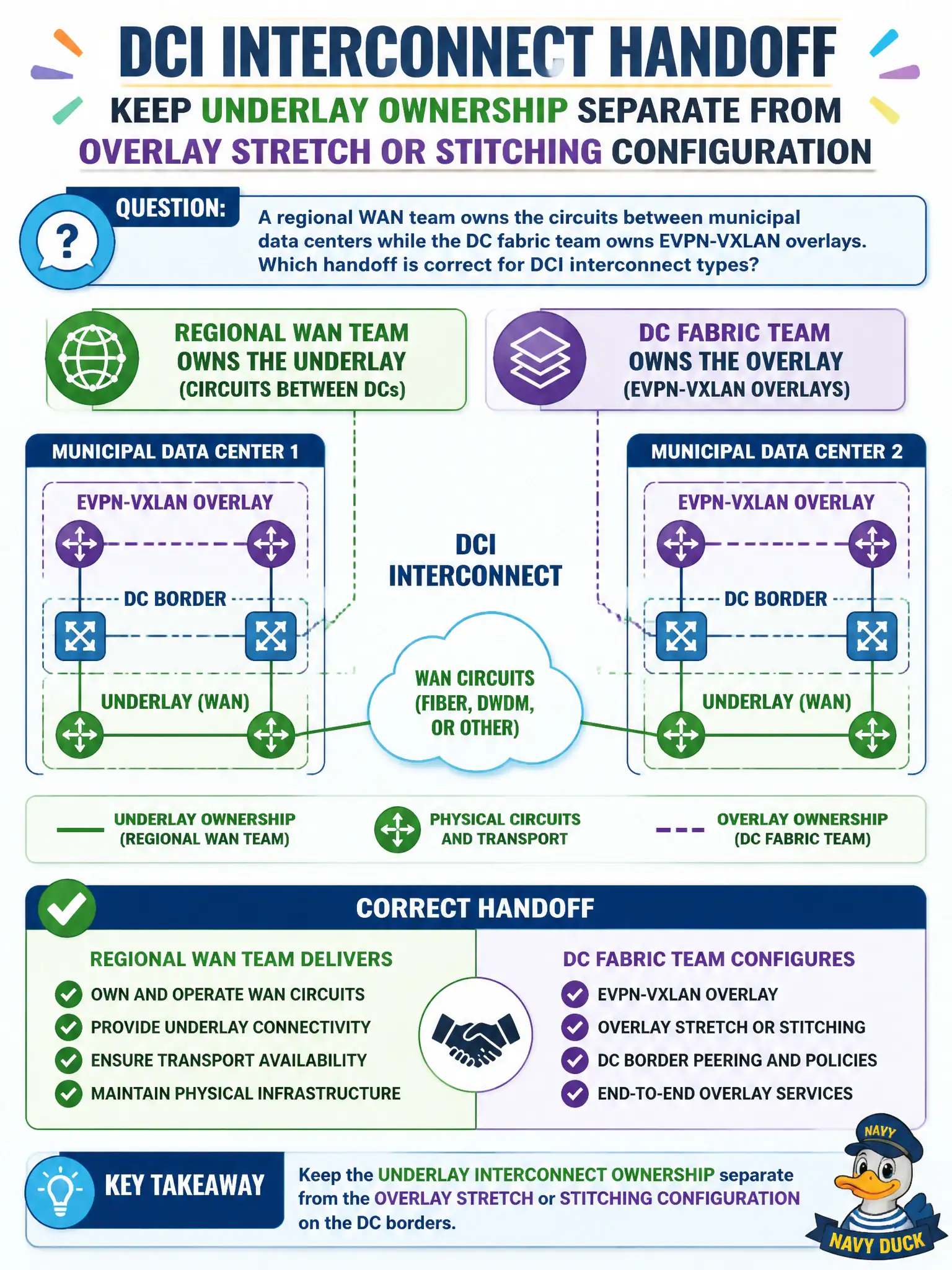
A regional WAN team owns the circuits between municipal data centers while the DC fabric team owns EVPN-VXLAN overlays. Which handoff is correct for DCI interconnect types?
Select an answer to reveal the explanation.
Short Explanation
WAN owns the roads; DC fabric owns the overlay neighborhoods. Keep underlay interconnect operations separate from stretch and stitching on the borders so each team configures what it actually controls.
Full Explanation
When a regional WAN team owns circuits between municipal data centers and the DC fabric team owns EVPN-VXLAN overlays, the correct handoff keeps underlay interconnect ownership separate from overlay stretch or stitching configuration on the DC borders. WAN engineers deliver IP, optical, or MPLS reachability and SLA; DC engineers configure EVPN tenants, RTs, and stretch mode on borders. The WAN team must not be forced to configure every tenant VNI and MAC VRF on PE routers unless that is an explicit managed service. Overlay ownership does not require the DC team to renumber every WAN IGP area into the fabric ASN. Interconnect type selection is part of JNCIP-DC DCI concepts, not only a Design-track paper exercise. Exam caveat: clear responsibility matrices prevent change collisions—WAN MTU changes without DC notice break VXLAN DCI even when both teams did their job. Operational check: document who owns underlay MTU/routing versus overlay EVPN on the city DCI; run a joint failure test; ensure each team monitors its layer with a single shared runbook entry point. Maintain a RACI for WAN underlay versus DC overlay on every municipal DCI circuit, including who approves MTU changes. Maintain a RACI for WAN underlay versus DC overlay on every municipal DCI circuit, including who approves MTU changes.