
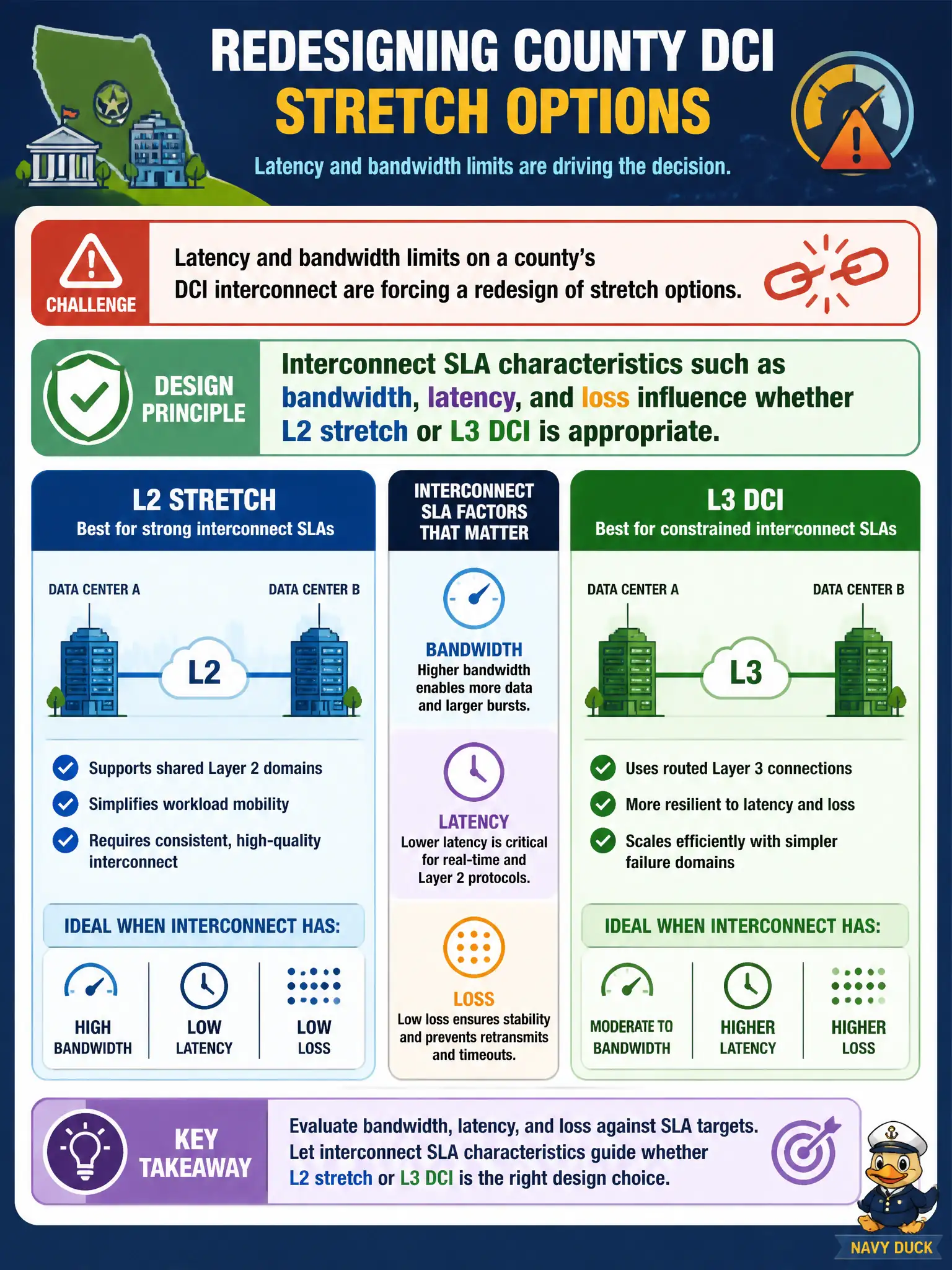
Latency and bandwidth limits on a county's DCI interconnect are forcing a redesign of stretch options. Which design principle applies?
Select an answer to reveal the explanation.
Short Explanation
The interconnect's speed, delay, and loss are the weather forecast for stretch choices. Bad SLA often pushes you toward L3 DCI; silky dark fiber can make careful L2 stretch more realistic.
Full Explanation
Interconnect SLA characteristics—bandwidth, latency, and loss—directly influence whether Layer-2 stretch or Layer-3 DCI is appropriate for a county redesign. High latency and limited bandwidth often argue against stretching chatty L2 domains across the WAN, while L3 DCI tolerates WAN realities better for many applications. SLA metrics do affect DCI model choice even when EVPN is enabled. High latency does not always require stretching every VNI at Layer 2. Lossy links do not force all tenants into a single shared underlay ASN across cities. Exam caveat: a low-latency dark fiber might make selective L2 stretch acceptable for mobility apps while other tenants stay L3—decide per tenant against measured SLA, not globally from a slogan. Operational check: measure latency, loss, and throughput on the county DCI path, map each application to L2 or L3 stretch needs, reject L2 stretch where SLA cannot absorb BUM and chatter, and retest after QoS/MTU tuning. Tie stretch-mode approvals to measured DCI SLA tickets so latency and loss drive L2-versus-L3 decisions for county apps. Tie stretch-mode approvals to measured DCI SLA tickets so latency and loss drive L2-versus-L3 decisions for county apps.