
After a change window, a city engineer verifies EVPN overlay health. Beyond interface counters, what should that verification emphasize?
Select an answer to reveal the explanation.
Short Explanation
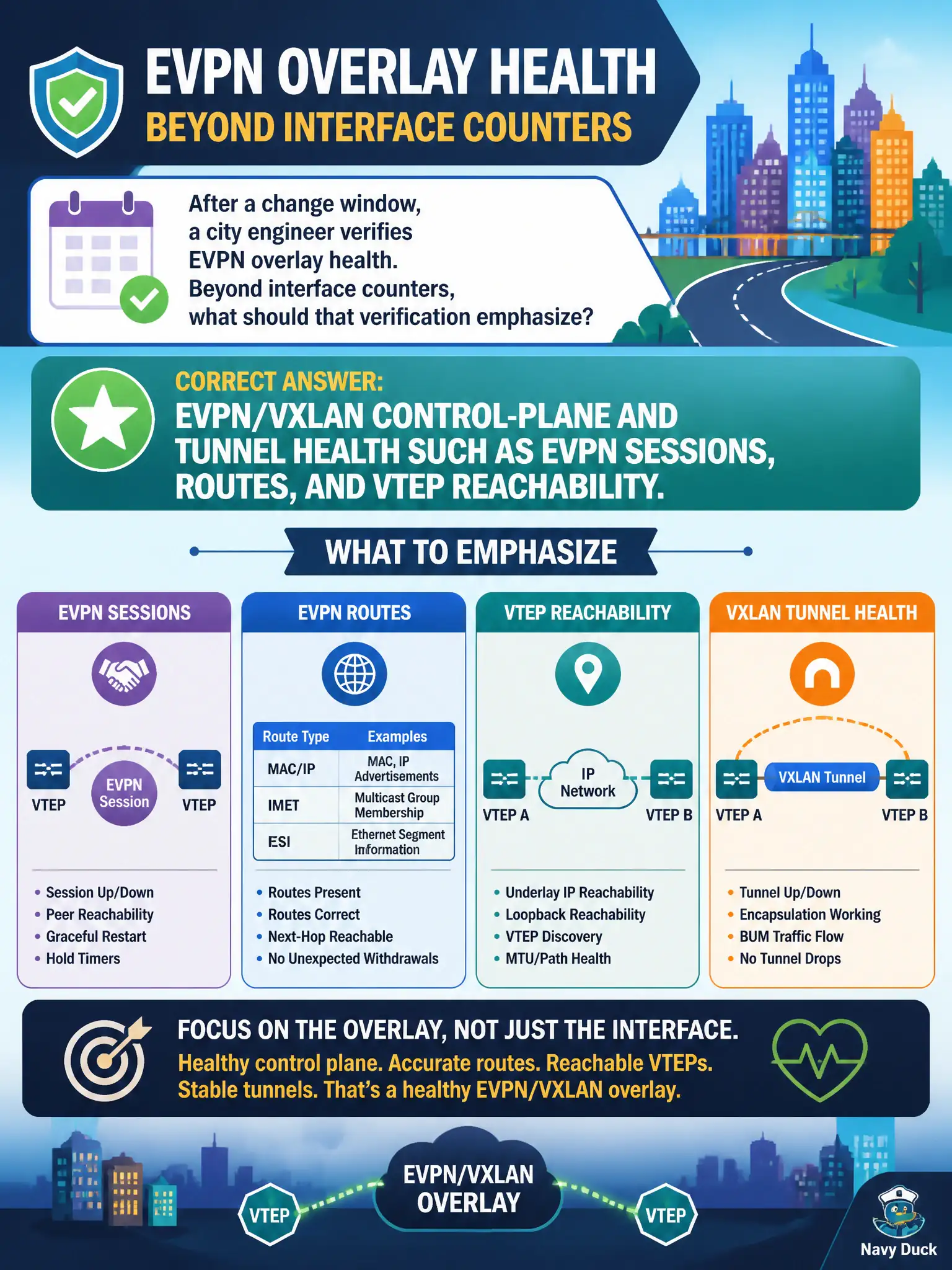
Interface counters tell you the road still has asphalt; EVPN checks tell you the street signs and tunnels still line up. After a change, look at sessions, EVPN routes, and VTEP reachability—not just green link lights. Rack-door paint and printer leases will not prove the overlay is healthy.
Full Explanation
Post-change EVPN overlay verification must emphasize control-plane and tunnel health—EVPN sessions, routes, and VTEP reachability—beyond green interface counters. Rack-door color is not fabric validation. Printer VLAN DHCP counts do not prove overlay health. Unrelated UPS battery age is not an EVPN check. Exam caveat: Interface stats can look healthy while overlay state is broken after a change window. Operational check: Capture pre/post EVPN route counts, session state, and VTEP reachability in the change evidence pack. In civic data-center operations, record the expected CLI or collector evidence for this concept so the next on-call engineer can validate fabric behavior without re-deriving the design under incident pressure. In civic data-center operations, record the expected CLI or collector evidence for this concept so the next on-call engineer can validate fabric behavior without re-deriving the design under incident pressure. In civic data-center operations, record the expected CLI or collector evidence for this concept so the next on-call engineer can validate fabric behavior without re-deriving the design under incident pressure. In civic data-center operations, record the expected CLI or collector evidence for this concept so the next on-call engineer can validate fabric behavior without re-deriving the design under incident pressure.