
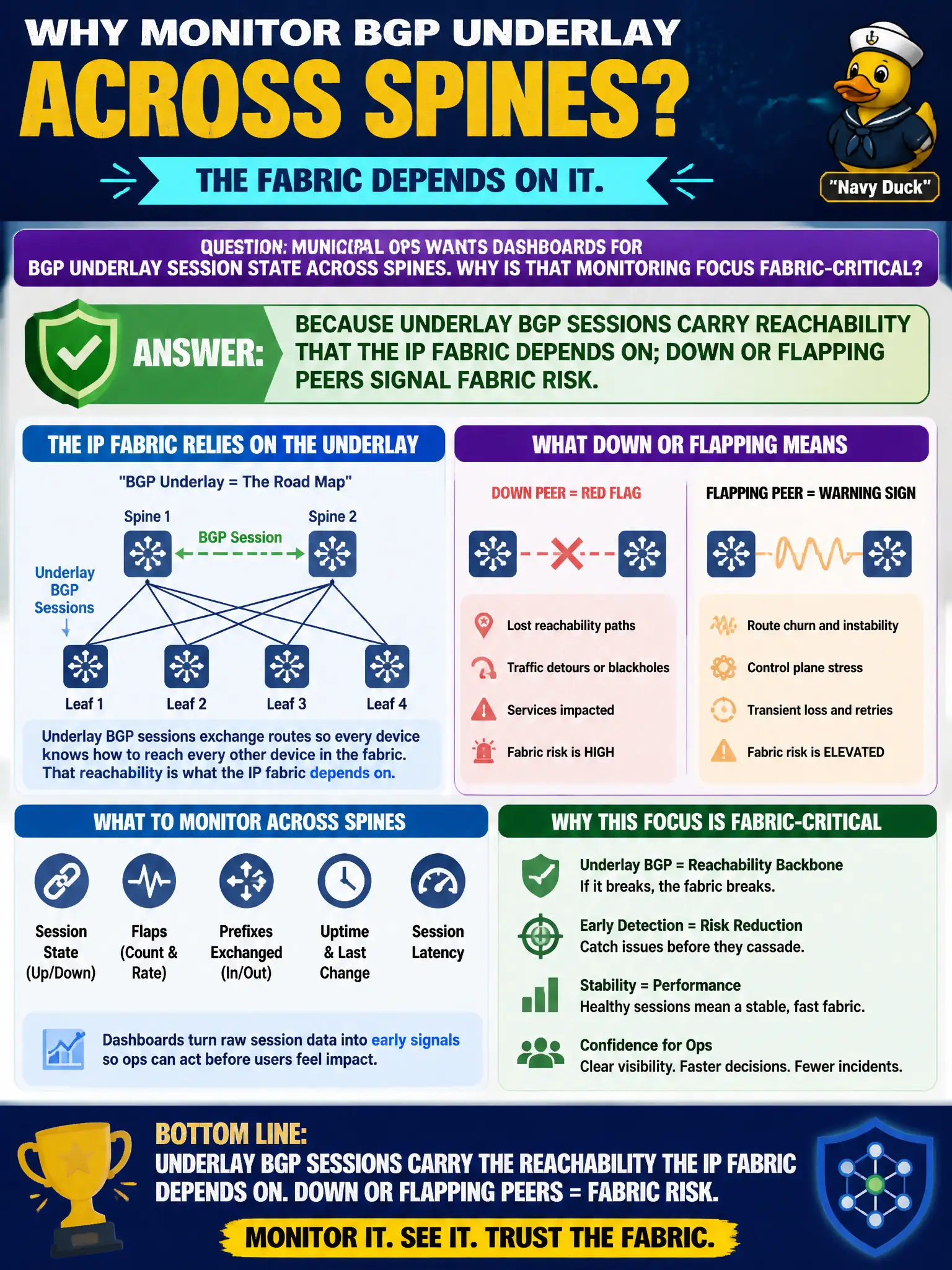
Municipal ops wants dashboards for BGP underlay session state across spines. Why is that monitoring focus fabric-critical?
Select an answer to reveal the explanation.
Short Explanation
The underlay BGP sessions are the steel beams holding up the building—if a beam drops, the overlay apartment tenants feel it next. Dashboarding peer state across spines is how the NOC sees a crack before the floor sags. Guest Wi-Fi captive portals are a totally different movie.
Full Explanation
Underlay BGP sessions carry the reachability the IP fabric depends on; dashboards for spine peer state are fabric-critical because down or flapping peers signal municipal fabric risk. BGP underlay state is not primarily about wireless captive portal timers. Spines in an IP fabric do run routing; they are not MAC-only bridges. Underlay BGP is not unrelated to leaf forwarding and must not be ignored. Exam caveat: Overlay symptoms often originate as underlay session loss—correlate both planes. Operational check: Shut a lab BGP peer to a spine and confirm dashboards/alerts reflect session down before overlay checks fail. In civic data-center operations, record the expected CLI or collector evidence for this concept so the next on-call engineer can validate fabric behavior without re-deriving the design under incident pressure. In civic data-center operations, record the expected CLI or collector evidence for this concept so the next on-call engineer can validate fabric behavior without re-deriving the design under incident pressure. In civic data-center operations, record the expected CLI or collector evidence for this concept so the next on-call engineer can validate fabric behavior without re-deriving the design under incident pressure.