
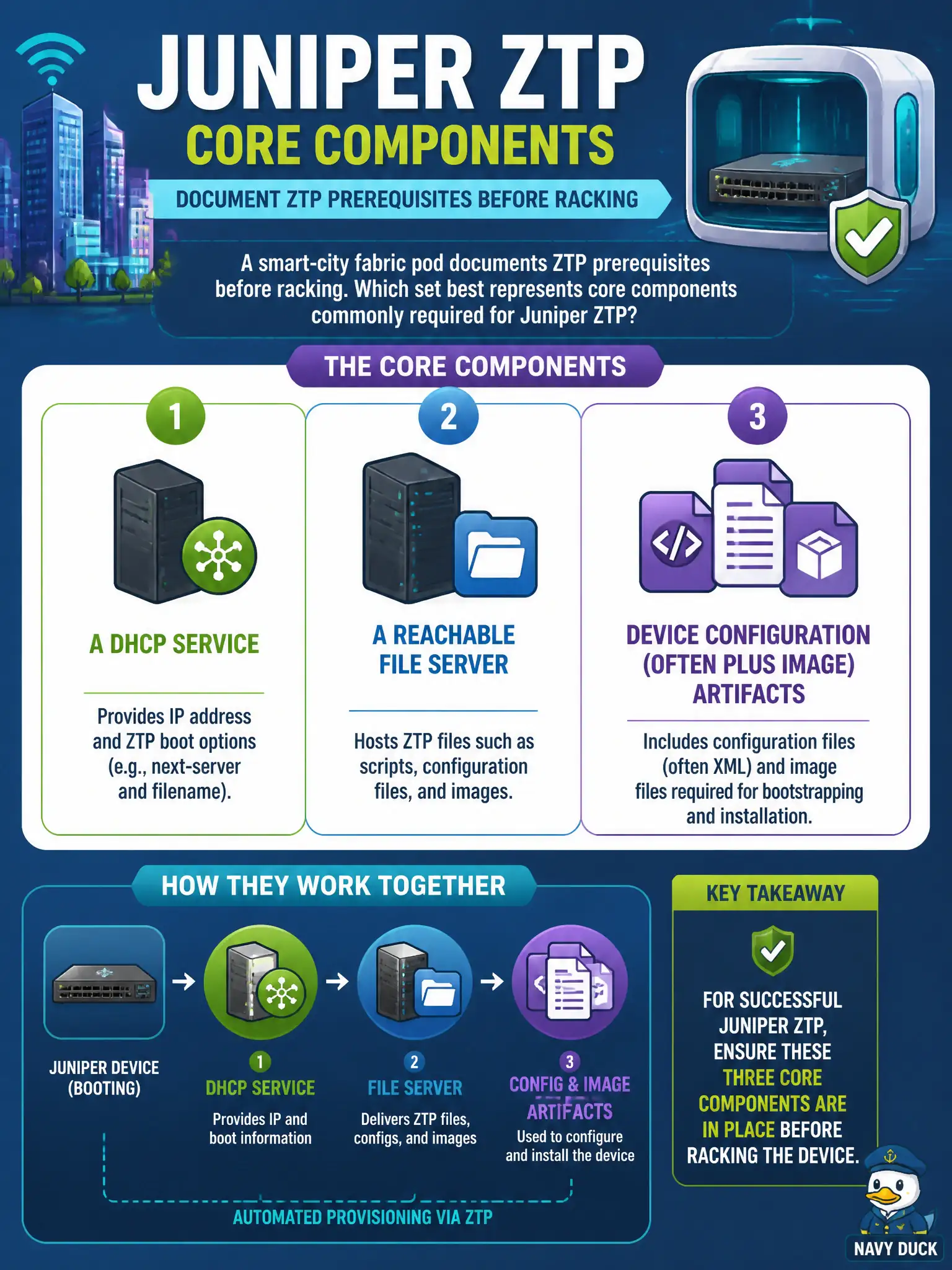
A smart-city fabric pod documents ZTP prerequisites before racking. Which set best represents core components commonly required for Juniper ZTP?
Select an answer to reveal the explanation.
Short Explanation
Before rolling racks, the smart-city team needs three basics: DHCP to hand out addresses and pointers, a file server holding configs and images, and the actual artifacts those leaves will pull. Skip any of those and ZTP is a wish, not a plan.
Full Explanation
Core Juniper ZTP components for a smart-city pod are DHCP, a reachable file server, and prepared configuration artifacts—often plus Junos images. Document that chain before racking. TPM-only with no network services misses the DHCP-and-file retrieval model. Multicast PIM-only with no DHCP invents a dependency that does not deliver addressing and file pointers. EVPN route reflectors alone without file artifacts confuse overlay scale-out with day-0 content delivery. Exam caveat: Exact option numbers and transfer methods vary, but DHCP plus reachable artifacts is the describe-level constant. Operational check: Pre-rack: validate scopes/options, management reachability to the file server, and presence of each role’s config/image objects. In civic data-center practice, treat the correct concept as part of a controlled management design rather than an isolated checkbox, and document the expected show-command or log evidence so the next on-call engineer can prove the fabric behavior without re-deriving the theory under pressure. In civic data-center practice, treat the correct concept as part of a controlled management design rather than an isolated checkbox, and document the expected show-command or log evidence so the next on-call engineer can prove the fabric behavior without re-deriving the theory under pressure.