
An operations director wants a repeatable method to measure cloud service performance, identify improvement opportunities, and track those improvements to completion, instead of fixing issues on an ad hoc basis. Which practice fits this goal?
Select an answer to reveal the explanation.
Short Explanation
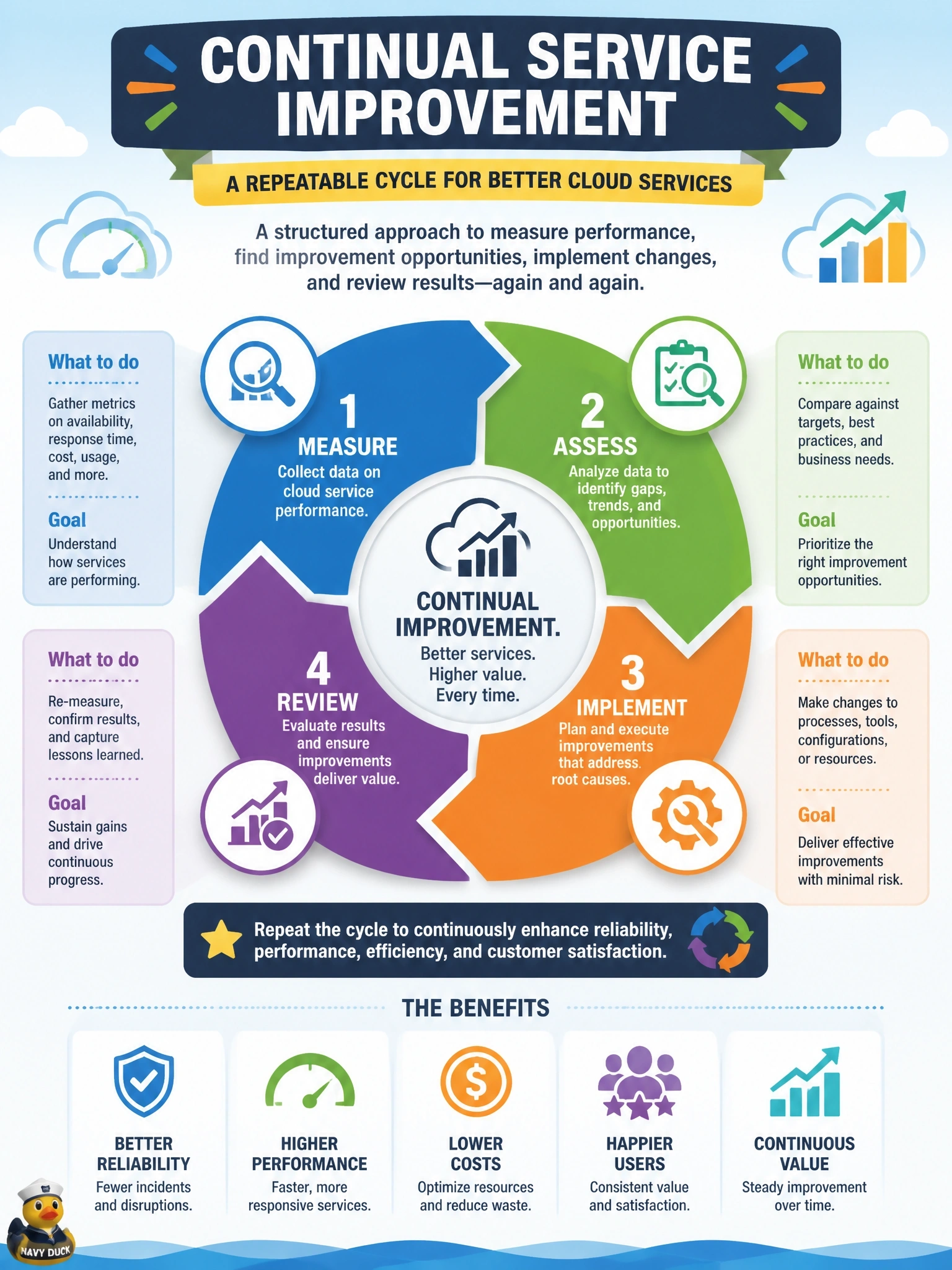
Continual improvement is the habit of asking 'how did we do, and what's next?' on a schedule, not only when something breaks. You measure, pick improvements, make them and check they worked, then go round again. The trap is mistaking a fix-it practice for a get-better practice.
Full Explanation
Continual service improvement, called continual improvement in ITIL 4, aligns services with changing business needs by repeatedly identifying and implementing improvements. It follows a structured cycle, often expressed as plan-do-check-act or the ITIL improvement model: establish the vision and current baseline through metrics, define measurable targets, plan and implement improvements, and review whether the targets were met before starting again. Improvement opportunities are recorded in a register, prioritized, assigned owners and tracked to completion. Incident management restores service after disruptions; it generates useful data for improvement but is reactive by design and does not manage a pipeline of planned enhancements. Release management makes changes available to users; improvements may eventually be delivered through releases, but release management does not identify or prioritize them. Configuration management maintains accurate records of configuration items and relationships; it supports analysis but is not itself an improvement cycle. Exam caveat: ISO/IEC 20000-1 and ISO/IEC 27001 both require continual improvement of their management systems, so the concept appears in standards as well as in ITIL. Operational check: confirm that an improvement register exists with owners, target dates and measured outcomes, that service metrics are reviewed on a set cadence, and that completed improvements show evidence of the expected change in those metrics.