
A cloud-hosted ordering service never goes down, but response times climb sharply at month-end peaks and customers abandon their orders. Which management practice is primarily responsible for addressing this?
Select an answer to reveal the explanation.
Short Explanation
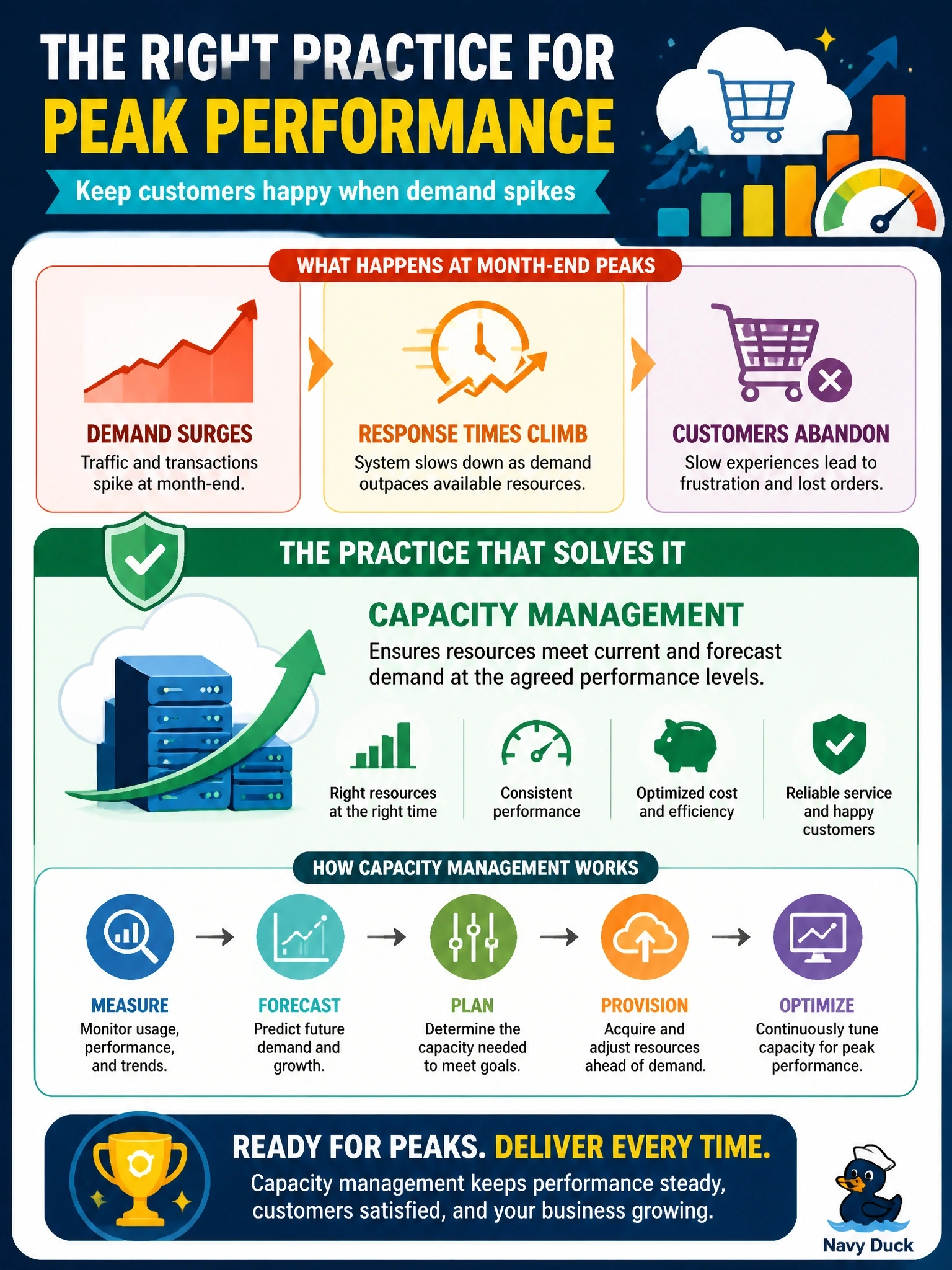
The shop's open, but there's a queue out the door every month-end. That's not an availability problem; it's capacity. You plan resources for the peaks you know are coming, and in the cloud you can use elasticity to meet them.
Full Explanation
Capacity management, often called capacity and performance management, ensures that services achieve agreed and expected performance by providing resources that satisfy current and forecast demand cost-effectively. It analyses usage trends, models predictable peaks such as month-end, and plans or automates scaling of compute, storage, database and network resources. In the cloud this often means automatic and scheduled scaling ahead of known peaks. The scenario describes a performance shortfall under demand, not downtime. Availability management focuses on whether the service is able to perform its function when required, measuring uptime and reliability; the service in the scenario is always available, so the core issue lies elsewhere, even though both practices share monitoring data. Incident management restores service when users report problems; it would handle each slowdown reactively but would not prevent the next month-end peak. Continuity management prepares recovery from major disruptions; failover to another site does nothing for a predictable surge of normal traffic. Exam caveat: elasticity is the cloud characteristic that makes capacity responsive, but someone still has to define scaling limits, thresholds and cost budgets. Operational check: compare month-end utilization and response times with scaling thresholds, confirm that scaling actions occur before latency targets are breached, and record a capacity plan for known peaks.