
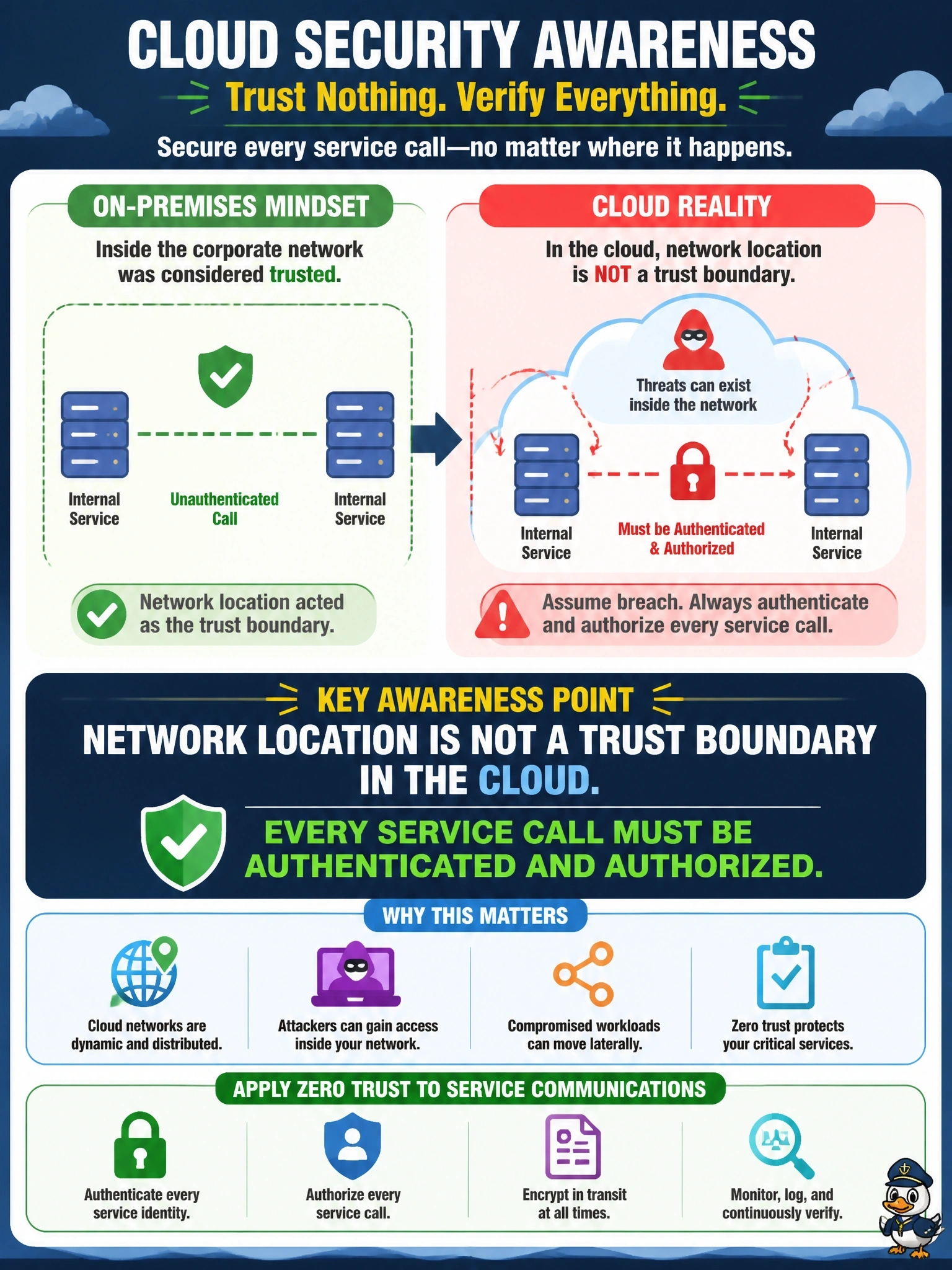
Developers migrating an application to the cloud leave calls between internal services unauthenticated, reasoning that only components inside the virtual network can reach them, as was true in the corporate data center. What awareness point should the cloud security professional emphasize?
Select an answer to reveal the explanation.
Short Explanation
Being inside the fence used to mean you were one of the good guys; in the cloud, that assumption gets people burned. One compromised workload, a misconfigured route or a stolen credential, and an attacker is 'inside' too. So you check who's calling every time, not where they're calling from.
Full Explanation
A common pitfall in cloud development is carrying the on-premises perimeter model into an environment where it no longer holds. Cloud networks are software-defined, change through API calls, and are reachable through many paths: peered networks, misconfigured security groups, compromised workloads, management plane access and service integrations. Treating location in the virtual network as proof of trust means one compromised component can call every other service freely. The awareness point is that each request between services must carry an identity that is authenticated, for example with mutual TLS or signed workload tokens, and authorized against policy. Provider isolation separates tenants from each other; it does nothing to stop an attacker who has already gained a foothold inside the customer's own network. TLS encryption protects confidentiality and integrity in transit, but encryption without verifying the caller's identity still accepts requests from anyone who can open a connection. A private subnet without public addresses reduces exposure to the internet but leaves every internal path open, which is precisely the assumption that fails. Exam caveat: the 2026 outline frames this as a cloud development pitfall and as secure by design; the principle matters more than any product name. Operational check: review service-to-service calls for authentication, and test whether a workload without credentials can reach internal APIs.