
An audit of a cloud-hosted CRM finds that nightly backup jobs have reported success for two years, yet no one has ever restored data from them, and failover is a manual process documented only in one engineer's notes. Which action best addresses the audit finding?
Select an answer to reveal the explanation.
Short Explanation
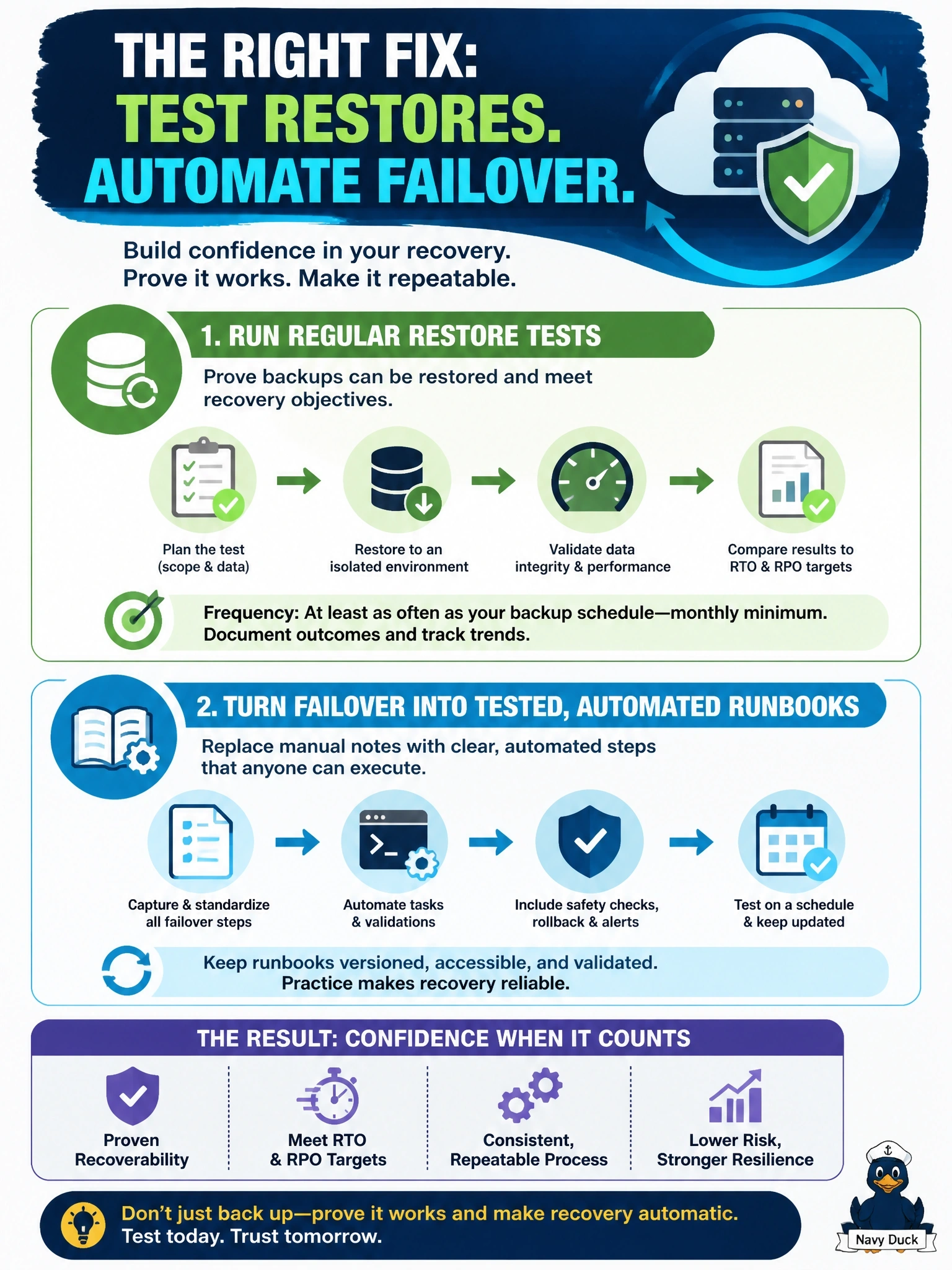
A backup you've never restored is a rumor, not a backup. The finding isn't that backups fail; it's that nobody has proven they can come back, and failover lives in one person's head. You fix that by testing restores and turning the notes into automated, tested runbooks. More backups or better alerts just give you more of the unproven thing.
Full Explanation
A successful backup job proves only that data was written somewhere; it does not prove the data is complete, uncorrupted, decryptable, or restorable within the recovery time objective. The audit identified two gaps: backups have never been validated through restoration, and failover depends on undocumented knowledge held by one person. The remedy is scheduled restore testing that measures recovered data and elapsed time against the RTO and RPO, combined with converting the failover procedure into documented, automated runbooks that are exercised regularly and do not depend on a single engineer. Increasing backup frequency improves the achievable RPO, but more unverified copies leave the core risk untouched. Copying backups to another region is a good resilience practice against regional failure, yet it does nothing to show those copies can be restored or to remove the key-person dependency. Alerting on failed jobs is useful hygiene, but the jobs already report success; the gap is assurance about restoration, not detection of failures. Exam caveat: in cloud environments, automated recovery through templates and runbooks reduces both recovery time and human error, but automation must itself be tested. Operational check: review the restore test log for dates, data sets, verification method and elapsed time, and confirm the failover runbook has run end to end within the last test cycle.