
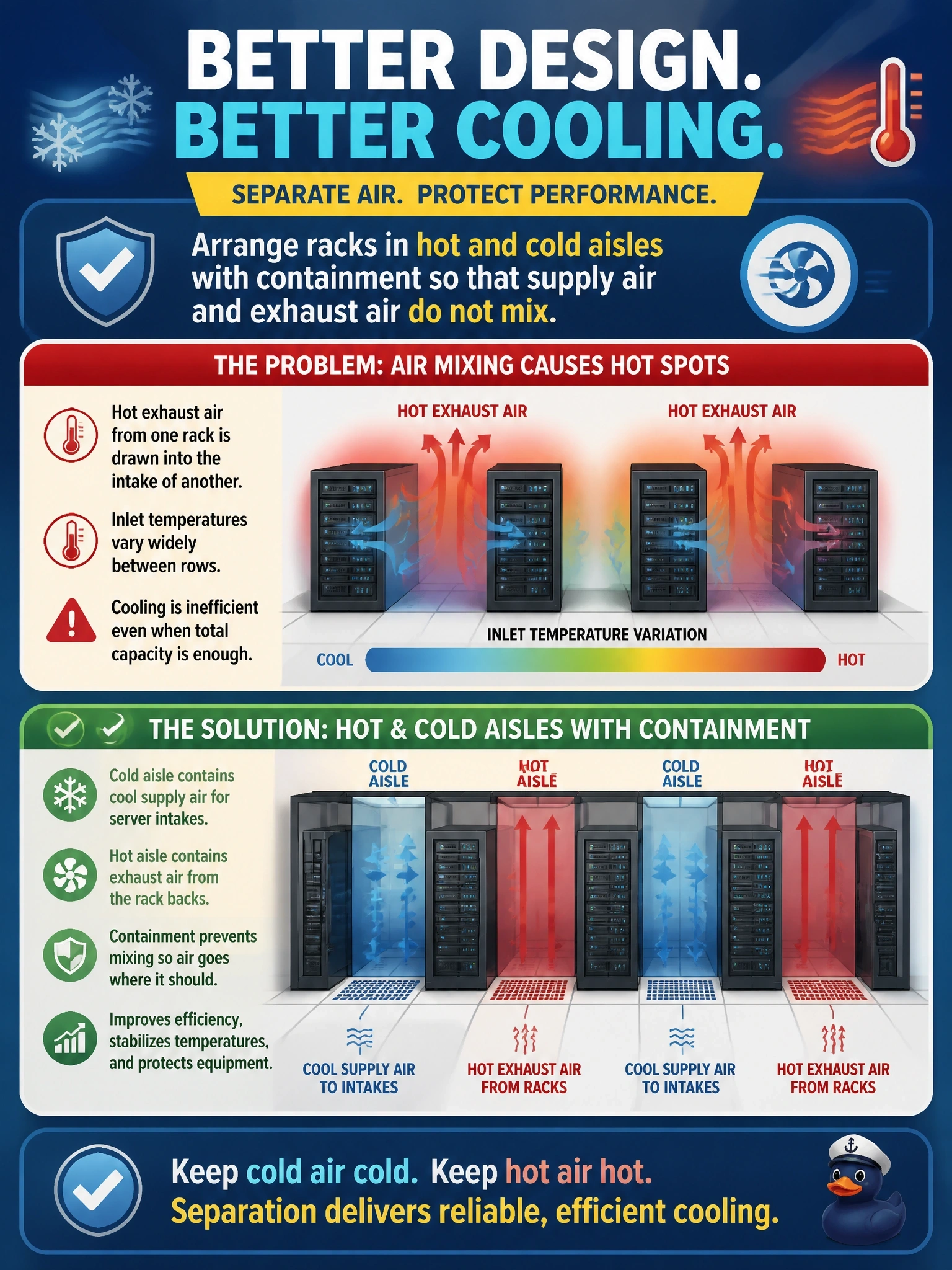
Monitoring in a provider's data hall shows server inlet temperatures varying widely between rows, with some racks drawing in hot exhaust air from neighboring racks. Total cooling capacity is sufficient. Which environmental design change best addresses this?
Select an answer to reveal the explanation.
Short Explanation
If the hot air coming out the back of one rack gets sucked into the front of the next, you're cooling the room and cooking the servers. Hot and cold aisle containment keeps those streams apart so cold air goes where it's needed. More air conditioning doesn't fix bad airflow; it just costs more.
Full Explanation
Environmental design aims to deliver conditioned air to equipment inlets and return exhaust heat to the cooling system without mixing. Hot aisle and cold aisle layouts face rack fronts toward each other across a cold aisle and rack backs toward each other across a hot aisle; adding containment with doors, roofs or chimneys physically separates the two streams. That eliminates recirculation, where racks ingest their neighbors' exhaust, and evens out inlet temperatures across rows. The scenario states that total capacity is already sufficient, so adding more air conditioning units treats the wrong cause; the problem is distribution, and extra units would raise cost and energy use while hot spots persist. Lowering the set point for the whole hall overcools most equipment, wastes energy and still allows mixed exhaust to reach some inlets. Raising humidity is not a cooling strategy; humidity is kept within a recommended band to avoid condensation at the high end and electrostatic discharge at the low end, and pushing it up adds condensation risk. Exam caveat: HVAC design affects availability, because thermal events cause throttling and hardware failure. Operational check: after containment is installed, compare inlet temperature readings across all rows and confirm they fall within the recommended envelope.