
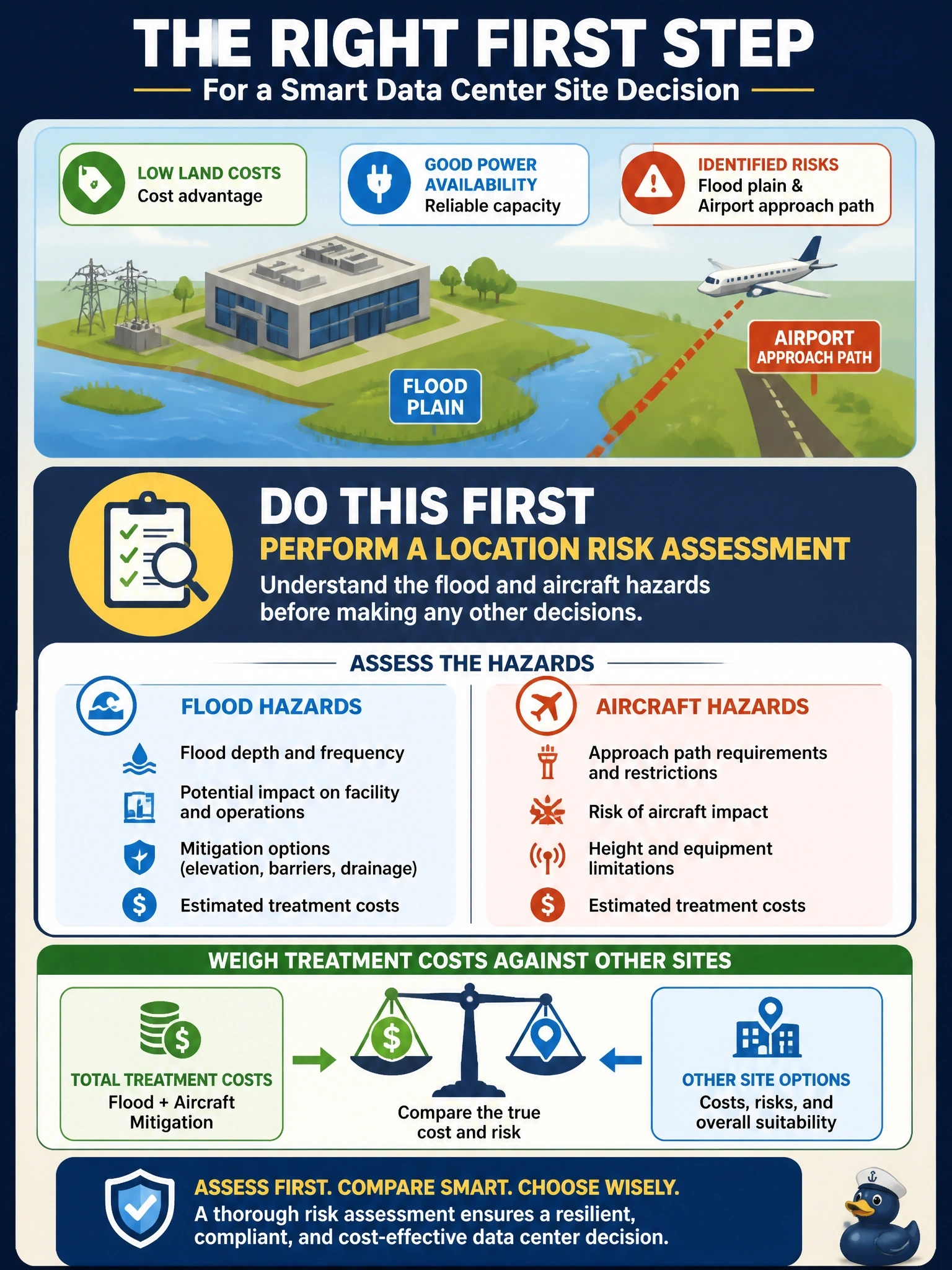
A provider is evaluating a candidate site for a new data center. The site has low land costs and good power availability, but it lies in a designated flood plain and under an airport approach path. What should the provider do first?
Select an answer to reveal the explanation.
Short Explanation
You wouldn't buy a house in a flood zone without checking the insurance and the sandbag bill first. Same deal here: you assess the location risks and compare what it'd cost to treat them against other sites. Jumping to yes or no before you've done the analysis is the trap.
Full Explanation
Physical design begins with site selection, and location is the one attribute that cannot be changed later. A location risk assessment identifies natural and man-made hazards, such as flooding, seismic activity, severe weather, proximity to flight paths, rail lines or hazardous facilities, then estimates their likelihood and impact and the cost of treatments such as raised floors, flood barriers, hardened construction or insurance. The results are compared with alternative sites so leadership can make an informed decision that balances cost, power, connectivity, latency and risk. Selecting the site because cost and power look attractive ignores identified hazards and skips the analysis that a defensible decision requires. Relying on geographic redundancy assumes other regions will absorb the loss, but it does not justify knowingly building a facility likely to suffer prolonged outages, and redundancy itself costs capacity. Rejecting the site outright overstates the rule; every location has some hazard, and the decision depends on the assessed level of risk and the cost of mitigation, not on mere presence of a hazard. Exam caveat: the expected answer to site questions is usually analysis before commitment. Operational check: confirm the site assessment documents flood zone data, flight path proximity and the costed treatment options for each hazard.